
Beyond the Graph: Bridging Interests and Geography in LBSN Community Search
Effective Community Search Over Location-Based Social Networks: Conceptual Framework with Preliminary Result
The paper proposes a conceptual framework for "Attri-Spatial Social Community Search" over Location-Based Social Networks (LBSNs). It introduces a hybrid approach that integrates user interest mining (via TF-IDF on check-in tags), spatial proximity, and social cohesiveness (k-core) into a unified query model for more effective community retrieval.
TL;DR
Social networks are no longer just lists of friends; they are rich datasets of where we go and what we like. This paper proposes a framework to move beyond simple graph connectivity (k-core) by integrating Dynamic Interest Profiling (what you like) and Spatial Constraints (where you are) into a unified community search engine.
Context: Why "Connectivity" is Not Enough
In traditional community search, the goal is often to find a "k-core"—a group where every member has at least k friends. While mathematically sound, this fails in the real world. Why? Because a "community" isn't just a dense cluster of connections; it's a group of people who actually share commonalities.
If you are looking for a group to grab chocolate with in a specific neighborhood, you don't just want a group of people who know each other; you want a group that (1) actually likes chocolate and (2) is physically near that location. Existing SOTA methods often handle these dimensions in isolation.
Methodology: The Three-Dimensional Fusion
The researchers propose a hybrid approach partitioned into three distinct phases:
1. Interest Profiling (The "What")
Instead of relying on static user profiles, the authors extract keywords from a user's check-in history. By applying TF-IDF (Term Frequency-Inverse Document Frequency), they treat each user as a "document" of visited places.
- Formula: calculates the relevance score of an interest for a user, ensuring that unique interests (like "Art Gallery") carry more weight than generic ones.
2. Graph Refinement (The "Who")
Most social graphs are sparse. The authors introduce Intra-similarity using Cosine Similarity between user interest vectors. If two users are not friends but share many interests and a common neighbor, the framework considers them for potential community inclusion.
3. AttriSpatial K-Core Indexing (The "How")
The core of the system is the Core Relevance Score (CRS). It calculates the average interest weight of a subgraph, allowing the system to rank communities not just by how "tightly knit" they are, but by how relevant they are to the search query.
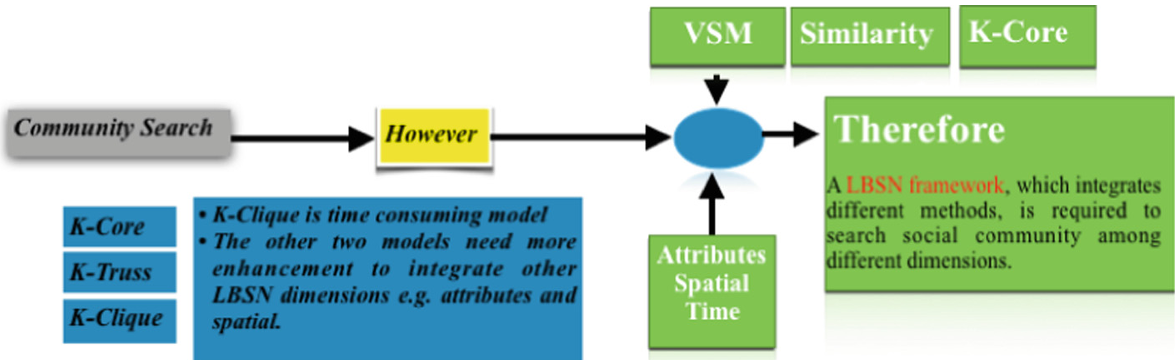 Figure 1: The conceptual framework showing the intersection of social, keyword, and spatial data.
Experiments and Preliminary Insights
The study utilized the Weeplaces dataset, analyzing over 7.5 million check-ins. The preliminary results focused on the feasibility of the interest extraction.
- Interest Differentiation: As shown in the distribution graphs, the TF-IDF approach successfully identified distinct clusters of interest.
- User Comparison: The research found that users might have high similarity in "Art Gallery" visits while differing significantly in "Coffee Shop" habits, proving that a one-size-fits-all "similarity score" is insufficient without keyword weighting.
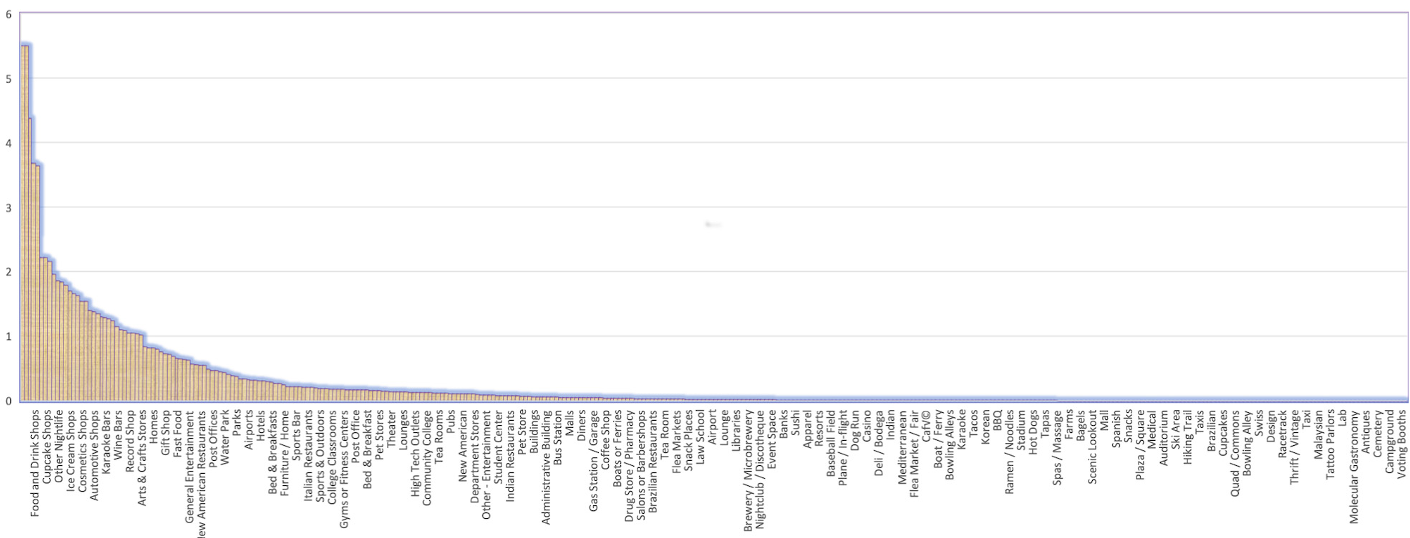 Figure 2: Distribution of interest weights across a sample of users, indicating how TF-IDF filters significant traits.
Critical Analysis & Conclusion
Takeaway
The real value of this work lies in its dynamic nature. By using check-ins as the ground truth for interests, the system automatically adapts as users change their habits. This is a significant step up from static attribute-based community search.
Limitations
As this is a "Conceptual Framework with Preliminary Results," the paper lacks a large-scale performance benchmark against dedicated SOTA algorithms like "SAC" (Spatial-Aware Community). Additionally, the computational overhead of calculating interest similarities for all non-friends could be prohibitive in massive graphs without extreme pruning.
Future Outlook
The authors intend to build a hybrid index named AttriSpatial to handle high-dimensional queries efficiently. We expect future iterations to integrate temporal decay—recognizing that an interest from five years ago shouldn't weigh as much as last week's check-in.
Senior Editor's Note: This research represents the ongoing shift from "Graph Mining" to "Multi-Modal Social Intelligence," where the physical world and the digital social graph finally converge.