
CS-HSN: Precision Community Search Through Directed Graph Mining Across Social Platforms
Effective and Efficient Community Search in Directed Graphs Across Heterogeneous Social Networks
The paper introduces CS-HSN, a novel framework for online community search that operates on directed graphs across heterogeneous social networks. By integrating user identity linkage and a unique k-Dcore structural model, it achieves state-of-the-art results in community cohesiveness and search efficiency through pre-constructed indices.
TL;DR
Determining "who belongs together" in a digital world is difficult when users are fragmented across multiple platforms like Twitter and Foursquare. CS-HSN bridges this gap by merging heterogeneous social networks and introducing the k-Dcore model. By treating relationships as directed and utilizing a specialized C-tree index, this framework delivers more cohesive communities with significantly higher query efficiency than traditional undirected search methods.
The "Undirected" Fallacy in Social Discovery
Most legacy community search algorithms simplify social networks into undirected graphs. However, social dynamics are inherently asymmetrical. Consider a celebrity with 30 million followers who only follows 100 people; treating these links as equal (undirected) creates a "hub" effect that flattens community structure and yields irrelevant results.
The authors identify three primary gaps in current research:
- Data Sparsity: A single network often lacks a complete view of a user's social footprint.
- Directional Neglect: Ignoring in-degree/out-degree leads to "zombie fan" effects and low-quality clusters.
- Computational Overhead: Online social networks are too massive for "from-scratch" searches during a live query.
Methodology: The k-Dcore Framework
The core innovation of this paper lies in its two-pronged approach: Network Alignment and Structural Decomposition.
1. User Identity Linkage
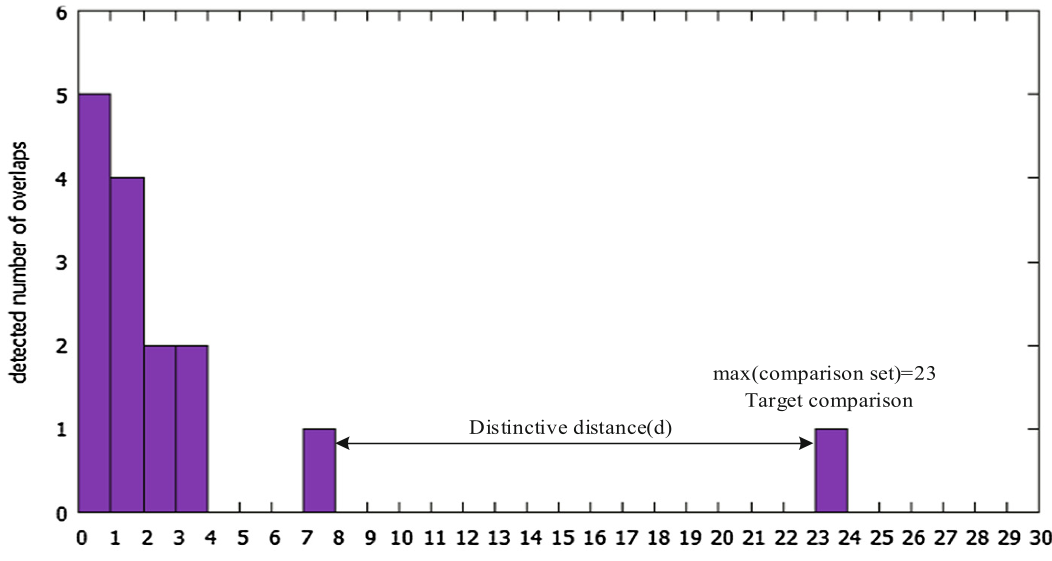
Instead of complex, offline supervised learning, the authors use a fast, online matching technique. They calculate the overlap of friend lists between accounts on different platforms and measure the Distinction Distance—the gap between the best match and the second-best. This ensures that only high-confidence matches are merged into the "Linked Social Network."
2. The k-Dcore Model
A community in CS-HSN is defined as a k-Dcore, which must satisfy:
- Strong Connectivity: Every member can reach every other member via directed paths.
- Minimum Degree Constraint: Every node must have an in-degree and out-degree .

3. Efficiency via C-tree Indexing
To avoid re-running the heavy Tarjan’s algorithm or core decompositions for every query, the system pre-computes a C-tree (Core tree). As shown in the architecture below, the tree organizes nodes by their core numbers, allowing the search to jump directly to the relevant subgraph.
Experimental Performance
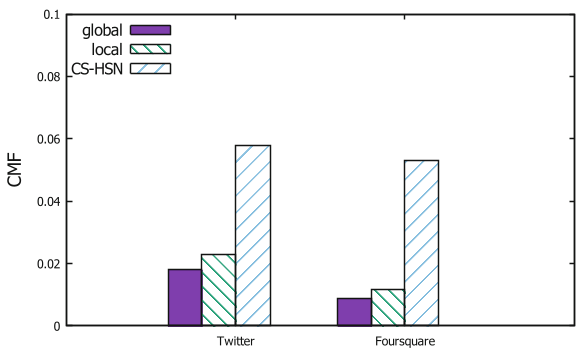
The researchers tested CS-HSN on datasets from Twitter (160k nodes) and Foursquare (76k nodes) in Singapore.
Cohesiveness (CMF)
Using the Community Member Frequency (CMF) metric, CS-HSN consistently outperformed "Local" and "Global" search methods. This confirms that utilizing directed edges and cross-platform information prevents the community from being "diluted" by weak or misleading connections.
Query Latency
The index-based approach shows its true strength in efficiency. While other methods' execution times vary wildly with the cohesiveness parameter , CS-HSN maintains a near-constant, ultra-low latency.
Critical Insight & Future Outlook
The primary takeaway is that structural truth resides in directionality. By refusing to simplify the graph, the authors actually made the community discovery more robust.
Limitations: The current identity linkage relies heavily on friend-list overlap. In an era of increasing privacy settings where friend lists might be hidden, future iterations would need to incorporate more "fuzzy" signals like spatio-temporal behavior or content style without sacrificing the "online" speed.
Conclusion: CS-HSN represents a significant step forward for real-time social analytics, providing a template for how we can merge fragmented digital identities into a singular, structurally sound social graph.