
Efficient Dense Subgraph Querying: Navigating the Complex Social Internet of Things
15256_Effective and Efficient Dense Subgraph Query in Large-Scale Social Internet of Things.
The paper introduces DSQS (static) and DDSIU (dynamic) algorithms for community search in the Social Internet of Things (SIoT). These methods utilize a novel "first-connection-last-expansion" strategy and graph kernel indexing to achieve State-of-the-Art performance in finding dense subgraphs across large-scale, time-varying networks.
TL;DR
As the Social Internet of Things (SIoT) scales, finding relevant communities for resource discovery becomes a massive computational challenge. This paper moves beyond traditional "seed expansion" by proposing DSQS and DDSIU—two algorithms that prioritize forming a "core" first through Steiner trees and leverage graph kernel indexing for lightning-fast incremental updates in dynamic networks.
Background: Why SIoT Changes the Game
The Social Internet of Things isn't just a network of people; it is a hybrid ecosystem of people-to-people, people-to-things, and things-to-things interactions. This "ubiquity" creates a graph complexity that breaks standard community detection algorithms.
- Scale: Millions of nodes and hundreds of millions of edges.
- Dynamics: Connections change in real-time as devices move or status updates occur.
- Goal: We need to find the most likely community for a set of query nodes (Community Search) rather than partitioning the entire graph (Community Detection).
The "First-Connection-Last-Expansion" Intuition
Most community search methods start with a seed and expand outward. However, if your query nodes are distant, this leads to disconnected subgraphs and local optima.
The authors pivot this strategy:
- Identify Key Nodes: Use Random Walks with Penalized Hitting Probability (PHP) to find top-k neighbors for each query node.
- Connect the Core: Use a refined Steiner Tree algorithm to connect these nodes with minimum cost.
- Expand: Only once a connected "core" exists, expand it into a dense subgraph using rank-constrained sampling.

Handling Dynamics: The Graph Kernel Index
Recomputing a dense subgraph every time an edge is added or removed is a waste of resources. The authors introduce DDSIU (Dynamic Dense Subgraph Incremental Update).
The core innovation here is the Graph Kernel Index, which stores the insertion order and state transition probabilities (). When an update occurs, the algorithm classifies it into three types:
- Type I/II: Internal or boundary updates that might change proximity bounds.
- Type III: Distant updates that have zero impact on the query result.
By only recomputing the "affected range" identified by the index, the system achieves near-instantaneous query responses on subsequent snapshots.
Experimental Proof
The researchers tested their approach against the DSR baseline on massive datasets, including the Orkut social network (3 million users, 117 million edges).
Key Findings:
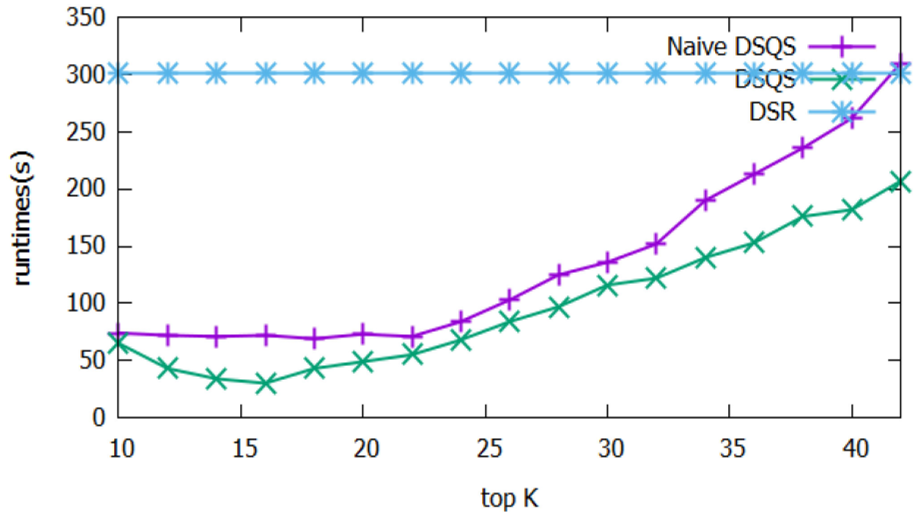
- F1-Score Stability: While "Naïve" versions provide the highest accuracy, the optimized DSQS maintains superior F1-scores over baselines while being significantly faster.
- Latency: Even on datasets with 100 million edges, queries finish in under 200 seconds.
- Dynamic Efficiency: Once the index is built, DDSIU reduces the running time on new snapshots by several orders of magnitude compared to starting from scratch.
Critical Insight
The real magic is in the Duplicate Factor (DF) introduced for the Steiner Tree. By accounting for shortest-path overlaps, the algorithm avoids the redundancy that usually plagues Steiner-based methods, leading to a much "tighter" and denser subgraph core.
Conclusion & Future Work
The paper successfully addresses the "Inertia" of large-scale community search. However, the authors admit a limitation: the current model focuses on undirected graphs. In the future, adapting this to directed service-dependency graphs in SIoT will be the next frontier for ensuring efficient resource discovery.
Takeaway: In massive graphs, connecting known entities before exploring the neighborhood is the key to both precision and speed.