
Scoping the Social Map: Why Your Event Recommender Needs a Sense of Place
Effective event discovery: using location and social information for scoping event recommendations
This paper introduces a classification framework for event recommendation by categorizing events into four types based on social density and geographic scope. Using data from a global corporate event service, the authors demonstrate how inferring event properties from attendee locations can significantly improve recommendation relevance and address the cold-start problem.
TL;DR
Not all events are created equal. Some are global webinars, others are local coffee meetups, and many are "socially-clustered" meetings. This paper from IBM Research argues that standard collaborative filtering (CF) is blind to these distinctions. By classifying events into a 2x2 matrix of Social Density vs. Geographic Reach, the authors show how to fix the "location mismatch" problem and provide better recommendations for brand-new users.
Problem & Motivation: The Context Blindness of CF
Traditional Collaborative Filtering (CF) operates on the principle: "Users who liked X also liked Y." While powerful, this logic breaks down for events. If you attended a global virtual town hall, a CF engine might recommend a localized workshop in building 5 simply because the same group of people attended both.
The authors identified a critical failure: 11% of CF-recommended events were physically unreachable for the users. In a corporate or social setting, "relevance" is a three-legged stool consisting of content, social ties, and geographic feasibility. Most systems ignore the latter two or treat them as static filters rather than dynamic properties of the event itself.
Methodology: Mapping the Spatio-Social Quadrants
The core insight is that an event's nature can be inferred from its attendees. If attendees are scattered across 700 cities, it’s a global event. If attendees have high historical interaction, it’s a social event.
1. Social Density
Using a graph , the authors measure the density of previous interactions among participants: High density implies a "closed-loop" social event (e.g., a team meeting); low density implies a general-interest event (e.g., a public lecture).
2. Geographic Scoping
By taking the 90th percentile of distances between all attendee pairs, the authors define a "radius of interest." This allows the system to determine if an event is localized to a campus or has a "Global" reach.
The Four Categories
As visualized in the paper's framework, events fall into:
- Local Not Social: Highly clustered, but attendees are strangers.
- Social and Local: Geographically close and socially linked teams.
- Social Not Local: Distributed teams or recurring online interest groups.
- Global: Massive, distributed events with low interpersonal overlap.
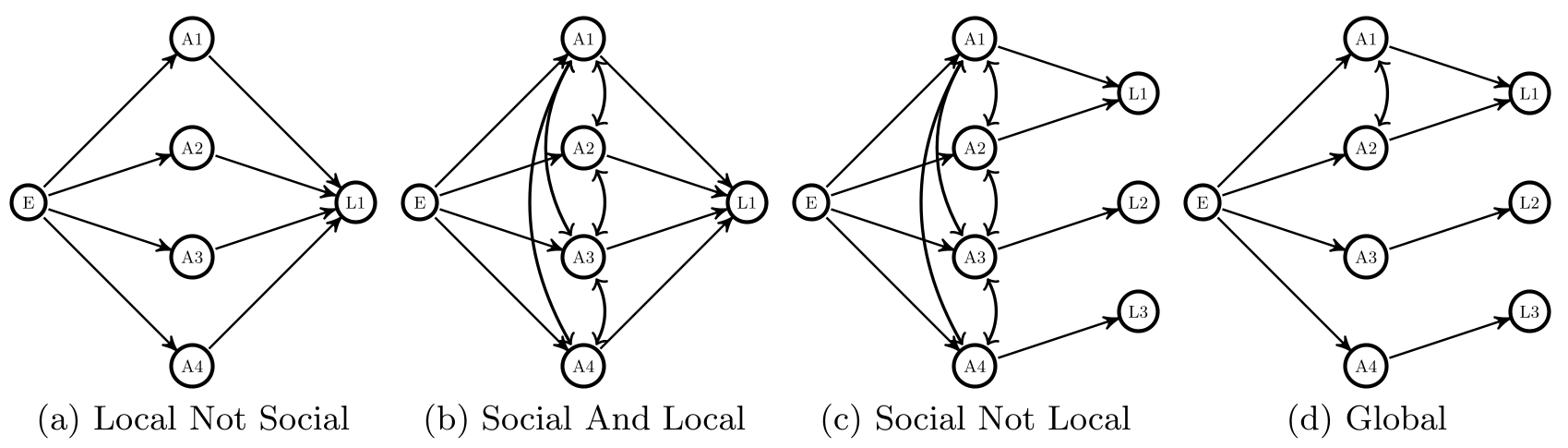
Experiments & Results: Solving the Cold-Start
The authors tested their hypothesis using IBM's w3Inviter dataset, covering over 81,000 users and 3,000+ active events.
Collaborative Filtering Weakness
The research found that standard k-Nearest Neighbor algorithms disproportionately recommend "Social Not Local" events. While these are popular, they neglect the "Local" niche that is often most actionable for users.
Winning the Cold-Start
For new users (those who attended <5 events), the researchers compared Rank-Pop (Popularity) against Rank-Loc (Proximity to inferred event centroid).
- For Local Events: Proximity-based ranking (Rank-Loc) outperformed popularity by a significant margin (e.g., 7.29 vs 4.31 at @10).
- For Global Events: Popularity remained the king, as location is irrelevant for virtual or widespread talks.

Critical Insight & Conclusion
This work highlights that "Location-Based" doesn't just mean "Near Me." It means understanding the intrinsic radius of an item. A music festival has a radius of 500 miles; a localized coding dojo has a radius of 5 miles.
The Takeaway
Future recommender systems should not treat location as a hard filter (e.g., "only show events within 10 miles"). Instead, they should:
- Classify the item's "Reach" based on participant geography.
- Weight proximity more heavily for "Local" clusters and popularity more heavily for "Global" clusters.
Limitations: The study relies on corporate directory locations, which may not capture mobile users or remote workers accurately. However, as a framework for scoping recommendations, it provides a robust mathematical foundation for "Location-Intelligence" in social software.