
HI-LDA: Bridging the Trust Gap for Smarter Travel Recommendations
Where to go: An effective point-of-interest recommendation framework for heterogeneous social networks
This paper proposes HI-LDA (Heterogeneous Information based LDA), a latent probabilistic generative model for Point-of-Interest (POI) recommendation. By integrating heterogeneous data from both Location-Based Social Networks (LBSNs, e.g., Foursquare) and Communication-Based Social Networks (CBSNs, e.g., Twitter/Facebook), it achieves SOTA performance in both home-town and out-of-town recommendation scenarios.
TL;DR
When you travel to a new city, whose advice do you trust more: a random anonymous review on a travel app, or a friend's casual post on social media? Most current recommendation systems rely on the former, leading to poor "out-of-town" experiences. This paper introduces HI-LDA, a framework that fuses Location-Based Social Networks (LBSNs) with Communication-Based Social Networks (CBSNs) to provide highly accurate, trust-based POI recommendations.
The "Out-of-Town" Dilemma and the Trust Crisis
Recommending a Point-of-Interest (POI) isn't just about distance; it's about context. Existing systems face two massive walls:
- Data Sparsity: If you've never been to London, the system has zero check-in history to learn your local preferences.
- The Distrust Factor: Anonymous LBSN reviews (like those on Yelp or Foursquare) can be unreliable or "fake."
The authors' core insight is that social trust is transferable. Even if your friend hasn't left a formal review on Foursquare, their "private" comments or posts on Twitter/Facebook contain latent preferences that are far more valuable for predicting what you'll like.
Methodology: The HI-LDA Architecture
The proposed model, HI-LDA (Heterogeneous Information based LDA), doesn't just look at where you've been; it looks at who you talk to and what you talk about.
1. Geographical Clustering via P-DBSCAN
Before calculating interests, the system partitions the world. Unlike standard DBSCAN, the authors' P-DBSCAN (Popularity-based DBSCAN) accounts for "noise" points that might actually be popular "hidden gems."
2. The Generative Process
HI-LDA operates on three distinct levels:
- Community-Behavior: Models the likelihood of a user belonging to a social community and exhibiting specific interaction behaviors (replying, reposting).
- Region-POI: Models geographical clusters using Gaussian distributions to capture spatial localness.
- Sentiment-Word: Uses an LDA-based approach to extract sentiment from the textual content of both LBSN reviews and CBSN comments.
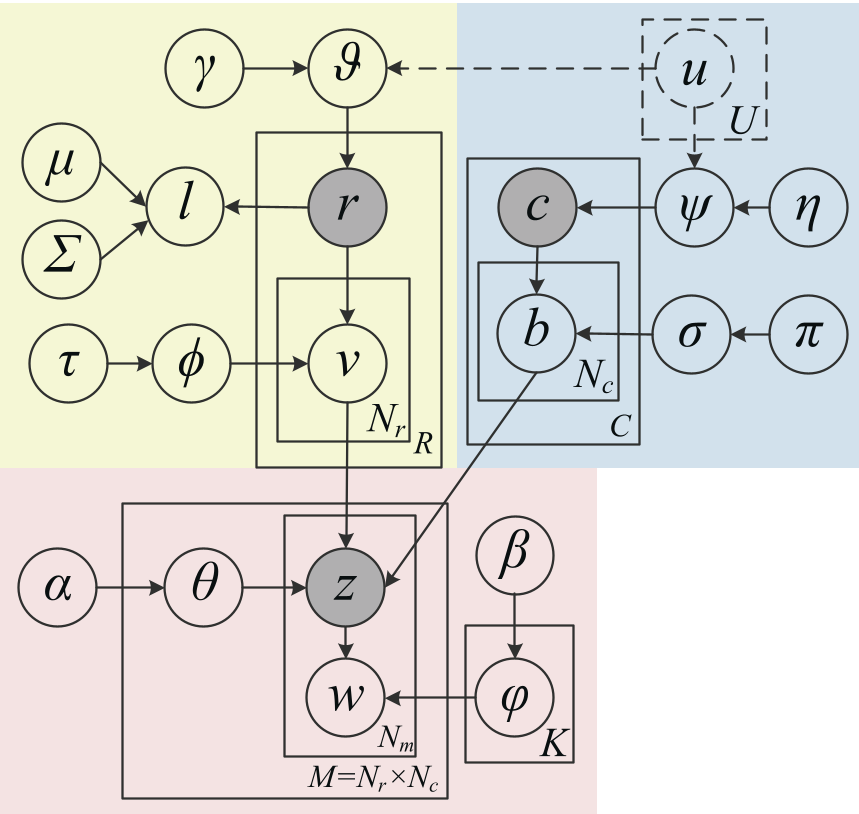 Fig 1: The graphical representation of HI-LDA shows how anchor links bridge user identities across LBSN and CBSN domains.
Experimental Proof: Excellence in Unfamiliar Territory
The model was tested on two massive real-world heterogeneous datasets: Foursquare-Twitter and Foursquare-Facebook.
Performance Gains
HI-LDA consistently achieved better Accuracy@k than state-of-the-art baselines like ST-LDA and UCGT. The performance gap was most noticeable in the Facebook dataset, suggesting that the "closer" friendship ties in Facebook provide better recommendation signals than the "weaker" ties in Twitter.
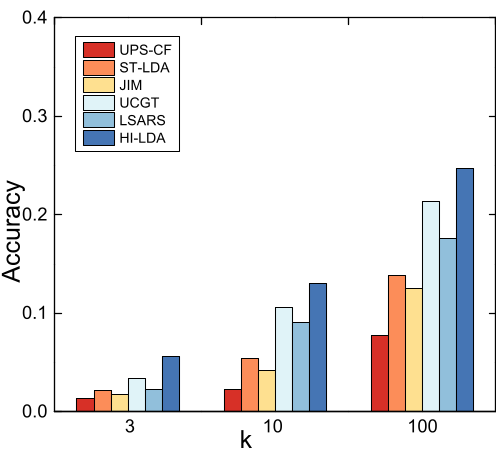 Fig 2: Top-k recommendation performance comparison highlighting HI-LDA's superiority over traditional CF and LDA variants.
Key Ablation Insights:
- Social vs. Temporal: Social influence has a significantly greater impact on decision-making than temporal effects in out-of-town scenarios.
- Community Awareness: Distinguishing between individual interests and community-level preferences (HI-LDA-V1) is crucial for picking up on shared tastes among friend groups.
Critical Insight & Conclusion
The true value of HI-LDA lies in its treatment of Heterogeneity. By using "Anchor Links" to marry a user's geographical footprint with their social discourse, the model effectively solves the cold-start problem.
Future Outlook: While HI-LDA is highly efficient (training time is comparable to simpler models), its current reliance on Gibbs sampling could be further optimized with Variational Inference for real-time, large-scale industrial deployment. Additionally, as we move into the era of LLMs, the "textual sentiment" component of HI-LDA could be significantly enhanced by replacing the word-distribution approach with dense embedding vectors from models like BERT or Llama.
Takeaway: Your social circle is your best travel guide. HI-LDA is the first formal step toward a recommendation engine that truly understands this human intuition.