
Can Strategy Save the Social Media Addict? Decoding the Impact of SNS on Academic Success
Can effective study approaches mediate the negative effect of social networking on academic performance?
This study investigates whether effective study approaches (Deep, Surface, and Strategic) can mediate the negative impact of social networking on academic performance. Using a descriptive-correlational method and mediation analysis on 380 college students, it confirms that social networking significantly degrades GPA and highlights the specific vulnerability of strategic study habits.
TL;DR
Social networking is a double-edged sword that, for most students, cuts deepest into their GPA. This study reveals that social media usage directly impairs academic performance. More surprisingly, it proves that even "Strategic Study Approaches"—the gold standard of organized learning—cannot effectively mediate or nullify the negative influence of social media. In the battle between scrolling and studying, the scroll wins by force of distraction.
Background: The SNS Paradox
In the modern academic landscape, technologies like Telegram and Instagram are integral to student life. However, while some researchers claim social media facilitates peer learning, others point to a sharp decline in grades. This research, conducted in the unique cultural context of Iran, seeks to find the "missing link": Does social media make us worse students because it fundamentally changes how we study?
The Core Mechanism: Study Approaches
The researchers categorized students into three study types based on the ASSIST framework:
- Surface Approach: Forgetting the "why" and focusing on memorizing keywords.
- Deep Approach: Connecting new knowledge to previous concepts.
- Strategic Approach: Organizing time and space efficiently to maximize grades.
The authors hypothesized that social media leads to "Multitasking", which induces a lack of focus, potentially driving students away from Deep/Strategic learning toward a fragmented Surface approach.
Methodology and Architecture
The study utilized a path analysis model to evaluate the relationship between Social Networking (Independent Variable), Study Approaches (Mediators), and Academic Performance (Outcome).
 Figure 1: The hypothesized mediation model connecting SNS usage to GPA through learning styles.
Key Findings: The Hard Truth
The data from 380 students revealed several critical insights:
- Direct Negative Impact: Every unit of increase in social networking dependency correlated with a significant drop in GPA (β = -0.283).
- The Strategic Failure: While having a Strategic approach is highly beneficial for grades (β = 0.347), social media use significantly erodes these very habits (β = -0.22).
- The Global Constant: Despite the shift from Facebook to Telegram/Instagram, the negative correlation remains persistent across cultures.
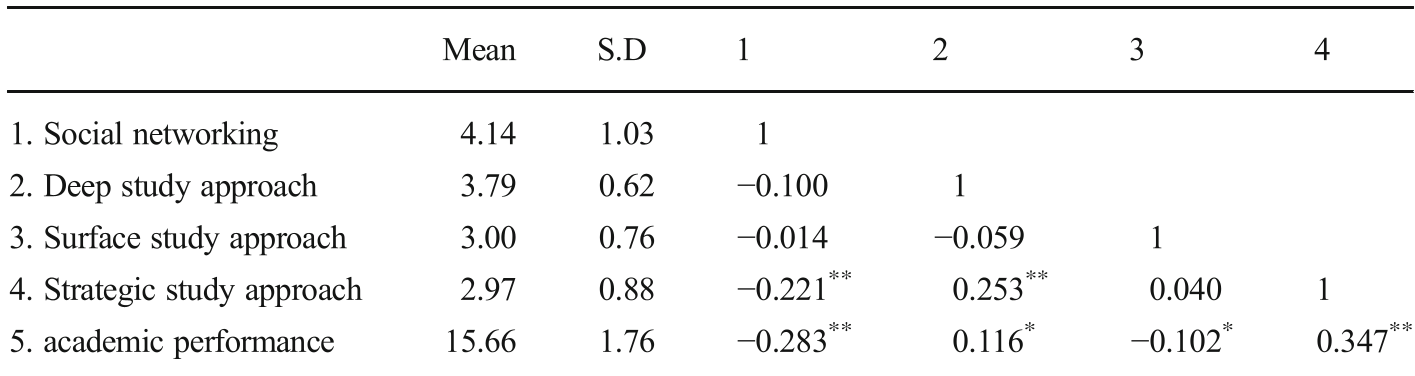 Table 2: Correlation matrix showing the negative relationship between SNS and Academic Performance.
Deep Insight: Why Strategy Isn't Enough
The most profound takeaway is the failure of the mediation hypothesis. The authors found that even when accounting for a student's ability to organize their time (Strategic Approach), the negative weight of social media remains substantial.
This suggests that the "Attention Deficit" and "Multitasking Cost" of social networks are so intrusive that they bypass a student's organizational skills. You cannot "schedule" your way out of the cognitive load that frequent social media switching imposes on the brain.
Conclusion & Future Outlook
The study concludes that improving study habits alone is insufficient for students heavily involved in social networking. Educational institutions must shift focus from simply teaching "how to study" to teaching "how to disconnect."
Limitations: The study relies on self-reported GPA and cross-sectional data. Future research should utilize objective metrics like eye-tracking or app-usage logs to quantify the exact moment-to-moment distraction cost of SNS during study sessions.
Takeaway for Educators: Don’t just provide better study materials; provide digital-free zones. The negative effect of SNS is a structural distraction that strategy alone cannot defeat.