
Optimized Preprocessing: The Key to Mastering Social Media Sentiment at Scale
Effective Text Data Preprocessing Technique for Sentiment Analysis in Social Media Data
This paper proposes an optimized text preprocessing pipeline and a novel weighted sentiment algorithm for Twitter data, specifically targeting Google Now and Amazon Alexa datasets (N=1,314,000). The researchers introduce a hybrid scoring system combining hashtag and cleaned text weights, ultimately achieving SOTA-level performance with a Support Vector Machine (SVM) classifier.
TL;DR
Researchers have developed a highly efficient sentiment analysis pipeline for Twitter data that balances accuracy and computational speed. By introducing a weighted hashtag-text algorithm and identifying Stemming as the most efficient preprocessing step, the study achieved a remarkable 90.3% accuracy using an SVM classifier, significantly outperforming more complex Deep Learning models in practical big data scenarios involving over 1.3 million tweets.
Background & Positioning
In the era of Big Data, companies like Google and Amazon rely on real-time feedback to judge product sentiment (e.g., Google Now vs. Amazon Alexa). However, Twitter data is "dirty"—filled with emojis, mentions, and hashtags. This paper positions itself as a pragmatic guide for engineers: it isn't just about which model is "smartest," but which preprocessing-classifier pipeline actually works when you have millions of rows to process on standard hardware.
The Core Motivation: Speed vs. Accuracy
The authors identified two major roadblocks in existing sentiment workflows:
- The Hashtag Dilemma: Most pipelines either treat hashtags as normal text or delete them, ignoring that a hashtag often contains the "core" sentiment of a post.
- The Preprocessing Bottleneck: Techniques like Spelling Correction are great for quality but disastrous for speed, often taking 400x longer than simpler methods.
Methodology: The Weighted Sentiment Algorithm
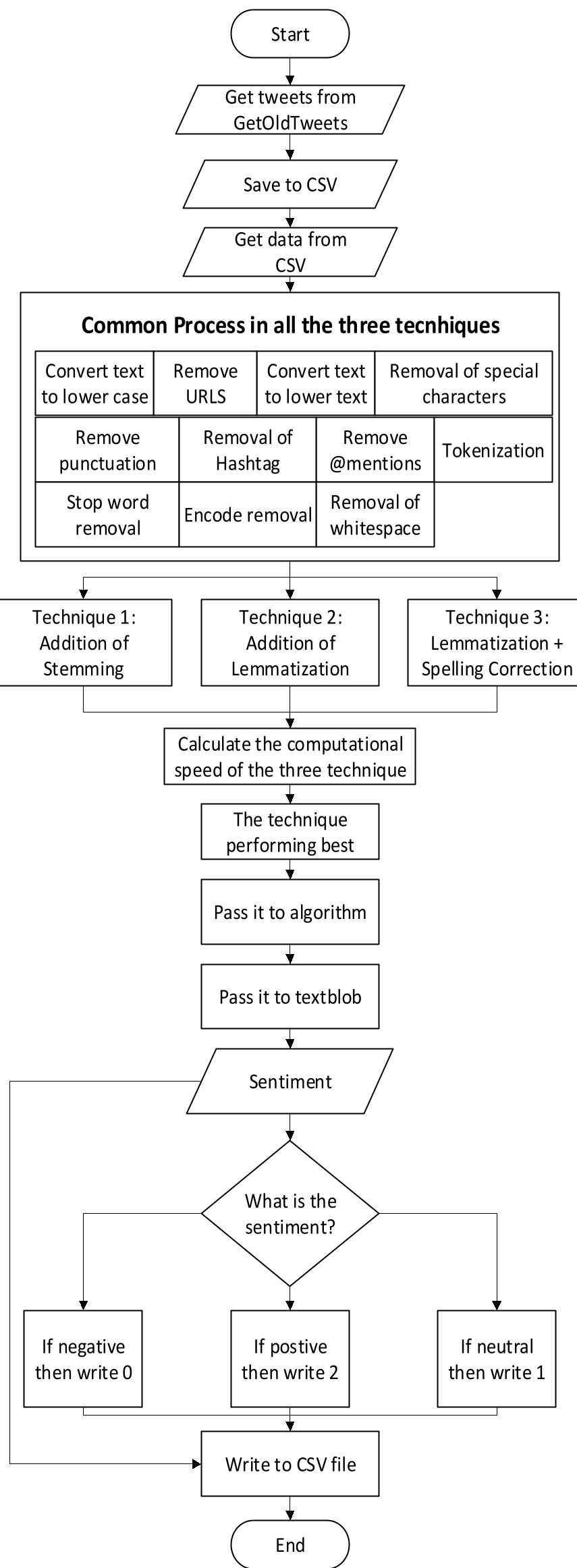
The breakthrough of this paper lies in its Proposed Weighting Algorithm. Instead of a flat analysis, the system treats the tweet as two distinct components:
- Hashtag (H): Assigned a 40% weight ().
- Cleaned Text (T): Assigned a 60% weight ().
The formula ensures that if a user writes a sarcastic or vague tweet but tags it with #LoveIt, the sentiment is correctly pulled toward the positive.
Comparing Preprocessing Techniques
The study compared three primary methods:
- Stemming: Reducing words to their root (e.g., "running" to "run").
- Lemmatization: Using a dictionary to find the base form.
- Spelling Correction: Fixing typos before processing.
The Insight: While Spelling Correction is precise, its computational cost is prohibitive for big data. Stemming was selected as the "Golden Mean"—it was fast and provided enough "dissimilarity" from uncleaned data to prove it was actually removing noise effectively.
Experiments and SOTA Results
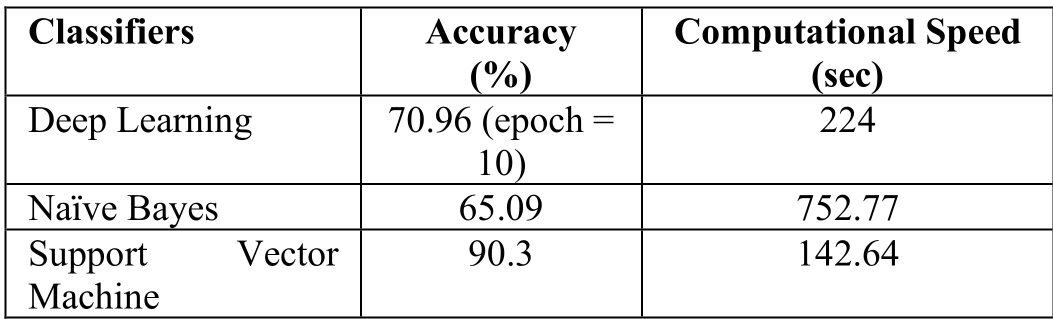
The researchers tested their algorithm and processed data across three major classifiers: Deep Learning (DL), Naïve Bayes (NB), and Support Vector Machine (SVM).
Key Findings:
- SVM is King: Achieving 90.3% accuracy, SVM handled the high-dimensional, unstructured nature of Twitter data better than DL or NB.
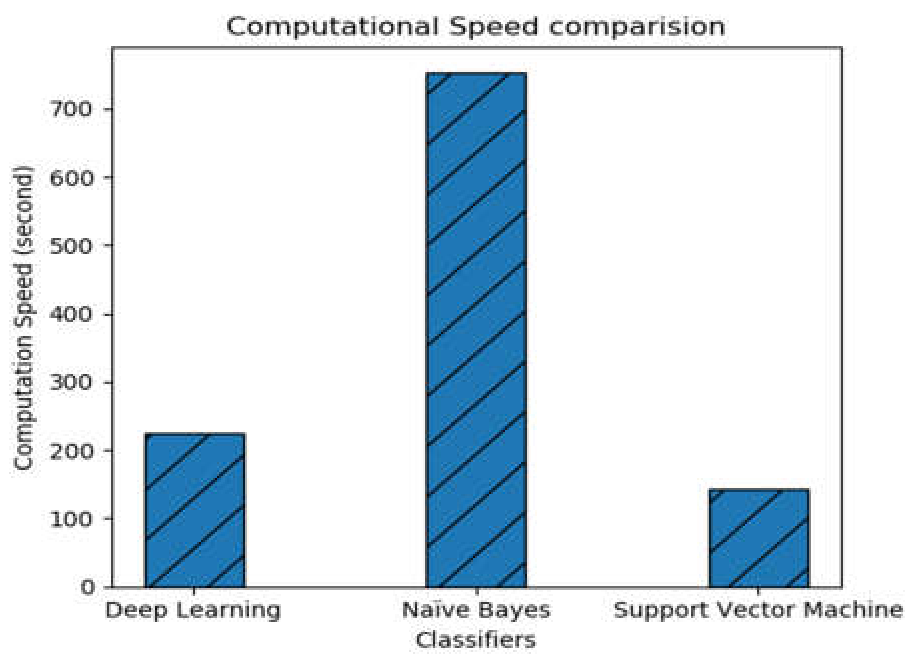
- Efficiency: SVM was the fastest to train (142 seconds), while Naïve Bayes took over 752 seconds for the same task.
- Case Study: The system successfully mapped the popularity of Amazon Alexa (peaking in 2018) vs. Google Now (peaking in 2016), aligning perfectly with real-world product launch timelines like the Amazon Echo and Google Assistant.
Critical Analysis & Professional Perspective
The success of the SVM in this study highlights an important industry truth: Inductive Bias matters. For shorter, unstructured text where features are sparse, the geometric margin maximization of SVMs often generalizes better than Deep Learning models, which may require significantly more labeled data (beyond the N=10,000 used for training here) to reach their full potential.
Limitations: The authors bravely admit a common pitfall: Sarcasm. A tweet like "Great, another update that breaks my phone #Awesome" would likely be classified as positive by this algorithm. Future iterations would need a context-aware transformer (like BERT) to handle linguistic irony.
Conclusion
This research proves that "cleaning" is just as important as "modeling." By giving hashtags the weight they deserve and choosing high-speed stemming over heavy spelling correction, developers can build sentiment engines that are both highly accurate and fast enough for real-time social media monitoring. For practitioners, the message is clear: Don't ignore the hashtags, and never underestimate a well-tuned SVM.