
Deciphering Social Echoes: A Hybrid Exponential Model for OSN Visibility Prediction
13796_Effective Visibility Prediction on Online Social Network.
This paper introduces a novel exponential model for predicting the visibility of resources on Online Social Networks (OSNs), specifically Twitter. By integrating local topological features with user behavioral attributes like topic interest and relationship strength, the proposed model achieves a peak prediction accuracy of approximately 90%, significantly outperforming traditional regression and standard Deep Neural Network (DNN) baselines.
TL;DR
Predicting how far a tweet will travel is notoriously difficult due to the "noise" of human behavior. This paper moves beyond simple network analysis by proposing an Exponential Visibility Model. By calculating a "forwarding probability" based on a user’s specific topic interests (e.g., Politics, Science) and their relationship strength, the model hits a 90% accuracy rate, proving that content-interest fit is the engine of social propagation.
The Motivation: Why Network Topology Isn't Enough
Most prior research treats Social Networks as simple pipe systems: if node A connects to node B, information flows. However, in reality, we ignore 90% of our feed. The authors argue that "Visibility"—the measure of resource exposure—is not just about how many followers you have, but about the behavioral resonance between the tweeter and the audience.
Existing models suffered from:
- Over-reliance on topology: Assuming every follower is an active listener.
- Binary privacy views: Treating tweets as either "public" or "private" without measuring the probability of leakage.
Methodology: The Fusion of Topology and Behavior
The authors break down Visibility into two distinct pillars:
1. Topological Visibility ()
This measures the "potential" reach based on the local graph. It uses a damping factor to account for the fact that interest wanes as a tweet moves further from its source.
- Key Formula Detail: It incorporates the Clustering Coefficient. A high coefficient means your followers already know each other (a "closed" clique), which actually slows down the spread to new audiences.
2. Behavioral Visibility ()
This is where the magic happens. The researchers used Latent Dirichlet Allocation (LDA) and a Multinomial Naive Bayes (MNB) classifier to categorize users into interest groups (Science, Sports, etc.).
The DNN baseline architecture used for comparison.
The Exponential Leap
The core contribution is the Exponential Model. It defines the fraction of activated users at a certain "hop" distance as: Where is the "Forwarding Probability"—a weighted average of the follower's interest in the topic and their trust/relationship level with the sender.
Experiments: Real-World Twitter Validation
The authors scraped data from 153,635 users and over 2 million interactions to test their theory.
Key Findings:
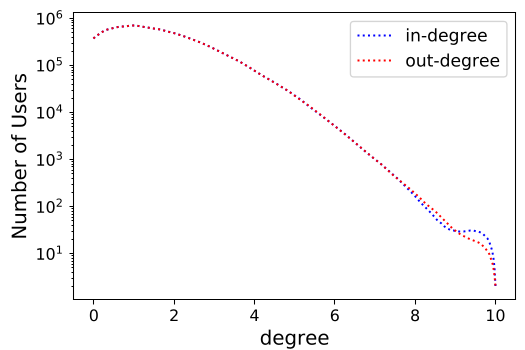
- The Power-Law Reality: Like most social phenomena, visibility follows a power-law distribution. Most tweets die in obscurity, while a few reach massive visibility.
- The "Hop" Sweet Spot: For users with <2000 followers, 3 hops is the predictive limit. For "influencers" (>2000 followers), visibility prediction is most accurate at 2 hops.
- Accuracy Dominance:
- Proposed Exponential Model: ~90% Accuracy.
- Deep Neural Network (DNN): ~69% Accuracy.
- Polynomial Regression (PR): ~20% Accuracy (fails to capture non-linear social dynamics).
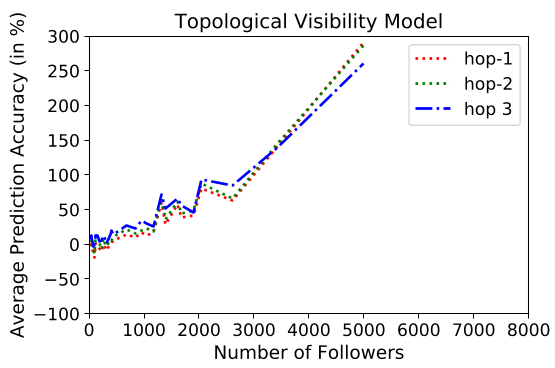 Typical accuracy distribution across different models and follower counts.
Critical Analysis & Takeaways
The success of the Exponential Model over the DNN baseline is a fascinating result. It suggests that in social dynamics, mathematically grounded growth models (like exponential decay/growth) often outperform "black-box" deep learning when data is structured around clear human signals like "interest" and "trust."
Limitations
- Static Snapshots: The model assumes the social graph is static during the prediction window. In reality, news cycles and "trending topics" can reshape the graph in hours.
- Language Bias: The study was limited to English-language tweets.
Final Thoughts
This research is a wake-up call for OSN privacy settings. If we can predict visibility with 90% accuracy, platforms should be able to warn users: "Sharing this 'private' photo might reach 5,000 people due to your followers' interests." By quantifying the invisible reach of our digital lives, we take one step closer to true digital privacy.