
Scaling Software Diversity: A 90,000-Program Deep Dive into Reliability
The Effectiveness of Software Diversity in a Large Population of Programs
This paper presents a large-scale empirical study on multiple-version software diversity using over 89,000 programs submitted to the UVa Online Judge. It quantifies the reliability gains of 1-out-of-2 redundancy and evaluates the specific impact of language diversity (C, C++, Pascal) on reducing coincident failures.
TL;DR
Is writing the same code twice—but in different languages—actually worth the effort? This paper uses a massive dataset of 89,402 programs from the UVa Online Judge to prove that while "multiple-version diversity" is a powerful reliability booster (offering a 100x improvement on average), the specific choice of programming language (like C vs. Pascal) adds only a marginal ~10% benefit.
The "Common Difficulty" Problem
In safety-critical systems, developers often use N-version programming: writing multiple versions of a software component so that if one fails, the other can take over. However, the theoretical models by Eckhardt and Lee and Littlewood and Miller warn us that this isn't a silver bullet.
The problem is the Difficulty Function . Some inputs are naturally harder to handle than others. If all programmers find a specific corner case (like an swap) difficult, they will all fail on the same input, rendering diversity useless. This paper seeks to quantify just how much "common difficulty" exists in the real world across tens of thousands of implementations.
Methodology: The "3n + 1" Treasure Trove
The authors first performed an exploratory analysis on the "3n + 1" problem, a simple algorithm that masks deep complexity. By analyzing 36,123 submissions for this single problem, they identified "Equivalence Classes"—groups of programs that fail in exactly the same way.
The Failure Signature
By plotting failure sets, the authors visualized how different bugs manifest. A "swap fault" (failing when the first input is larger than the second) creates a triangular failure region, while loop errors create distinct diagonal patterns.
 Figure 1: Visualizing "Difficulty" - the black dots represent inputs where programs in a specific equivalence class fail.
Key Finding 1: The Plateau of Diversity
The study confirmed that for "unreliable" software, diversity follows the independence assumption (where the probability of a system failure is simply the product of the probabilities of each version failing).
However, as code gets better, we hit a plateau. For programs with a Probability of Failure on Demand (PFD) better than 0.001, the improvement factor levels off at about 100. In some extreme cases, effectiveness collapses entirely if one specific input becomes a "universal" trap for every developer.
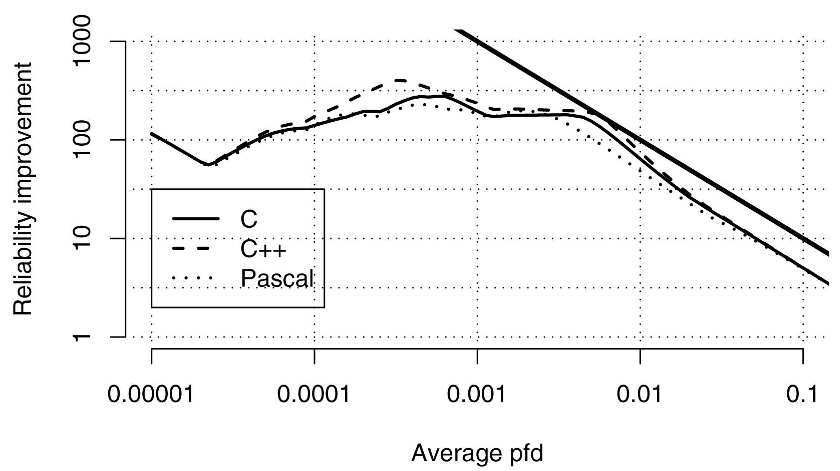 Figure 5: The plateau effect. Reliability improvement is significant but hits a ceiling as the pool PFD decreases.
Key Finding 2: The Myth of Language Diversity?
One of the most interesting claims in safety engineering is that using different languages (e.g., C and Pascal) prevents coincident faults because the languages have different "inductive biases."
The authors found that:
- Pascal programmers were much less likely to make loop errors than C programmers, thanks to Pascal's stricter
forloop syntax. - Despite this, the overall gain from mixing languages was only about 10-13%.
- C and C++ pairs showed almost zero extra diversity, likely because C++ programmers in the study rarely used specialized language features that would have differentiated their logic from C.
| Language Pair | Additive Improvement |
|---|---|
| C / Pascal | 1.13 (13% gain) |
| C++ / Pascal | 1.07 (7% gain) |
| C / C++ | 1.02 (2% gain) |
Critical Perspective: Small vs. Large Programs
The authors acknowledge a major caveat: this is "Programming in the Small." These are algorithmic contest problems, not multi-million line operating systems. In industrial systems, the complexity of the specification itself might become the primary source of failure, potentially making diversity even less effective if everyone misinterprets the same complex requirement.
Final Takeaway
Software diversity is a robust tool for reliability, but it is not a shortcut to perfection. If you are building a dual-redundant system, focusing heavily on language diversity provides diminishing returns. Your real enemy isn't the syntax of the language—it's the inherent difficulty of the logic points where every human mind tends to stumble.