
The Bridge Advantage: How Social Network Structure Drives What We Reveal Online
Effects of ego networks and communities on self-disclosure in an online social network
The paper presents a large-scale quantitative study on Google+ to analyze how network structures—specifically ego networks and communities—influence user self-disclosure. By categorizing users into "open," "moderate," and "closed" types based on Communication Privacy Management (CPM) theory, the authors demonstrate that positional advantages in a network, such as acting as a "bridge," significantly increase the propensity to reveal personal information.
TL;DR
Contrary to the popular belief that "more friends mean more privacy concerns," a massive study of 30 million Google+ users reveals that the more central you are as a "bridge" between different social groups, the more likely you are to be an open book. By applying the Structural Holes theory to social network analysis, researchers found that "bridging" individuals disclose significantly more personal data to leverage social and informational advantages.
The Motivation: Moving Beyond Surveys
Understanding self-disclosure—the act of revealing personal information—is the "Holy Grail" for digital marketers and sociologists alike. However, for years, our understanding was limited to two flawed methods:
- Small-scale surveys: Which suffer from "say-do" gaps (what people say they do vs. what they actually do).
- Sampled subgraphs: Which often miss the "big picture" of how communities interact.
The authors of this study took a different route. By capturing over 70% of the publicly known Google+ ecosystem, they analyzed the "Why" behind sharing through the lens of Communication Privacy Management (CPM) theory and architectural network physics.
Methodology: The Two-Layer Deep Dive
The research looks at the social graph at two granularities: the Ego Network (your immediate circle) and Communities (the larger clusters you belong to).
1. The Ego Network & The "Structural Hole"
The most striking finding involves "Effective Network Size." According to the Structural Holes theory, if your friends all know each other, they are "redundant" sources of information. If you connect groups that don't otherwise talk, you sit on a Structural Hole.
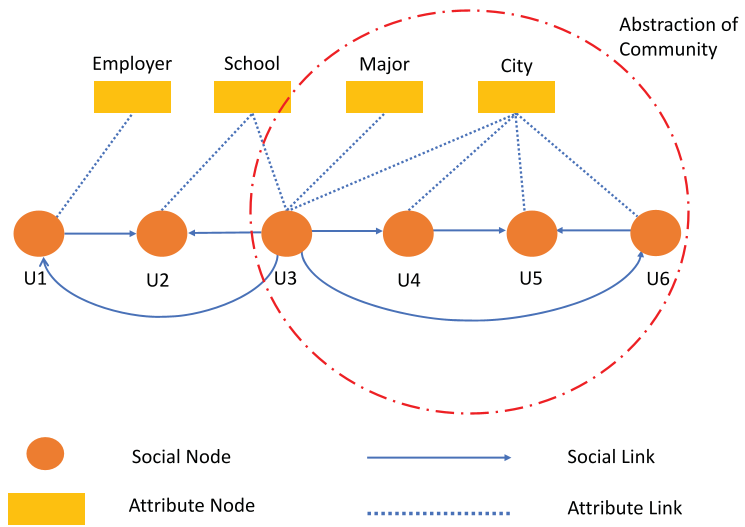 Figure 1: Illustration of how social nodes link to community structures and attribute nodes (personal info).
2. Positional Centrality
The authors didn't just look at how many friends you have (Degree), but where you stand in the crowd. They used:
- Betweenness Centrality (BC): Does the shortest path between others go through you?
- PageRank: How influential are you within your specific sub-community?
Key Results: Bridges Talk More
The study categorized users into three buckets: Open (shared all 4 optional attributes), Moderate, and Closed (shared nothing).
- The Paradox of Friends: In private networks like Facebook, more friends usually lead to less sharing. In the more public-professional context of Google+, the opposite is true. Open users had a median degree 400% higher than closed users.
- The Density Factor: Moderate users actually have denser ego networks than open users. This suggests that "Open" users thrive in sparse networks where they act as the primary link between disparate groups.
- Predictive Power: By using these structural features, the researchers built a Random Forest model that significantly outperformed traditional benchmarks.
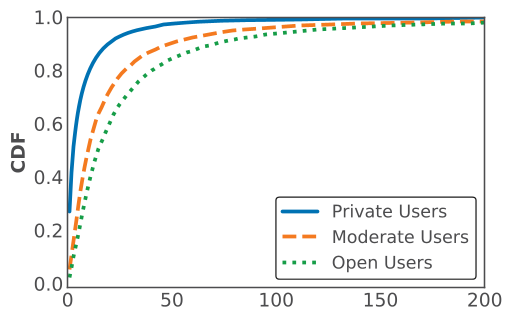 Figure 2: Distribution of Ego Network properties across Open, Moderate, and Closed user types.
Critical Analysis: Why This Matters
The "Aha!" moment of this paper is the link between Social Capital and Self-Disclosure. If you are a bridge (high Betweenness Centrality) between two communities, revealing your "Employer," "Major," or "School" isn't just a privacy risk—it's a credentialing tool. It signals your legitimacy to both sides of the bridge, allowing you to harvest the informational benefits of your position.
Limitations & Future Work
While the study is massive, it represents a snapshot of Google+ in 2011. The social landscape has shifted toward algorithmic feeds (TikTok) and encrypted messaging (WhatsApp). The next frontier is determining causality: Does being a bridge make you disclose more, or do people who disclose more naturally become bridges?
Conclusion
This research proves that our privacy settings are not just reflections of our personality; they are reflections of our geometry in the social graph. If you find yourself sharing more than others, take a look at your network—you might just be the bridge holding different worlds together.