
Harmonizing Social and Physical Networks: A Game-Theoretic Blueprint for Regional Water Systems
Efficiency and stability of self-organizing cooperation networks: roles of a cost allocation scheme for regional joint water distribution systems
This paper proposes a cost allocation scheme for regional joint water distribution systems using the Myerson value from cooperative game theory. It models the system as a two-fold network (social and physical) and demonstrates that a "grand coalition" can be self-enforced through "component balance" and "equal bargaining power," even when the physical infrastructure is partitioned.
TL;DR
Regional infrastructure projects often fail not because of engineering flaws, but because autonomous partners can't agree on how to split the bill. This paper introduces a Myerson value-based cost allocation scheme that ensures long-term stability in "self-organizing" cooperation networks. By separating the Social Network (who is talking to whom) from the Physical Network (where the pipes are), the authors prove that even if a system is physically fragmented, it can remain socially and economically unified and stable.
The "Grand Project" Dilemma: Why Stability Matters
When multiple municipalities plan a joint water distribution or wastewater system, they usually aim for "economies of scale." However, autonomous regions are self-interested. If Region A feels its costs are subsidizing Region B without a fair trade-off, it will leave the "Grand Coalition" and build its own smaller, less efficient system.
Prior work often assumed that a unified project is a given. This paper argues that the evolution of cooperation is a non-cooperative game where stability is reached only if no two players have an incentive to change their bilateral relationship—a concept known as Pairwise Stability.
Methodology: The Two-Fold Network Hierarchy
The core insight of the paper is the definition of a two-strata hierarchy:
- Social Network: A graph where links represent a "willingness to work together bilaterally" (wwb).
- Physical Network: The actual engineering design that minimizes total costs for a given group .
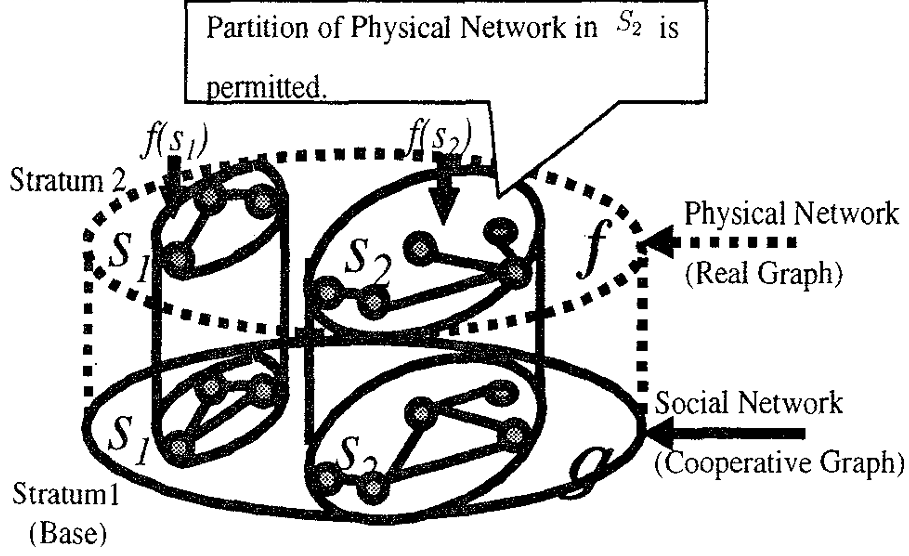
The authors use the Myerson Value, which satisfies two critical axioms:
- Component Balance: The total cost of a joint project is distributed entirely among its connected participants.
- Equal Bargaining Power: The change in cost for Player if the link is severed must equal the change in cost for Player .
This ensures that links are only maintained if they are mutually beneficial or at least neutrally impactful, leading to a "self-enforcing" equilibrium.
Case Study: When Pipes and People Part Ways
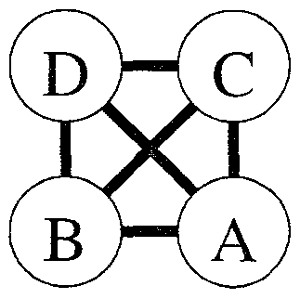
The paper analyzes a basin-wide wastewater system with four regions (A, B, C, D).
Case 1: The Ideal Scenario
When wastewater loads are distributed normally, the optimal physical design is a unified network connecting all nodes at a central point (Region A). Here, the physical network and the social network are isomorphic.
Case 2: The Fragmentation Paradox
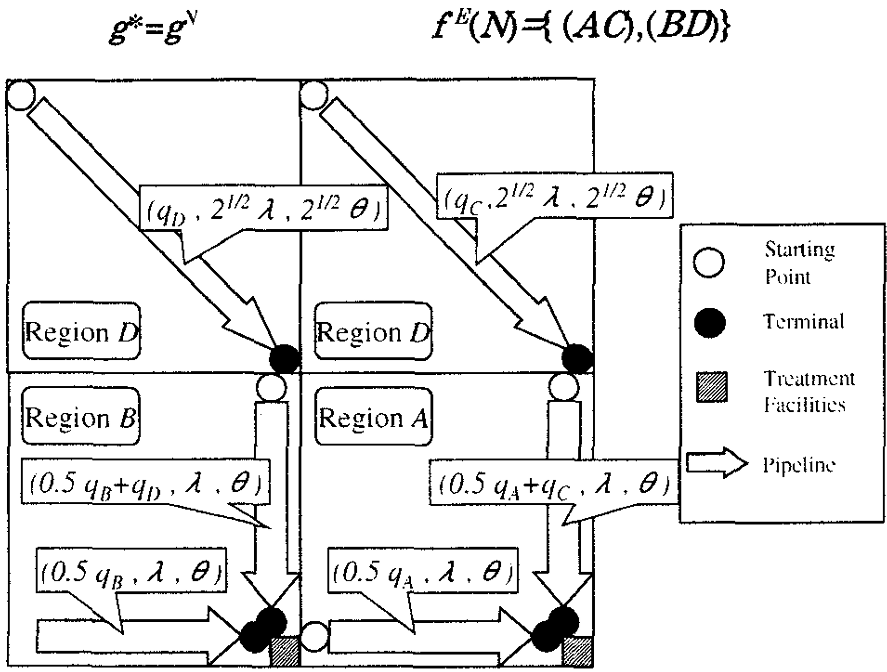
In a scenario where one region (Region B) has an extremely high load, the most "efficient" engineering solution is actually to build two separate systems (A-C and B-D).
- The Conflict: Usually, this would mean the players split into two groups.
- The Solution: The Myerson value scheme shows that the "Grand Coalition" (all four working together) remains the equilibrium. This allows for side-payments across the physically disconnected components, maximizing total regional efficiency while keeping everyone at the table.
Critical Analysis & Conclusion
Takeaway
The paper beautifully demonstrates that economies of scale do not always hold for physical pipeline layouts, but subadditivity of costs (the idea that the whole is cheaper than the sum of parts) often survives if social cost-balancing is permitted.
Limitations
- Gravity Constraints: The model assumes gravity-only flow, which simplifies the engineering cost function but might not apply to pumped systems.
- Information Symmetry: The game assumes all players have perfect information regarding each other's cost functions, which is rare in real-world political negotiations.
Future Outlook
This framework provides a mathematically grounded way for regional planners to justify "socially balanced" pricing. Instead of charging based on the physical pipe length, regions can move toward "social component balancing," ensuring that the most efficient regional design is also the most politically stable one.