
Bit-Vector Transform: Slashing Access Control Latency in Multimedia Social Networks
An efficient access control method for multimedia social networks
This paper introduces an efficient bit-vector transform-based access control method specifically designed for Multimedia Social Networks (MMSNs). By organizing access rights into an M-dimensional space using bit-vectors and AVL trees, it achieves a significant performance leap over traditional relational database (RDB) models, particularly in fine-grained and multi-range access scenarios.
TL;DR
As social networks evolve from simple text to complex multimedia, traditional database-driven access control has hit a performance wall. This paper proposes a Bit-Vector Transform approach that re-imagines access rights as dimensions in a searchable coordinate system. The result? A 30x speedup in access validation, enabling real-time privacy enforcement even for complex, "blurred" or multi-layered content permissions.
Context & Motivation: The Scalability Trap
In modern MMSNs (like Facebook or YouTube), privacy isn't just binary ("can I see this?"). Users now demand fine-grained control:
- "Only my close friends can see the high-res version; others see a blurred thumbnail."
- "Only colleagues over age 25 in specific regions can view this specific video segment."
Existing systems rely on Relational Databases (RDB). Every time you scroll through a feed, the system must run dozens of SQL-like "JOIN" and "WHERE" queries to check credentials. When millions of users access millions of items, the database becomes a catastrophic bottleneck.
Methodology: High-Speed Bitwise Privacy
The authors propose moving away from comparison-based checks to geometric bit-vector operations.
1. The M-Dimensional Space
Imagine every access credential (Age, Trust, Friendship) as an axis. The system breaks these axes into "elementary ranges." Every content item is assigned a specific bit in a long bit-vector.
- If bit #5 is "1" in the "Age [18-25]" range, it means Content #5 allows access for that age group.
2. AVL Tree Organization
To find the right bit-vector instantly, the system uses AVL trees (self-balancing binary search trees). These trees store the endpoints of access ranges, ensuring that finding which range a user's attributes fall into takes logarithmic time—.
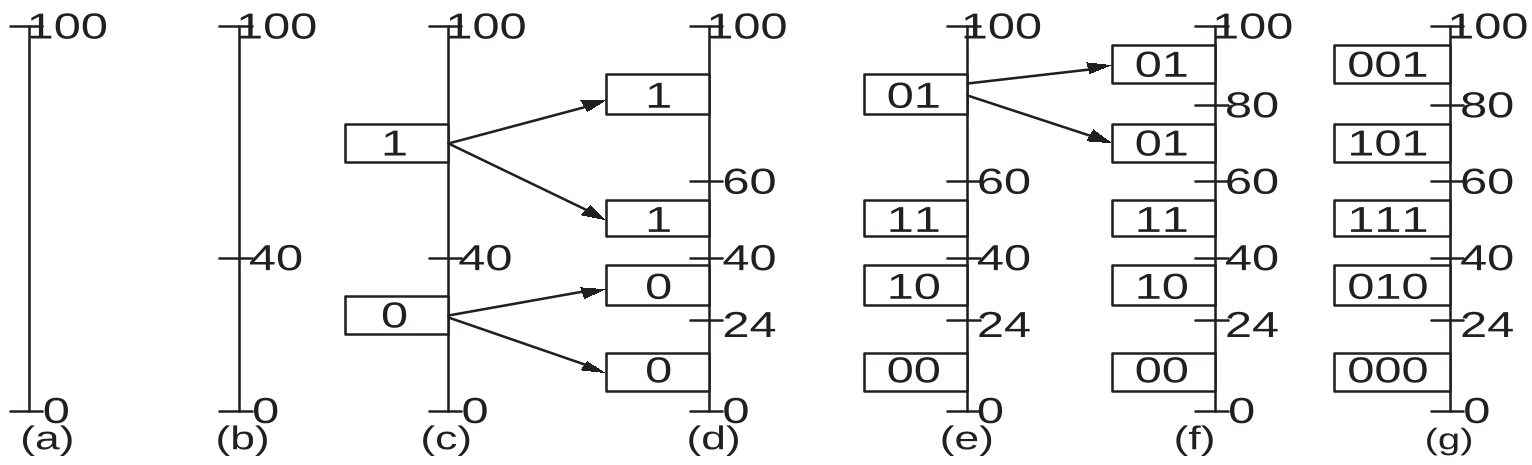 The figure above illustrates how credentials like Friendship Level (F) are segmented into ranges, each mapped to a bit-vector representing content items.
3. The Power of "AND"
The final decision is mathematically elegant. If a user has attributes across dimensions, the system fetches bit-vectors and performs a bitwise AND operation: If the -th bit in the resulting vector is 1, the user is cleared for content . Computers are exceptionally fast at bitwise AND, making this nearly instantaneous regardless of content volume.
Experimental Performance
The researchers compared their approach against standard RDB models on a 2.40 GHz CPU environment.
- Performance: The proposed method maintained nearly constant access time, even when access rights became non-continuous (multi-range).
- Efficiency: For a profile with 1,000 to 10,000 content items, the bit-vector method was consistently 30 times faster than database lookups.
 The graph shows the dramatic difference in "Time Required" between the RDB approach (top lines) and the proposed Bit-Vector approach (bottom lines).
Critical Insight & Limitations
The "magic" here is the trade-off. By pre-calculating bit-vectors during content insertion, the system pays a small "tax" when a user uploads a photo to make the reading process lightning fast.
Limitations:
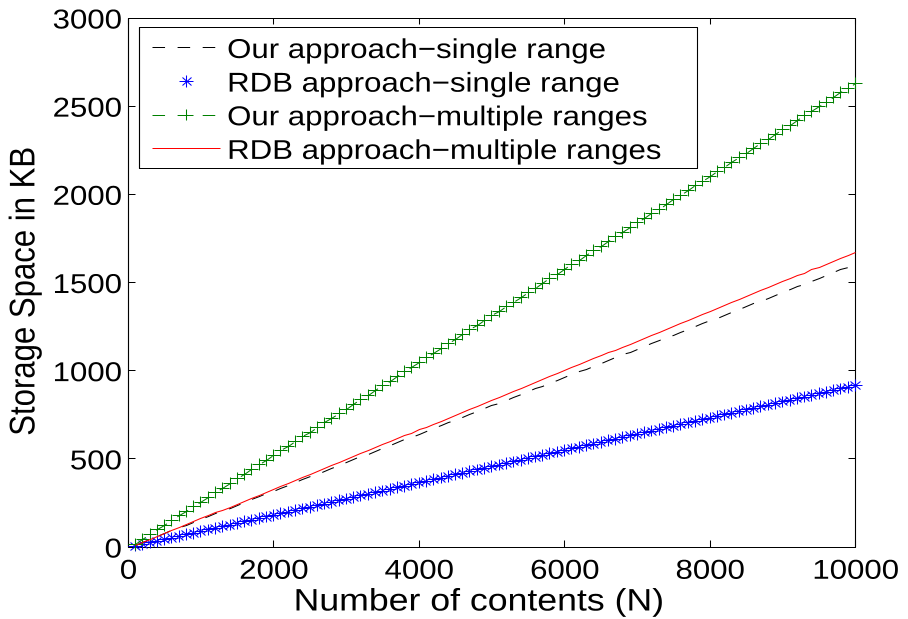
- Storage Overhead: The index takes 60-70% more space than a raw database. In the era of cheap storage but expensive latency, this is usually a trade worth making.
- Bit-Vector Length: As the number of contents grows extremely large, the bit-vectors grow longer. Future iterations might need hierarchical bit-vectors or compression (like Roaring Bitmaps) to handle billion-scale datasets.
Conclusion
This work shifts the access control paradigm from "Querying Data" to "Computing Intersections." For any developer building high-concurrency platforms with complex privacy requirements, the Bit-Vector Transform provides a blueprint for moving past the limitations of traditional relational logic.