
DOCNet: Redefining Overlapping Community Mining with Fuzzy Logic and Local Expansion
An efficient algorithm for community mining with overlap in social networks
This paper introduces DOCNet, an efficient community mining algorithm designed to detect overlapping structures in social networks. By leveraging a local expansion strategy based on a novel fuzzy membership degree and optimizing a custom "Index of Connectivity" (IC) objective function, the method achieves SOTA performance in identifying bridge nodes between groups.
TL;DR
Social networks are messy; individuals often belong to multiple circles simultaneously—family, work, and hobbies. DOCNet (Detecting Overlapping Communities in Networks) is a new algorithm specifically designed to find these "bridge" individuals. By focusing on local expansion rather than global optimization, it achieves a quadratic time complexity , making it viable for large-scale graphs where traditional methods fail.
The "Disjoint" Fallacy in Network Science
In the early days of graph theory, we viewed communities as distinct islands. However, in reality, these islands are connected by bridges—nodes that exhibit overlap. Identifying these nodes is notoriously difficult because they are "unstable" and sit at the boundaries of multiple high-density clusters.
Existing solutions like the Clique Percolation Method (CPM) are mathematically sound but computationally ruinous for large networks. Others, like Fuzzy C-Means (FCM), ignore the underlying graph topology entirely, treating nodes like points in a Euclidean space rather than connected entities.
Methodology: How DOCNet Works
DOCNet shifts the focus to Local Expansion. Instead of slicing the whole graph at once, it builds communities from the ground up through a two-stage process:
1. Identifying the Center of Gravity
The algorithm doesn't pick starting points at random. It calculates a Node Importance (NI) score for every vertex: This combines the Clustering Coefficient (how well its neighbors are connected to each other) with the Node Degree. Think of this as finding the "social butterfly" who sits at the heart of a tight-knit group.
2. Intelligent Expansion via Fuzzy Membership
Once a core is established, DOCNet looks at boundary nodes. It decides whether to absorb a node based on its Membership Degree (), which is inversely proportional to the average shortest distance to the community and the compactness of the connections.
 The core logic of DOCNet involves sorting nodes by importance and iteratively expanding communities via a fitness function.
The expansion is governed by the Index of Connectivity (IC): The algorithm stops expanding a community the moment adding the most likely candidate decreases the IC score.
Experimental Showdown: Synthetic and Real-World
The authors tested DOCNet against heavyweights like COPRA, GCE, CPM, and EAGLE.
Synthetic Benchmarks (LFR)
On LFR benchmarks with up to 50,000 nodes, DOCNet showed remarkable resilience. While labels propagation methods (COPRA) often collapsed as the network mixing parameter () increased, DOCNet maintained a steady Normalized Mutual Information (NMI) score.
The F-Score Advantage
Where DOCNet truly shines is in its Recall. It is exceptionally good at finding all overlapping nodes, even if it slightly compromises on precision. As shown in the comparison below, DOCNet's F-score (the balance of precision and recall) actually improves as the network becomes more complex.
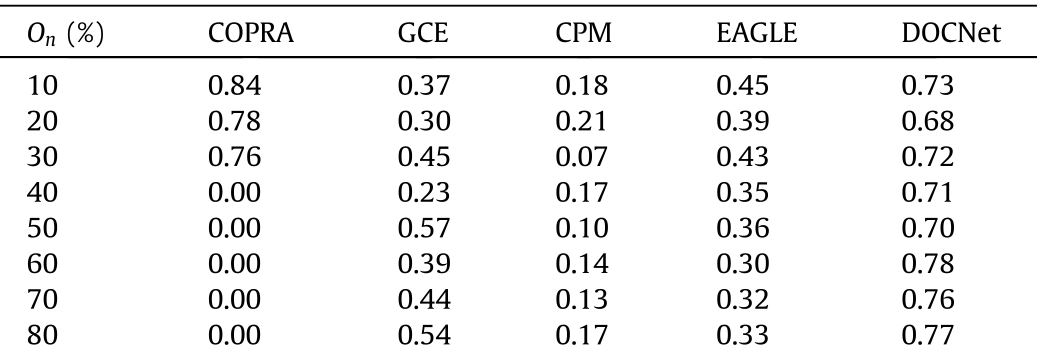 Table showing NMI performance: Note that while GCE is strong, DOCNet (last column) maintains high consistency as increases.
Critical Insight: Why it Wins
The brilliance of DOCNet lies in Theorem 2 of the paper. It proves that if the "most eligible" neighbor (the one with the highest membership degree) doesn't improve the community's connectivity index, then no other neighbor will. This allows the algorithm to terminate early, maintaining its efficiency without sacrificing accuracy.
Conclusion & Future Outlook
DOCNet provides a robust framework for mining overlapping groups in large, messy social networks. Its reliance on local metrics makes it a perfect candidate for parallelization.
Limitations: The current model is designed for undirected and unweighted graphs. In the real world, relationships have "weights" (frequency of contact) and "directions" (following vs. followed). Future iterations of DOCNet will need to incorporate these dimensions to remain relevant in the era of sophisticated social media analytics.
Takeaway: If your task involves finding hidden bridges in massive networks, local expansion via fuzzy membership is likely more efficient and reliable than global partitioning.