
TS-RW: Bridging Uncertainty and Time in Social Network Link Prediction
An efficient algorithm for link prediction in temporal uncertain social networks
This paper introduces TS-RW (Time Series Random Walk), an efficient link prediction algorithm designed for temporal uncertain social networks. By transforming probabilistic graphs into deterministic equivalents and utilizing a localized subgraph strategy, the method achieves state-of-the-art accuracy in forecasting future connections across various real-world datasets.
TL;DR
Predicting who will connect next in a social network is hard; it's even harder when the data is noisy (uncertain) and constantly changing (temporal). This paper presents TS-RW, a framework that transforms complex probabilistic "possible worlds" into a manageable deterministic random walk model. By focusing on local subgraphs and weighting recent history more heavily, it achieves superior accuracy (AUC) compared to traditional static metrics.
The Challenge: Navigating the "Possible Worlds"
In a standard social network, a link either exists or it doesn't. In an uncertain network, every edge has a probability . Mathematically, an uncertain network is a distribution over "possible worlds"—an astronomical number of potential snapshots.
The authors identify two fatal flaws in prior work:
- Computational Explosion: Determining reachability or similarity across all possible worlds is #P-complete.
- Temporal Decay: Most methods treat time as a flat dimension, failing to realize that a contact made yesterday is usually a better predictor for tomorrow than a contact made a year ago.
Methodology: The Math of Efficiency
The core innovation lies in Theorem 1, which proves that a probabilistic random walk on an uncertain graph can be perfectly mirrored by a standard random walk on a deterministic graph, provided the transition weights are calculated correctly.
1. Subgraph Optimization (ComSim)
Instead of checking the whole network, the algorithm uses a local subgraph .
 Through dynamic programming, the ComSim algorithm reduces the weight calculation complexity to , where is the node degree. This makes the global computation , matching the complexity of a standard SimRank on a deterministic network.
2. Temporal Integration
To handle the "temporal" aspect, the method aggregates multiple snapshots into a unified matrix using a damping factor : This ensures that the most recent network structure has the greatest influence on the prediction.
Experimental Evidence: SOTA Rankings
The authors tested TS-RW against several baselines, including Common Neighbors (CN), Adamic-Adar (AA), and Katz (KTZ) across multiple datasets like the High School contact network and Balkan political message networks.
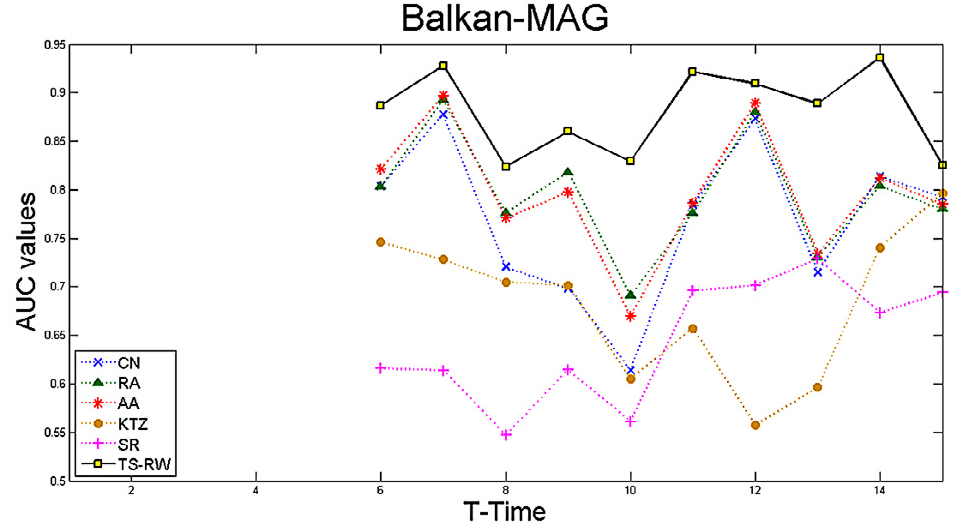
Key Findings:
- The Damping Factor Matters: As increases, performance typically peaks and then levels off, proving that "recent history" is the sweet spot for prediction.
- SimRank Superiority: By capturing global topological patterns via random walks (rather than just local neighbors), TS-RW consistently maintains a higher AUC.
Critical Insight & Conclusion
While link prediction is a well-trodden path, this paper’s contribution is the functional equivalence it establishes between uncertain and deterministic random walks. It effectively bypasses the "Possible World" explosion without sacrificing the nuances of edge probabilities.
Limitations: The complexity still scales with , which might be problematic for billion-scale graphs (like Facebook or Twitter). Future iterations would likely need to incorporate approximate SimRank or Graph Embedding techniques to further reduce the overhead.
Final Takeaway: If your network data is noisy or time-varying, stop using static indices. Integrating a temporal damping factor with a localized random walk is a robust, mathematically sound way to look into the future of social structures.