
Efficient Concept Clustering: Leveraging the Web's Pulse for Scalable Ontology Learning
Efficient concept clustering for ontology learning using an event life cycle on the web
The paper introduces a two-stage concept clustering framework for ontology learning designed to handle large-scale Web data. By utilizing an "event life cycle" to group terms with similar temporal fluctuations before applying expensive semantic similarity metrics, the method achieves significant computational speedups (up to 1541%) while maintaining high precision and recall.
TL;DR
Building ontologies from the Web is like finding needles in a shifting haystack. Modern systems struggle with the complexity of comparing every new term. This paper introduces a breakthrough: using the Event Life Cycle (time-based surges in news) to perform "rough clustering" first. This reduces computation by over 1500% while maintaining 98% accuracy compared to exhaustive methods.
The Scalability Bottleneck in Ontology Learning
Ontologies like WordNet facilitate machine understanding, but manual maintenance cannot keep pace with the Web's growth. Automating this via clustering is the standard approach, but it faces a fundamental logic trap:
- High-fidelity metrics (context-aware cosine similarity) are too slow for millions of terms.
- Low-fidelity metrics (string matching) miss deep semantic relationships.
The authors observe that the vast majority (over 99%) of pairwise similarity computations in a typical dataset are "wasteful"—they compare terms that have absolutely no relation to one another.
Methodology: The Two-Stage Filter
Phase 1: Rough Cluster Identification (The Temporal Filter)
The core insight is that terms related to the same real-world event (e.g., "David Beckham" and "LA Galaxy") follow a similar "Event Life Cycle." They appear, peak, and disappear in news articles at the same time.
Using the Gallistel Change Point Algorithm, the system monitors term frequency fluctuations (). By identifying specific "change points" where a term's distribution shifts significantly, the system groups terms into temporal "canopies" ().
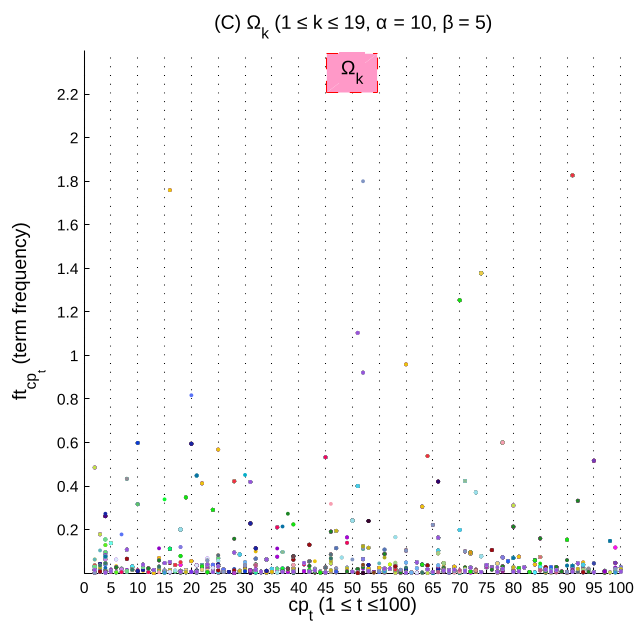 Figure 1: (A) Term frequency tracking, (B) Identifying change points, (C) Overlapping group assignment.
Phase 2: Refinement (The Semantic Deep-Dive)
Once the "rough" groups are established, the system applies a sophisticated tf-idf vector space model. It only computes similarities between terms within the same temporal window, effectively slashing the number of comparisons. A Sigmoid transfer function is then applied to the cosine similarity to smoothly delineate cluster boundaries.
Experimental Validation: Over 15x Faster
The researchers tested their framework on 173 sample terms extracted from an enormous corpus of 1.26 million news articles.
- Efficiency: The computational time dropped from 394.67 minutes (exhaustive) to just 25.61 minutes (proposed).
- Quality: Despite the speed, the F-measure reached 0.982, indicating that the temporal filter rarely missed actual semantic connections.
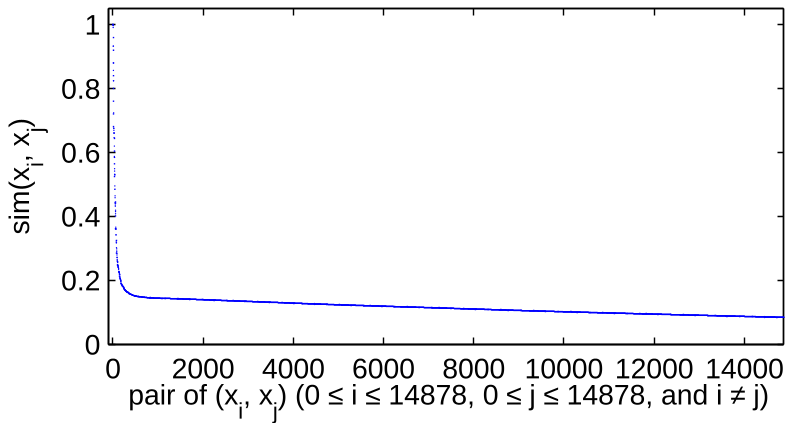 Figure 2: Distribution (A) shows similarity within rough clusters is concentrated and useful; Distribution (B) shows the "long-tail" of wasted computations in traditional methods.
Critical Insight & Future Outlook
This work highlights a profound "Temporal Inductive Bias": semantic relevance in highly dynamic environments (like news) is often preceded by temporal co-occurrence.
Limitations: The model relies on "bursty" events. For concepts that change slowly (e.g., "mathematics," "philosophy"), the event life cycle might be too flat to trigger the change point detector.
Conclusion: As we move toward 2026 and beyond, where real-time data streams from IoT and social media dominate, these "temporal-first" approaches will be essential for keeping our knowledge graphs and AI systems up-to-date without melting our servers.