
Efficient Crowdsourcing: Why "Winner-Take-All" is Socially Suboptimal
Efficient crowdsourcing contests
The paper introduces a socially optimal mechanism for crowdsourcing contests titled CSEC and PSEC. It shifts the objective from solely maximizing principal utility to maximizing global social welfare by optimally balancing production quality against producer effort costs.
TL;DR
In this seminal work, Cavallo and Jain challenge the status quo of "winner-take-all" crowdsourcing contests. They argue that to maximize total social welfare, we must balance the principal's value against the collective effort costs of producers. By introducing the CSEC and PSEC mechanisms, they provide a mathematical blueprint for incentivizing the "socially correct" amount of effort—often requiring payments to all participants, not just the winner.
Problem & Motivation: The Hidden Cost of Redundancy
Crowdsourcing is fundamentally a race against a deadline. Because production is uncertain, a principal often wants multiple agents working simultaneously. However, if 100 people work on a logo but only one is used, the cumulative effort of the other 99 is socially "wasted" unless the probability of a high-quality outcome justifies that cost.
Existing auction-based models focus on the Principal's Utility:
- How do I get the best logo for the lowest price?
This paper asks the Social Planner's Question:
- How many people should be working on this logo so that the increase in expected quality is greater than the total human effort expended?
Methodology: The "All-or-Nothing" Effort Intuition
The core of the methodology lies in determining the Efficient Effort Policy. The authors prove a vital "Extreme-Effort" Lemma. Under common distributions (like Uniform or Truncated Normal), it is rarely efficient for an agent to work "half-heartedly."
1. Determining (Optimal Participants)
For a constant skill scenario with uniformly distributed quality, the optimal number of participants follows a parabolic relationship with the principal's value .
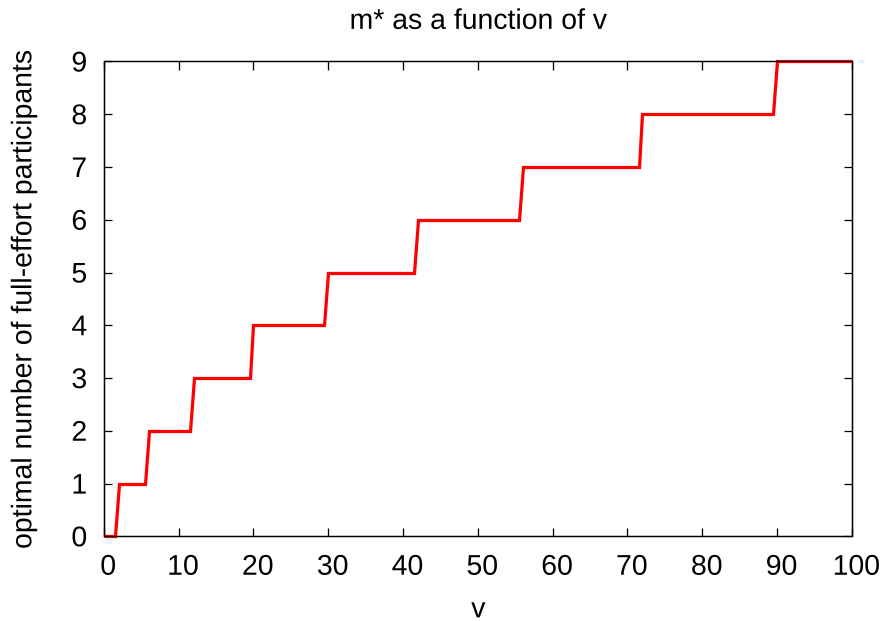 Figure 1: The relationship between the Principal's value (v) and the number of agents who should exert full effort.
2. The Incentive Mechanism (CSEC)
To make this work with selfish actors, the Constant Skill Efficient Crowdsourcing (CSEC) mechanism is proposed.
- The Principal reports their value and pays the total expected effort cost.
- The Agents are paid their effort cost plus a "marginal contribution" bonus.
- Crucially: Every agent who is asked to work gets paid, which is a radical departure from standard contests.
Experiments & Theoretical Results
The authors demonstrate the robustness of the "extreme-effort" policy using the Truncated Normal Distribution. They visualize how quality density shifts with effort:
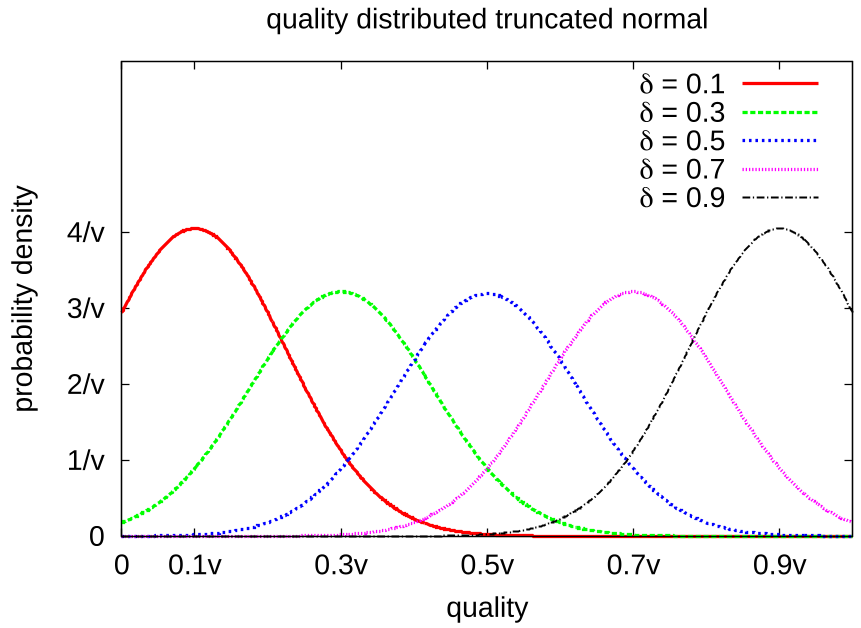 Figure 2: Probability densities over quality for varying degrees of effort (µ = δ_i v).
When skill levels are private (the PSEC mechanism), the problem enters the territory of the Myerson-Satterthwaite Impossibility Theorem. The authors elegantly navigate this by requiring ex ante commitment—producers must agree to the mechanism before they definitively know their specific skill for a given task. This allows the mechanism to remain budget-balanced and efficient in expectation.
Critical Analysis & Conclusion
The Takeaway
The "Winner-Take-All" model is efficient for the principal's pocketbook but often inefficient for society. If we treat crowdsourcing as a production system, we must pay for the effort we command.
Limitations
- Quality Observability: The mechanism assumes the principal or the system can objectively "value" the quality of submissions in dollar terms. In creative fields (like logo design), this is highly subjective.
- Risk Neutrality: The model assumes agents are risk-neutral. In reality, producers in crowdsourcing often exhibit risk-averse behavior, which might require higher premiums to ensure participation.
Ultimately, this work provides a rigorous foundation for the next generation of "fair" crowdsourcing platforms, proving that efficiency and self-interest can be aligned through sophisticated mechanism design.