
TCC-Aware Forwarding: Bridging the Gap Between Opportunistic and Ad Hoc Networks
Efficient Data Forwarding in Mobile Social Networks with Diverse Connectivity Characteristics
This paper introduces a TCC-aware data forwarding framework for Mobile Social Networks (MSNs) that combines opportunistic "carry-and-forward" with multi-hop MANET communications. By identifying and exploiting Transient Connected Components (TCCs), the authors propose two strategies (TCC and Enhanced TCC) that significantly improve delivery ratios while reducing network overhead compared to standard SOTA opportunistic protocols.
TL;DR
Most data forwarding in Mobile Social Networks (MSNs) treats the world as a series of isolated, lucky encounters. This paper proves that "Transient Connected Components" (TCCs)—short-lived clusters where nodes are multi-hop away—are everywhere. By making protocols "TCC-aware," we can boost delivery rates by up to 40% and cut redundant traffic by half.
The Problem: The Sparse Network Fallacy
In the world of Mobile Social Networks, human mobility is the backbone of data transport. Most research assumes these networks are highly sparse, forcing a "carry-and-forward" approach: you hold the data until you physically bump into someone with a better chance of reaching the destination.
However, the authors point out a massive blind spot: Transient Connected Components (TCCs). Imagine a classroom or a highway platoon. For a few minutes, nodes are close enough to form a mini-Ad Hoc network (MANET). Traditional protocols treat these as single, direct contacts, missing the chance to use multi-hop communications to find the best carrier within that entire cluster.
Methodology: High-IQ Forwarding with TCCs
The authors propose two layers of optimization:
1. Identifying the TCC
Nodes use local broadcasts to map their current TCC. Instead of just looking at the person in front of them, a node looks at the entire "neighborhood" reachable via multi-hop.
2. Enhanced Data Forwarding & Set Centrality
The "Standard" TCC strategy simply gives a copy of the data to the node with the highest centrality in the cluster. But what if two high-centrality nodes always hang out with the same people? That's redundant.
The Enhanced TCC strategy introduces Set Centrality. It calculates the probability that a set of nodes will reach the destination, accounting for overlapping contact patterns.
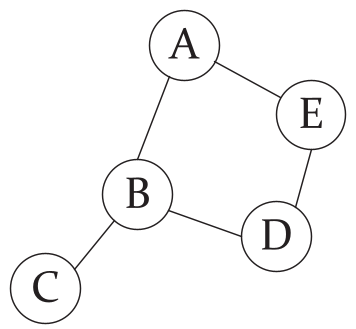 Figure 1: Comparison between (a) a physical TCC cluster and (b) the metrics used for forwarding decisions.
To find the best carriers, the authors formulate an optimization problem:
- Objective: Maximize the probability of contacting the destination.
- Constraint: Limit the number of copies (k).
- Solution: A dynamic programming approach similar to the Knapsack Problem.
Experiments: Real-World Evidence
The researchers didn't just simulate this in a vacuum; they used five real-world datasets, including the MIT Reality Mining and Infocom traces.
Performance Metrics
- Delivery Ratio: TCC-aware strategies crushed "Compare-and-Forward" by 10-40%.
- Overhead: Because the Enhanced strategy picks a diverse set of carriers, it creates significantly fewer "useless" copies, reducing overhead by up to 50%.
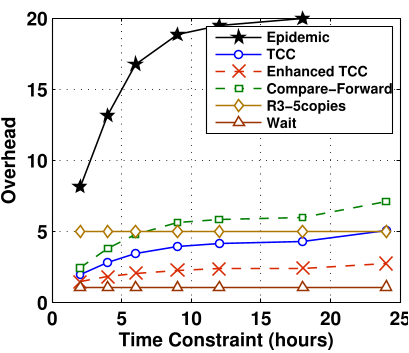 Figure 2: Delivery ratio comparison across different time constraints and traces.
Critical Insight: Why This Works
The brilliance of this paper lies in the realization that indirect contacts matter. Theorem 1 in the paper mathematically proves that TCC-contacts drastically increase contact opportunities. By treating a multi-hop path as an "instant" forward, the effective contact duration may be shorter, but the reach is much wider.
Conclusion & Takeaway
The paper shifts the MSN paradigm from "finding the right individual" to "finding the right component."
The Takeaway: If you're building systems for edge computing or disaster recovery where infrastructure is down, don't just wait for the next physical encounter. Scan the horizon for TCCs—your data's best path might be two or three hops away in the same room.
Limitations: The strategy relies on nodes being willing to broadcast and acknowledge, which consumes energy. In extremely adversarial or energy-constrained environments, the "broadcast overhead" of identifying the TCC must be balanced against the forwarding gains.