
PCS: Revolutionizing ATE Setup with Strategic Procorrelation
8730_Efficient and Economical Test Equipment Setup Using Procorrelation.
The Procorrelation System (PCS) is an automated software solution for ATE setup verification that replaces conventional Full-Wafer Probing (FWP). By using a partial-probing scheme and Least-Probed Good Die (LPGD) selection, it achieves 99.8% correlation quality while drastically reducing test time and wafer costs.
TL;DR
The Procorrelation System (PCS) is a sophisticated alternative to the wasteful practice of Full-Wafer Probing (FWP). By intelligently selecting "Least-Probed Good Dies" (LPGD) and integrating a pilot-wafer verification phase, PCS reduces probing effort by 98% while maintaining a staggering 99.8% correlation quality.
Background: The Cost of Perfect Correlation
In semiconductor manufacturing, Automatic Test Equipment (ATE) setup is a critical bottleneck. Before mass production, engineers must verify that the tester, probe card, and program are perfectly aligned. The "gold standard" has traditionally been FWP—probing every single die on a pre-verified wafer.
However, FWP is plagued by three major issues:
- Time/Cost: Huge wafers with tiny dies make full probing economically unfeasible.
- Physical Wear: Probing limits (usually 30-40 hits per die) mean correlation wafers are retired quickly.
- Data Blindness: FWP ignores historical data, probing "bad" dies repeatedly and wasting ATE cycles.
The Mathematical Intuition: Least-Probed Good Dies (LPGD)
The core innovation of PCS is moving from blind exhaustive probing to statistically balanced partial probing.
The system maintains a Recorded Correlation Wafer (RCW) database that tracks every die's history, coordinates, and PbCnt (Probing Count). To select the best dies for setup verification, PCS calculates a PbWgt (Probing Weight), which is the sum of probing counts for a specific touchdown group.
Architecture and Workflow
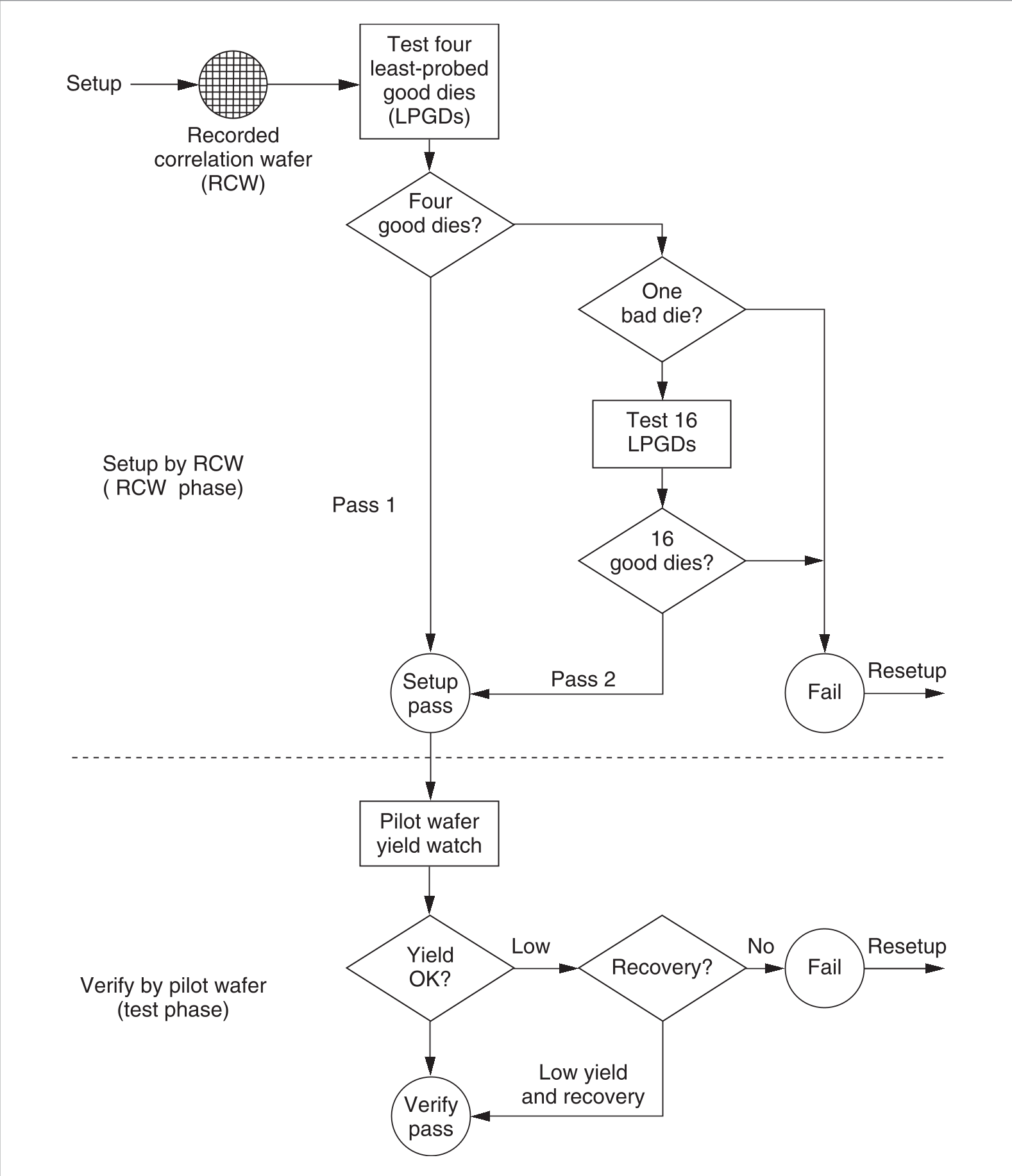
PCS employs a three-tiered verification logic:
- Phase 1 (Pass): Probes 4 LPGDs in a geographically balanced manner (one per quadrant). If all pass, the setup is verified.
- Phase 2 (Pending): If one fails, it probes 16 additional dies.
- Phase 3 (Pilot): The first wafer of the actual production lot acts as a final double-check.
Intelligent Die Selection and Maintenance
A major challenge in multi-die probing is maintaining topological balance. PCS divides the wafer into four quadrants and uses specific selection arrows to ensure uniform coverage. This prevents "over-probing" specific regions of the wafer, thereby extending the life of the RCW significantly.
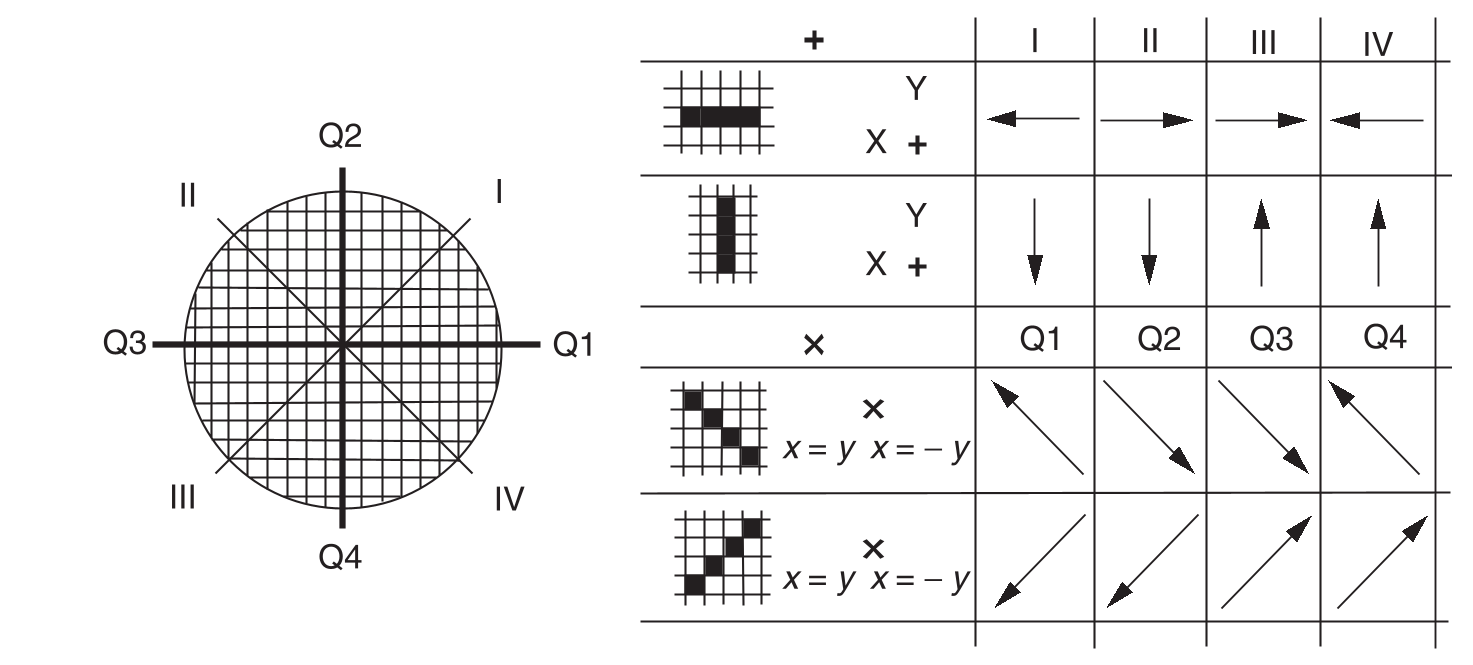
The weight-updating scheme is particularly elegant. Instead of recalculating the entire wafer map, PCS uses a local Weight-Updating Map. When a die is probed, only the overlapping potential probing touchdowns (maximum of dies) are updated in the database, ensuring the system remains responsive even as die counts scale into the thousands.
Experimental Results: Validated at TSMC
The system was deployed across four TSMC test sites, logging over 5,500 runs.
- Efficiency: Average probing count per successful run dropped to just 8.1 dies, a massive reduction from FWP which would require hundreds or thousands.
- Wafer Longevity: While FWP wafers typically retire after 30 runs, PCS-managed RCWs survived over 175 runs with negligible die degradation (less than 6.5% toggle rate).
- Accuracy: The combination of RCW phase and Pilot-wafer phase caught almost all setup errors, achieving a final precision of 99.8%.

Critical Insights & Future Outlook
PCS proves that metadata is as valuable as hardware. By treating the correlation wafer as a dynamic resource rather than a static tool, TSMC was able to slash overhead.
Limitations: The current implementation focuses on linear n-die probing (). As the industry moves toward massive parallelism with non-linear, 2D probing maps, the complexity of identifying the "optimal" LPGD touchdown will increase.
Future Work: The next frontier involves automating the diagnosis module further using AI to predict why a setup failed (e.g., distinguishing between probe card aging and software parameter shifts) based on the specific failure patterns of the LPGDs.
Conclusion
The Procorrelation System is a masterclass in engineering efficiency. It replaces "brute force" testing with a surgical, data-driven approach, setting a new standard for economical ATE setups in the deep-submicron era.