
EEUICD: Redefining Interest Community Discovery in the Dynamic Era of IoP
An Efficient Evolutionary User Interest Community Discovery Model in Dynamic Social Networks for Internet of People
The paper introduces EEUICD, an efficient evolutionary model for discovering user interest communities in dynamic social networks within the Internet of People (IoP) framework. It leverages a multi-objective genetic algorithm combined with a Label Propagation Algorithm (LPA) to optimize community quality and temporal stability.
TL;DR
Social networks in the Internet of People (IoP) are not static graphs; they are living, breathing entities where interests shift and topologies evolve by the second. The EEUICD model (Efficient Evolutionary User Interest Community Discovery) introduces a robust framework that combines the global search capability of Genetic Algorithms with the localized efficiency of Label Propagation to track these shifts with unprecedented accuracy and speed.
The Problem: The Static Trap
Most community detection algorithms assume a "frozen" network. However, in platforms like Twitter, the "ground truth" of a community is dictated by information flow—who is talking to whom right now—rather than just who followed whom three years ago.
Previous SOTA methods faced a binary dilemma:
- Incremental Methods: Fast but sacrifice quality by only adjusting previous results locally.
- Evolutionary Methods (like FacetNet): High quality but computationally expensive, often failing to scale to millions of nodes.
Methodology: The Hybrid Intelligence
The core of EEUICD lies in its "Preprocessing -> Optimization -> Evolution" pipeline.
1. Preprocessing with HITS and s-Step Similarity
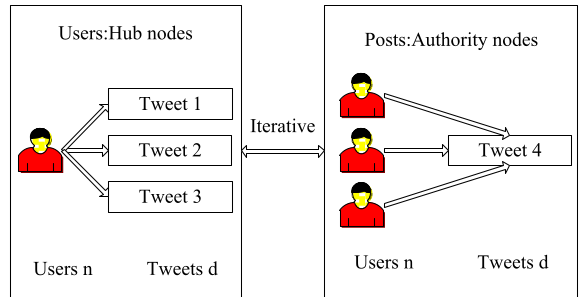
The authors realized that direct connections (adjacency matrices) are too sparse. They proposed an s-step similarity measure: By using an attenuation factor , the model captures the "influence shadow" of a user beyond their immediate friends. They then use the HITS algorithm to filter for "Hubs" (influencers) and "Authorities" (high-quality content), ensuring the algorithm ignores the noise of bot accounts and low-quality posts.
2. Multi-Objective Optimization
The model treats community discovery as a balancing act between two competing goals:
- Snapshot Quality (SC): Maximizing modularity () within the current timeframe.
- Temporal Cost (TC): Ensuring the community doesn't change so drastically from the previous step that it loses its identity (measured via F-measure).
3. LPA-Enhanced Mutation
In traditional Genetic Algorithms, mutation is random. EEUICD replaces this with a Label Propagation-based Mutation. Instead of flipping bits randomly, it uses the neighbors' labels to guide the "mutation," drastically speeding up the time it takes for the population to reach an optimal state.
Experimental Battleground
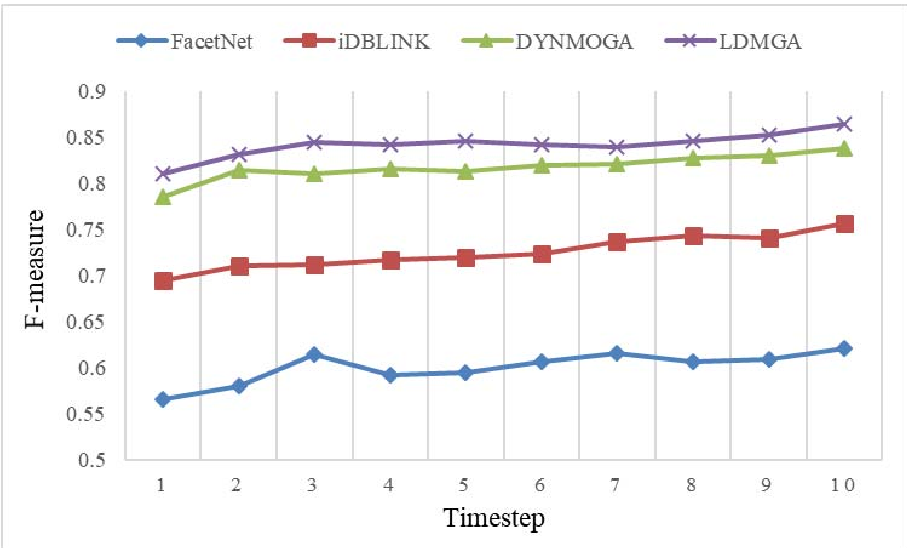
Testing on a massive Twitter dataset (July 2018), the authors pitted EEUICD against FacetNet, iDBLINK, and DYNMOGA.
Performance Metrics
- Precision & Recall: EEUICD maintained a lead in both, suggesting it doesn't just find large clusters, but correct ones.
- F-measure Consistency: Across diverse interests (Sports, Economy, Tech), the model consistently scored above 0.82, whereas earlier models like FacetNet struggled at 0.60.
Critical Insight: Why it Works
The "secret sauce" is the initialization. By using LPA to seed the initial population of the Genetic Algorithm, the search starts near a local optimum rather than in a random wilderness. This hybrid approach circumvents the execution time issues that previously made DYNMOGA impractical for real-world IoP applications.
Future Outlook
While EEUICD is a massive step forward for social networks, its reliance on a central adjacency matrix still poses a challenge for truly decentralized IoP environments. Future iterations could explore Distributed Genetic Algorithms to enable community discovery directly on edge devices (smartphones), ensuring privacy while maintaining the intelligence provided by this model.
Conclusion
EEUICD successfully bridges the gap between global optimization and local efficiency. For those building recommendation engines or public opinion monitors, this model offers a blueprint for handling the inherent "chaos" of dynamic human interactions.