
Establishing Efficient Governance: The Leap to Data-Driven e-Government
Establishing Efficient Governance through Data-Driven e-Government
This paper proposes a <strong>Data-Driven e-Government</strong> model that integrates Big Data, Machine Learning (ML), and AI into public administration. The core method focuses on closing the loop between data storage and decision-making to transform traditional digital services into proactive, citizen-centric ecosystems.
TL;DR
Data is the "new oil" of the 21st century, but most governments are still treating it like waste. This paper argues for a paradigm shift from simple e-government (digital forms) to Data-Driven e-Government. By leveraging Big Data, AI, and Machine Learning, governments can move from reactive administration to proactive, citizen-centric governance that saves billions and optimizes public safety.
Context: Beyond Digital Paperwork
The information age has evolved. We are no longer in an era where merely having a website suffices for a government. The authors position this work at the intersection of Decision Support Systems and Public Administration, suggesting that the next phase of modernization isn't just about "going digital"—it's about "going intelligent."
The Critical Bottlenecks
Why hasn't this happened yet? The paper identifies three structural "pain points":
- Structural Rigidity: Governmental and political structures are inherently complex and resistant to the rapid iterations required by AI and Big Data.
- Privacy vs. Utility: The delicate balance between utilizing granular data for social welfare and protecting the fundamental right to privacy.
- Fragmented Data: Information is often "trapped" in departmental silos, preventing the cross-functional insights needed for smart cities.
Methodology: The Four-Step Intelligence Loop
The authors propose a closed-loop system designed to turn raw administrative data into actionable national policy.
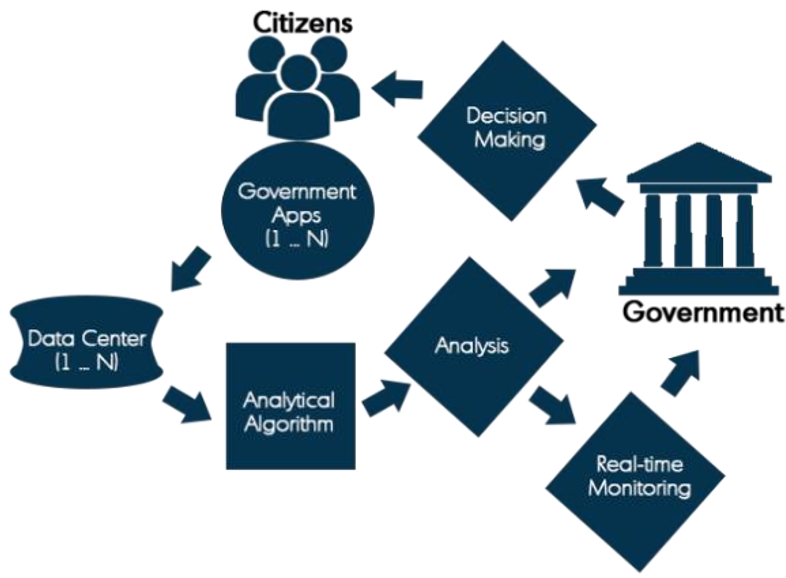
The model consists of four integrated pillars:
- Data Input & Storage: Aggregating e-services and open data platforms.
- Evaluation (Analytics): Applying Machine Learning to identify correlations, risks, and opportunities that are invisible to human administrators.
- Information Retrieval: Ensuring insights are accessible to the right departments at the right time.
- Decision Making: Moving toward evidence-based policy where simulation and data predict the outcomes of tax changes or urban planning.
Impact: The "Efficiency Dividend"
The potential scale of this transformation is massive. By analyzing operational efficiencies, the paper cites that European administrations alone could save over €100 billion.
Beyond the finances, the "Value-First" prospects include:
- Smart Safety: Using tourist and immigration data to analyze and evaluate potential security threats.
- Public Health: Real-time access to medical history via biometric data for emergency responders.
- Economic Agility: Predicting the impact of tax policy changes before they are implemented.
- Anti-Corruption: Using land registry data and automated tracking to prevent the fraudulent reselling of property.
Critical Insight & Conclusion
The true value of this paper lies in its definition of Digital Maturity. A government is only truly "e-mature" when its data flows back to the citizens as solutions, not just records.
Limitations: While the paper provides a robust high-level framework, the "how" of overcoming political resistance and technical inter-operability remains a secondary discussion. Future implementations must focus on the Ethics of AI in Governance to ensure that data-driven decisions do not inherit or amplify systemic biases.
Final Takeaway: To build a smart city, you must first build a smart government. Transitioning to a data-driven model is no longer an option—it is a fiscal and social necessity.