
Ejen-RRS: Solving the Scalability Bottleneck in Social Influence Maximization
An Algorithm based on Efficient Influence Maximization applied to Social Network
The paper introduces Ejen-RRS, an efficient Influence Maximization (IM) algorithm that combines graph partitioning, quota allocation, and deterministic edge valuation. It achieves SOTA-level scalability by optimizing Reverse Reachable Sampling (RRS) and the Maximum Influence Arborescence (MIA) model.
TL;DR
The Influence Maximization (IM) problem—identifying nodes to trigger the largest "word-of-mouth" effect—has long been plagued by high computational costs and probabilistic uncertainty. Ejen-RRS breaks this deadlock by partitioning massive networks into manageable communities and replacing random simulations with deterministic "alpha" values. This approach allows for near-optimal seed selection even in graphs with millions of nodes.
Background & Motivation: Why Current Algorithms Fail
Since Kempe et al. proved that IM is NP-hard in 2003, researchers have chased the (1 – 1/e – ε) approximation guarantee. However, traditional Monte-Carlo Greedy methods are prohibitively slow. While Reverse Reachable Sampling (RRS) and TIM improved speed, they still suffer from:
- The EPT Curse: Traversal width in large social networks can explode, consuming massive memory.
- Uncertainty: Relying on random samples leads to high variance in influence estimates.
- Redundancy: Densely connected cliques result in correlated RR sets, wasting computation.
Methodology: The Ejen-RRS Framework
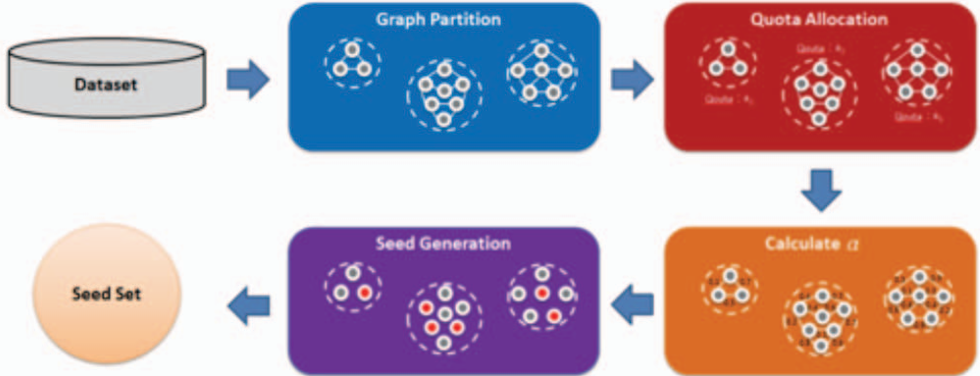
Ejen-RRS introduces a systematic four-phase pipeline to transition from global random sampling to localized deterministic selection.
1. Graph Partitioning (The Divide & Conquer Strategy)
Instead of performing a Breadth-First Search (BFS) on the entire graph G, Ejen-RRS uses structural similarity clustering. This restricts the "Expected Propagation Time" (EPT) to smaller sub-graphs (), significantly reducing the complexity.
2. Quota Allocation
The algorithm doesn't treat all communities equally. It uses a Size-Aware Quota Allocation mechanism. Larger clusters receive a higher budget of seeds because they represent more significant potential for innovation adoption.
3. Alpha Calculation (Removing Probability)
Drawing inspiration from the Maximum Influence Arborescence (MIA) model, the authors assign a deterministic value to edges. This eliminates the need to "flip coins" during the simulation, transforming a stochastic problem into a more stable coverage problem.
Experiments and Results
The authors tested Ejen-RRS across three diverse datasets: Email-Eu-core, Epinions, and Youtube.
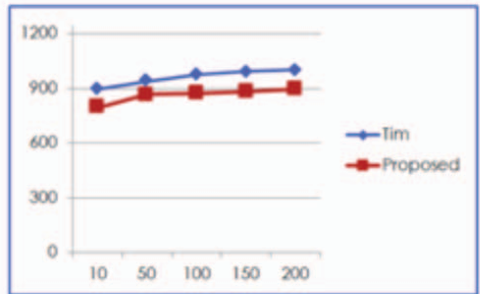
The results confirm two major victories for Ejen-RRS:
- Scalability: On the Youtube dataset (over 1 million nodes), Ejen-RRS maintains stable execution times where previous algorithms often bottleneck due to memory exhaustion.
- Precision: By avoiding the uncertainty of random sub-graphs, the influence spread achieved is more consistent and competitive with the theoretical upper bounds of TIM.
Critical Insights: Is Partitioning the Future?
The core contribution of Ejen-RRS is the realization that localized influence is a proxy for global influence. In real-world social networks, clusters are often self-contained. By optimizing within these partitions, we ignore long-range, low-probability paths that usually contribute "noise" rather than actual reach.
Limitations & Future Work
While Ejen-RRS is highly efficient, it currently relies on a static view of the network. Future research needs to address Dynamic Social Networks, where edges vanish or appear in real-time. Additionally, moving this framework into a distributed environment would allow it to handle graphs with hundreds of millions of users, like Facebook or X (Twitter).
Takeaway
Ejen-RRS demonstrates that by combining community structures with deterministic heuristics, we can finally apply complex influence models to industrial-scale social graphs without sacrificing accuracy.