
Efficient Influence Maximization: Bridging Mathematical Optimization and Social Dynamics
An efficient linear programming based method for the influence maximization problem in social networks
This paper introduces an efficient linear programming (LP) relaxation and pipage rounding method for the Influence Maximization Problem (IMP) under the Independent Cascade model. By combining Sample Average Approximation (SAA) with a novel binary integer programming formulation, the author achieves a provable approximation bound of , which asymptotically converges to the state-of-the-art guarantee.
TL;DR
Determining the most influential nodes in a social network—the Influence Maximization Problem (IMP)—is notoriously difficult. This paper presents a breakthrough by reformulating IMP into a linear programming-friendly structure. By applying Pipage Rounding to a Sample Average Approximation (SAA) model, the author provides a method that is not only mathematically rigorous with a asymptotic bound but also computationally faster and more accurate than traditional greedy heuristics in many real-world settings.
Problem & Motivation: The Stochastic Bottleneck
Why is IMP so hard? To find the optimal "seed" nodes, you must account for the "Independent Cascade" (IC) model, where influence spreads like a virus. The objective function is #P-hard to compute exactly because it involves an exponential number of possible "realizations" (scenarios) of the network.
Most researchers rely on Greedy algorithms. While Greedy works, it is essentially a "hill-climbing" approach that can be slow and doesn't always handle complex constraints well. The author’s insight was to treat this as a Stochastic Maximum k-Coverage Problem, allowing us to use the heavy machinery of Linear Programming (LP).
Methodology: The Power of Pipage Rounding
The paper introduces the Influence Maximization Binary Integer Program (IMBIP). The key steps are:
- Sampling: Use Monte Carlo sampling to create a set of fixed scenarios (SAA), transforming a stochastic problem into a deterministic one.
- LP Relaxation: Solve the "relaxed" version where seed variables can be fractions between 0 and 1.
- Pipage Method: Often, the LP results in fractional nodes. The Pipage method uses the mathematical property that the objective function is convex along certain directions. By shifting "mass" between two fractional variables, we can round them to 0 or 1 without losing objective value quality.
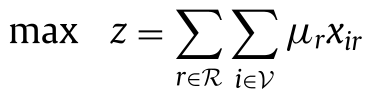 The IMBIP objective function aims to maximize the expected number of activated nodes across sampled scenarios.
Experiments: SOTA Results
The author tested the method against heavyweights like CELF (a fast greedy variant) and IMM (a martingale-based approach).
Key Findings:
- Accuracy: In the HEP arXiv dataset, the Pipage method had an average optimality gap of only 0.13% compared to the exact (but slow) IP solution.
- Scalability: The new formulation is significantly leaner, allowing it to handle networks with 50,000+ arcs easily—double the capacity of previous integer programming attempts.
- Efficiency: As the seed set size grows, the SAA-based LP approach becomes much more efficient than the Greedy method, which struggles with the combinatorial growth of .
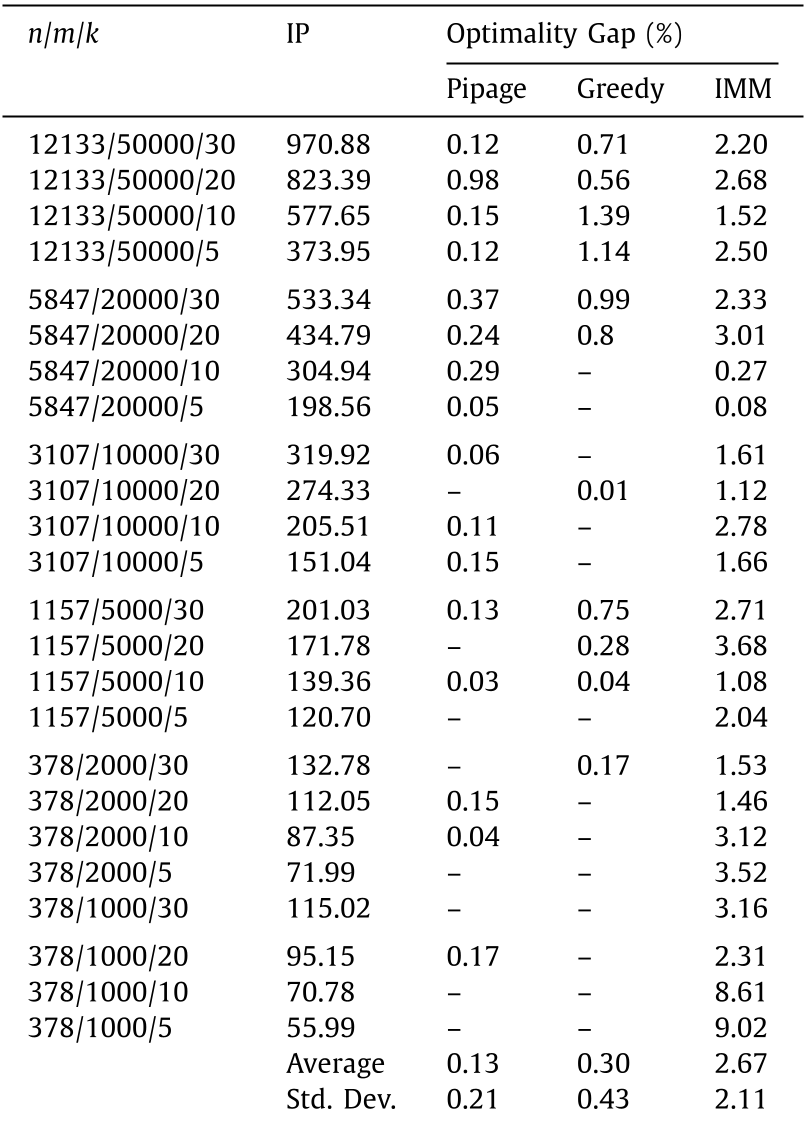 Comparison of the optimality gap: Pipage consistently yields better or equal results to Greedy and IMM in most scenarios.
Critical Analysis & Conclusion
The beauty of this work lies in its "Optimality-First" philosophy. While the industry has rushed toward move-fast-and-break-things heuristics, this paper proves that classical optimization techniques (LP and Rounding) are still highly relevant.
Limitations: The memory requirement remains , where is the number of samples. For networks with millions of nodes, the "predecessor sets" required for the LP constraints might become too large for standard RAM.
Future Outlook: The success of LP relaxation here suggests that even faster solvers, like Lagrangean relaxation or column generation, could potentially push these "optimal-seeking" methods into the territory of massive-scale social graphs (millions of nodes), traditionally the sole domain of heuristics.