
Efficient MSNs: Bridging Social Interests and Physical Proximity in MANETs
An Efficient Mobile Social Network for Enhancing Contents Sharing over Mobile Ad-hoc Networks
The paper proposes an efficient mobile social network (MSN) architecture designed for content sharing over Mobile Ad-Hoc Networks (MANETs). By integrating user interest keywords, location histories, and real-time proximity, the system constructs a decentralized P2P social layer that achieves superior search efficiency and lower management overhead compared to traditional flooding or index-based methods.
TL;DR
In the realm of Mobile Ad-Hoc Networks (MANETs), content sharing has long struggled with the trade-off between massive message flooding and the overhead of centralized indexing. This paper introduces an Efficient Mobile Social Network that optimizes content discovery by building "friendships" based on a multi-dimensional similarity metric: common interests, location history, and current physical proximity. The result is a self-organizing P2P network that reduces management costs while maintaining high search success rates.
The "Disconnected" Social Problem
Most social networks we use today (Facebook, Twitter) are inherently centralized. In a MANET—where devices communicate directly via Wi-Fi or Bluetooth—the challenge is constructing a social layer without a server.
Previous attempts fell into two traps:
- The Flooding Trap: Blindly broadcasting requests to every node, which kills battery life and clogs bandwidth.
- The Physical-Social Mismatch: Establishing social links between nodes that are "socially" similar but "physically" far apart, making the actual multi-hop data transfer nearly impossible in a dynamic mobile environment.
Methodology: The Architecture of Proximity
The authors propose a Dual-Layer Architecture. The top layer is a virtual social graph where edges represent high similarity, while the bottom layer is the actual physical routing of the MANET.
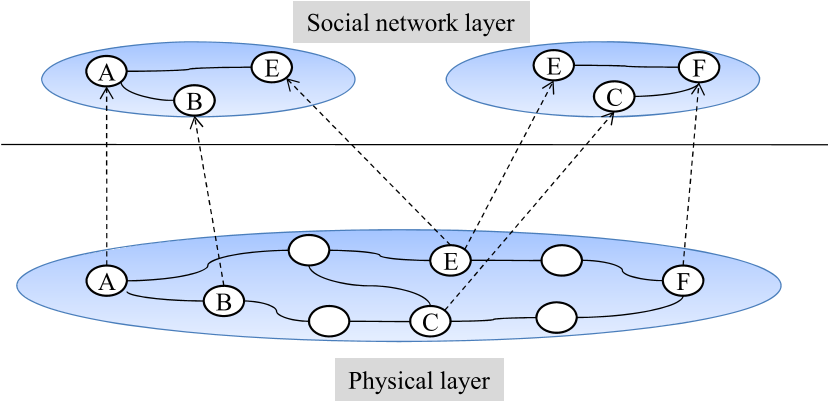
1. Calculating User Similarity ()
The core innovation lies in how similarity is measured. It isn't just about what you like; it’s about where you’ve been.
- Keyword Similarity (): Uses weighted matching of interest tags.
- Location History Similarity (): Models history as "Stay Regions" (circles where a user spends significant time). Similarity is the weighted sum of the overlap areas of these regions.
2. The Probability of Friendship ()
To ensure the social network is actually functional for data transfer, the system calculates a friendship probability that combines the social with the inverse of the current physical distance. This ensures that you are most likely to link with someone who shares your interests and is currently within reach.
3. Top- Maintenance
To prevent a management overhead explosion, each node only maintains links to its top- most similar and proximal friends. This "dynamic pruning" allows the network to stay lean even as the total number of users grows.
Experimental Results & Insights
The researchers compared their approach against Flooding-based and Mobility-assisted (Index) methods.
Reducing the Management Tax
As shown in the charts, the management overhead of the proposed method remains significantly lower than index-based methods. This is because index nodes in prior works had to track every node's interests, whereas here, management is localized and distributed.
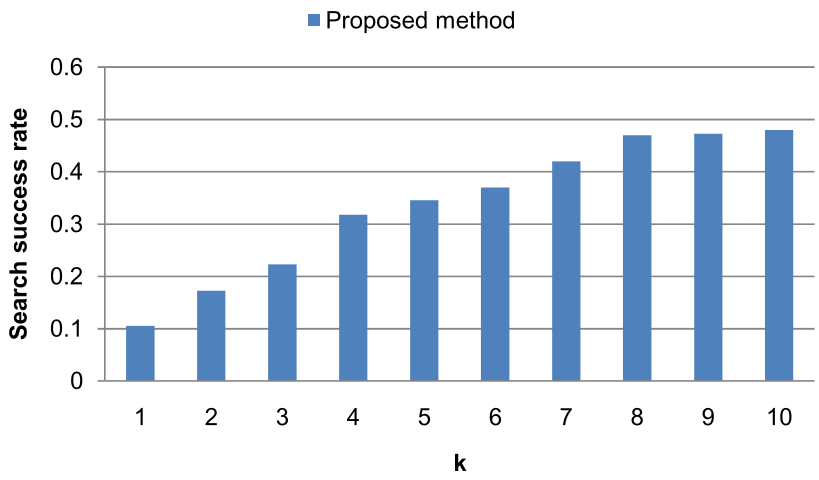
Success Rate vs. Connectivity ()
The parameter (the number of friends) is the "efficiency knob." Increasing improves the search success rate because nodes have more localized knowledge of the network. However, the study identifies a "sweet spot" where further increasing provides diminishing returns, allowing for optimal resource allocation.
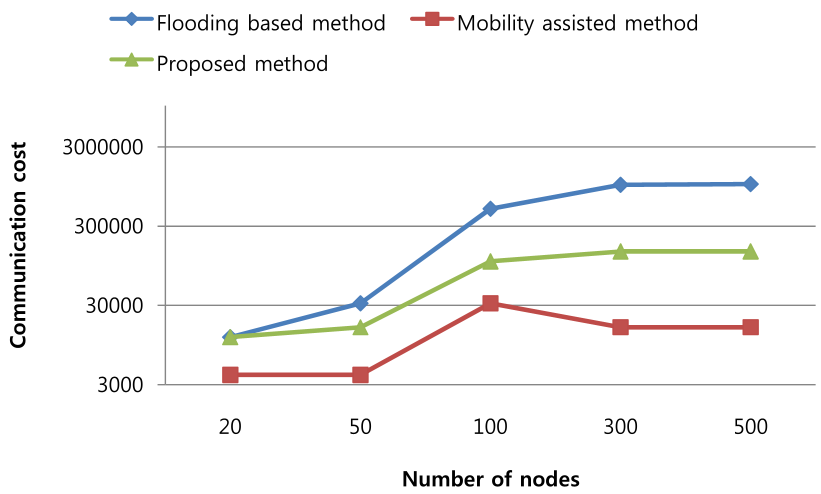
Communication Cost
The flooding-based method exhibits exponential growth in communication cost (messages sent) as nodes increase. The proposed MSN maintains a much flatter curve, proving its scalability for dense urban environments or large-scale conferences.
Critical Perspective & Conclusion
This paper successfully argues that location is a semantic proxy for interest. By pruning social connections that are physically impossible to maintain, the authors solve the "empty friend request" problem in MANETs.
Limitations: The model assumes users are willing to share location histories, which raises significant privacy concerns. Future iterations would likely need to incorporate Differential Privacy or Encrypted Matching to be viable in real-world consumer apps.
Final Takeaway: For the future of Decentralized Web (Web3) and Edge Computing, this paper provides a robust blueprint for how we can connect people based on "Social-Physical Dualism"—linking the digital world of interests with the physical reality of our movements.