
ODLF-PDP: Accelerating Social IoT Learning via Strategic Privacy and Topology Optimization
Efficient Online Decentralized Learning Framework for Social Internet of Things
The paper introduces ODLF-PDP, an Online Decentralized Learning framework tailored for Social IoT (SIoT). It combines a novel topology construction algorithm, BeTTa, with Partially Differential Privacy (PDP) to optimize training speed and data privacy in heterogeneous networks.
TL;DR
Online Decentralized Learning (ODL) in the Social Internet of Things (SIoT) faces a balancing act: respecting social trust while maintaining high-speed communication. ODLF-PDP breaks this deadlock. By introducing Partially Differential Privacy (PDP), it allows "untrusted" devices to collaborate safely, and uses the BeTTa algorithm to construct communication topologies that minimize physical bottlenecks. The result? A 20%+ reduction in training time with no sacrifice in privacy.
Problem & Motivation: The Social Trust Bottleneck
In the Social IoT paradigm, devices aren't just hardware; they have "relationships" (e.g., same owner, same manufacturer). Traditional decentralized learning assumes any node can talk to any node, but in the real world:
- Social Restrictions: Nodes often refuse to share raw model updates with "strangers" to prevent model inversion attacks.
- Physical Heterogeneity: Communication speeds (Wi-Fi vs. LoRa) and computing power vary wildly, creating significant straggler problems.
- Connectivity Paradox: Restricting communication to only "trusted" social neighbors often leads to sparse graphs with poor "spectral gaps," which drastically slows down mathematical convergence.
The authors' insight is counter-intuitive: Add noise to add speed. By using Differential Privacy (DP) on specific links, we can connect "untrusted" nodes, improving the network's global connectivity and speeding up the entire system.
Methodology: PDP and the BeTTa Algorithm
The framework consists of two core components:
1. Partially Differential Privacy (PDP)
Unlike traditional DP-based learning where every node adds noise, ODLF-PDP only requires noise injection when two nodes lack a social trust bond. This "partial" approach minimizes the accuracy loss associated with DP while maximizing the potential to add high-speed links to the communication graph.
2. The BeTTa Algorithm
The Batch-Size-Adaptive Time-efficient Topology Construction Algorithm (BeTTa) is the "architect" of the network. It optimizes for "Pseudo Training Time," a product of:
- Hitting Time (): A proxy for how fast information spreads globally.
- Local Iterate (): The bottleneck caused by the slowest physical link (communication + computation).
- Privacy Overhead: The cost of adding noise.
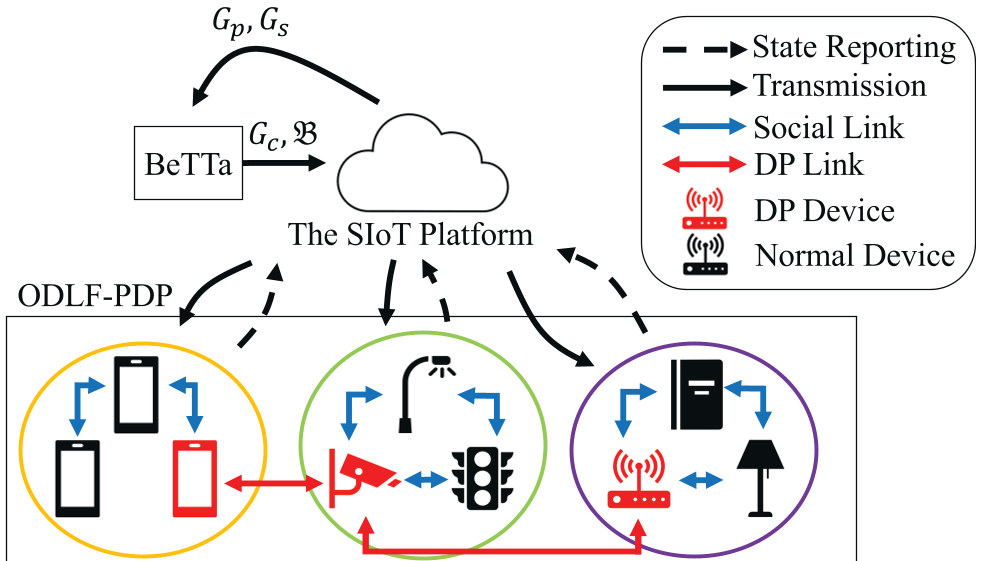 Figure: The ODLF-PDP framework, showing the interaction between the SIoT Platform (Topology building) and the decentralized training nodes.
BeTTa also performs a Mini-batch-size Expanding Step (MEP). Since the round time is governed by the slowest node, faster nodes can afford to process larger mini-batches in the same window, effectively increasing the "average mini-batch size" without delaying the network.
Experiments & Results
The authors tested the framework using the MNIST dataset mapped onto a real-world SIoT node distribution from Santander, Spain.
Convergence and Accuracy
ODLF-PDP consistently outperformed DAMBD (which lacks PDP) and PDOO (which applies DP globally). Even when the number of nodes doubled from 16 to 32, the framework maintained superior convergence rates.
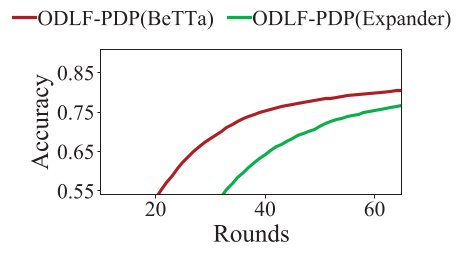 Figure: Convergence performance across different device counts. ODLF-PDP (red line) consistently reaches higher accuracy faster.
Physical Training Time Savings
The most impressive result is the "Physical Training Time." By optimizing the topology to avoid LoRa bottlenecks and utilizing Wi-Fi where possible (even if untrusted, via PDP), ODLF-PDP reached target accuracies significantly faster.
| Target Accuracy | ODLF-PDP (16 nodes) | DAMBD (16 nodes) | Speedup vs DAMBD |
|---|---|---|---|
| 75% | 1250.1s | 1582.7s | ~21% |
| 80% | 2138.1s | 2971.6s | ~28% |
Critical Analysis & Conclusion
Takeaway
ODLF-PDP effectively proves that in decentralized systems, topology is destiny. By treating privacy as a tunable parameter rather than a binary constraint, the researchers unlocked the ability to bridge "social islands," leading to a more robust and faster learning network.
Limitations
- Convergence Proofs: While the paper notes the regret bound is , the noise introduced by PDP does inherently limit the final achievable accuracy compared to a fully trusted, fully connected network.
- Static vs. Mobile: The current evaluation focuses on static SIoT devices. In a mobile environment, the BeTTa algorithm would need to run much more frequently, potentially creating its own computational overhead.
Future Work
The next frontier for this research is likely Energy Efficiency. In IoT, "time-saved" is often synonymous with "battery-saved." Integrating energy-aware link selection into the BeTTa algorithm could make ODLF-PDP the gold standard for battery-constrained edge AI.