
PromSky: Elevating Potential Stars in Social Networks via Skyline Optimization
An Efficient Potential Member Promotion Algorithm in Social Networks via Skyline
The paper introduces PromSky, an efficient algorithm for potential member promotion in social networks using Skyline queries. By incorporating a new Reputation Level attribute derived from graph eigenvectors and utilizing a Sort-Projection mechanism, it identifies non-skyline members who can become "stars" with minimal edge-addition costs.
TL;DR
Predicting the future "stars" of a social network isn't just about who has the most followers today. PromSky is a new algorithmic framework that uses Skyline queries and Eigenvector-based reputation to identify which ordinary members are one or two strategic connections away from becoming top-tier "Skyline" nodes. It achieves a 65% prediction accuracy while remaining computationally efficient even on million-node networks.
The "Star" Discovery Problem
In social network analysis, a Skyline member is an individual who is not dominated by any other member across all chosen metrics (e.g., in-degree, out-degree, and prestige). While identifying current stars is easy, the real value lies in Promotion Analysis: Finding "potential stars" who can reach the Skyline set by adding a minimum number of new edges (connections).
Prior work often failed because:
- Oversimplified Metrics: Relying solely on raw counts like in-degree ignores who is following you.
- Search Explosion: The number of possible edges to add is astronomical, making brute-force verification impossible for large graphs.
Methodology: Reputation and Geometry
1. Beyond Degrees: Reputation Level
The authors argue that a member’s importance depends on the reputation of their followers—an "infinite regress" solved by calculating the eigenvector of a normalized social relationship matrix. This ensures that a node followed by a few "prestigious" members might outrank a node followed by many "ordinary" ones.
2. Pruning via Sort-Projection
To avoid checking every possible connection, the paper introduces Skyline Distance. By projecting candidates into a 2D Cartesian space (In-degree vs. Out-degree), the algorithm identifies Local Optimal Points.
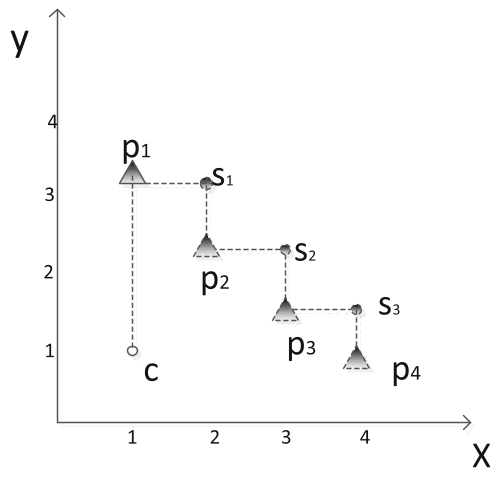
Fig 1: The geometric interpretation of the Skyline Boundary and Local Optimal Points.
The Sort-Projection algorithm calculates the minimum path (cost) required to move a candidate node past the boundary of currently dominating points. If a promotion plan cannot reach this geometric "GoodPosition," it is pruned immediately.
Experiments and Performance
The researchers tested PromSky on the DBLP dataset (academic collaboration network) from 1992 to 2016. They looked at "potential stars" in one year and checked if they actually became Skyline members in subsequent years.
Accuracy Gains
By adding the Reputation Level, the success rate of predictions jumped from 48% (previous SOTA) to 65%.
Efficiency at Scale
One of the most impressive results is the algorithm's scalability. While the traditional SkyBoundary algorithm's processing time spikes as the network grows, PromSky stays remarkably flat.
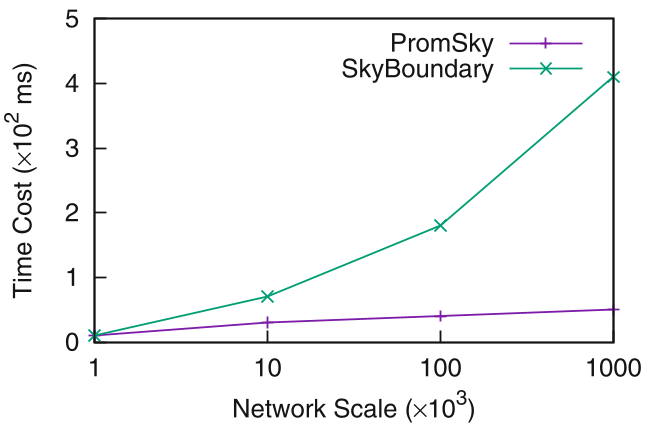
Fig 2: Processing time comparison showing PromSky's superior scalability vs. SkyBoundary.
This efficiency is attributed to two main factors:
- Infra-Skyline Focus: Only candidates in the "first layer" of non-skyline points are considered.
- Dominance-based Pruning: Avoiding redundant verification of plans that are mathematically guaranteed to fail based on existing node relationships.
Critical Insight
The brilliance of PromSky lies in treating social network growth as a geometric optimization problem. By combining the "soft" metric of reputation (eigenvectors) with the "hard" metric of Skyline boundaries, the authors provide a toolkit that is both sociologically sound and computationally lean.
Limitations: The current model assumes edge addition costs are linear and relatively static. In real-world enterprise social networks, the "cost" of a connection (e.g., getting a CEO to follow a junior dev) might be non-linear or highly context-dependent.
Conclusion
PromSky moves social network analysis from passive observation to active prediction. For platforms looking to recommend "rising stars" or for marketers looking to seed influencers, this eigenvector-skyline hybrid offers a robust, scalable blueprint for the future.