
Ensemble Intelligence: Elevating Regional Load Forecasting in Smart Grids
An Efficient Regional Short-Term Load Forecasting Model for Smart Grid Energy Management
The paper introduces a parallel ensemble machine learning model for regional Short-Term Load Forecasting (STLF) in Smart Grids. By combining Support Vector Regressor (SVR) and Random Forest (RF) through a simple averaging mechanism, it achieves state-of-the-art accuracy in predicting hourly energy demand for specific Indian regions.
TL;DR
As smart grids integrate more renewable energy and complex metering, accurate Short-Term Load Forecasting (STLF) has become critical for grid stability. This paper proposes a parallel ensemble model combining Support Vector Regressor (SVR) and Random Forest (RF). By averaging their outputs, the model achieves a high-precision MAPE of 1.18%, outperforming individual ML techniques and several complex hybrid models.
The Motivation: Moving Beyond Linear Models
Modern energy grids are no longer predictable systems. Regional load patterns are influenced by a chaotic mix of economic activities, climate shifts, and consumer behavior.
- The Problem with Linear Models: Statistical methods like ARIMA fail to capture the "spiky" and non-linear nature of consumption.
- The Limits of Single ML Models: SVR is powerful but can be brittle with outlier data; Random Forest is stable but sometimes lacks the fine-grained mapping capability of kernel-based methods.
The authors' insight is simple yet profound: Diversity leads to stability. By running SVR and RF in parallel, the errors of one are frequently canceled out by the strengths of the other.
Methodology: Parallel Hybrid Architecture
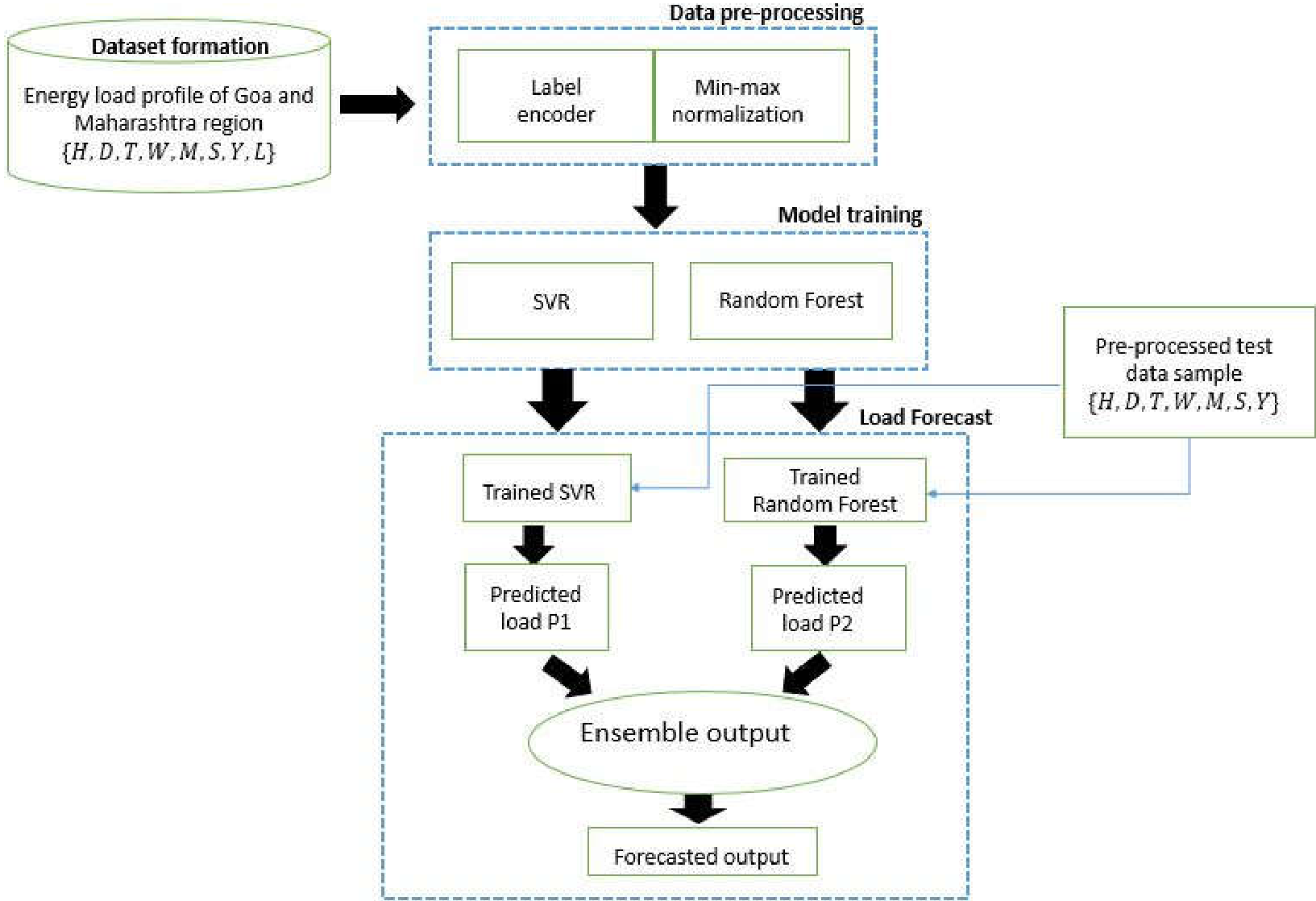
The proposed system follows a streamlined pipeline: Dataset Formation Pre-processing Parallel Training Ensemble Forecasting.
1. Feature Engineering
The model uses a multi-dimensional input vector including:
- Temporal factors: Hour (H), Day (D), Weekday (T), Year (Y).
- Seasonal factors: Month (M), Season (S).
- Behavioral factors: Working days vs. Weekends.
2. The Power of Two
The architecture employs two heavy hitters in supervised learning:
- Random Forest (RF): An ensemble of decision trees that prevents overfitting through random subspace selection.
- Support Vector Regressor (SVR): Uses a Radial Basis Function (RBF) kernel to map data into high-dimensional space, finding the optimal hyperplane for regression.
Empirical Evidence: Why It Works
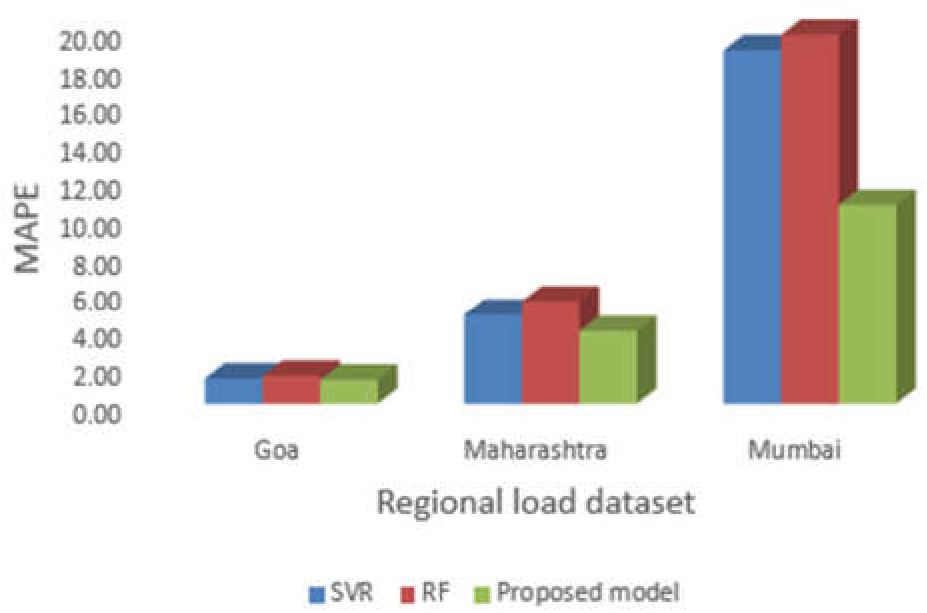
The model was tested using hourly data from 2016-2019 for the states of Goa and Maharashtra, India.
Performance Metrics
The results show a clear trend: the hybrid ensemble consistently yields lower RMSE (Root Mean Square Error) and MAPE (Mean Absolute Percentage Error) than its constituent parts.
SOTA Comparison
When compared to other benchmarks in the literature (e.g., ANN, RF+LSTM, or SVR+Firefly Algorithm), the proposed SVR+RF ensemble holds a competitive edge, particularly in the Goa dataset where it reached a MAPE of 1.18%.
| Model (Author/Year) | Dataset | MAPE (%) |
|---|---|---|
| ANN (Ning et al., 2019) | China | 1.74 |
| RF+LSTM (Moon et al., 2018) | Korea | 2.94 |
| Proposed SVR+RF | Goa (India) | 1.18 |
Critical Analysis & Conclusion
The value of this research lies in its computational efficiency and robustness. By using parallel execution, the training time remains low compared to deep learning models (like LSTMs), making it feasible for real-time edge deployment in smart grid controllers.
Future Perspectives
While the model captures temporal and seasonal trends excellently, its next evolution should include:
- Exogenous Weather Variables: Humidity and temperature data are high-impact variables not fully explored here.
- Explainability: Understanding why the load spiked (e.g., a specific festival or thermal wave) would add another layer of utility for grid operators.
Takeaway: In the race for complexity, sometimes a well-tuned ensemble of "classic" machine learning models remains the most reliable solution for mission-critical infrastructure like the Smart Grid.