
Efficient Social Search: Approximating the "Wisdom of Friends" via SampleDyn
Efficient sampling of information in social networks
The paper introduces "SampleDyn," a sampling-based framework designed to efficiently estimate information aggregates and item rankings within a user's local neighborhood in a social network. By utilizing biased random walks and a rejection sampling mechanism, the authors achieve high-accuracy social search results without the need for exhaustive graph crawls.
TL;DR
Collecting data from a user's entire social circle to personalize search is too slow for real-time applications. This paper proposes a sampling framework that uses "smart" random walks to estimate what your friends (and friends-of-friends) are clicking on, providing accurate rankings without visiting every node in the network.
The Problem: The "Explosion" of the Social Vicinity
Social search aims to re-rank search results based on the endorsements (clicks, likes, ratings) of a user’s social neighborhood. However, even at a depth of 3 or 4 hops, the number of nodes in a social graph can reach tens of thousands.
Crawling this entire vicinity at runtime is a performance nightmare. Traditional graph sampling methods like standard Markov Chain Monte Carlo (MCMC) are typically optimized for finding global stationary distributions, not for quickly probing a local neighborhood with a specific depth constraint.
Methodology: Tree-Based Sampling with Bias Correction
The authors' core insight is to treat the local neighborhood as a tree (or a spanning tree for graphs with cycles) and perform random walks from the root (the user).
1. Structural Transformation
To simplify the math, the authors transform the neighborhood into a tree where internal node values are moved to new leaf nodes. This ensures that every "endorsement" is at the end of a path.
2. The SampleDyn Algorithm
The challenge with simple random walks is bias: nodes closer to the root or with fewer sibling branches are hit more often. The authors introduce a rejection sampling mechanism:
- Random Walk: Traverse from the user to a depth .
- Acceptance Probability: Once a node is reached, it is accepted into the sample with probability , where is the probability of having reached that node and is a tunable constant.
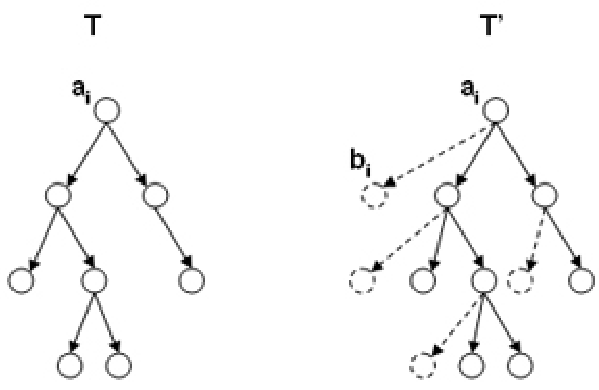 Figure 1: Transformation of a neighborhood graph into a sampling-ready tree structure.
3. The Efficiency-Bias Trade-off
The parameter is the "knob" for performance.
- A very small ensures perfectly uniform (unbiased) samples but results in many rejected walks (high latency).
- A larger speeds up the process by accepting nodes more frequently but introduces a controlled bias.
Experiments: Real-World Performance
The researchers tested their approach on three topologies: epinions-net (real), uniform-net, and prefatt-net (Preferential Attachment).
Key Finding: Batching Works
One might assume you need a fresh sample for every item you want to rank. However, the study shows that EvalBatch (using one sample to estimate counts for all URLs in a search result) performs almost as well as EvalSingle (a unique sample for every item), significantly reducing overhead.
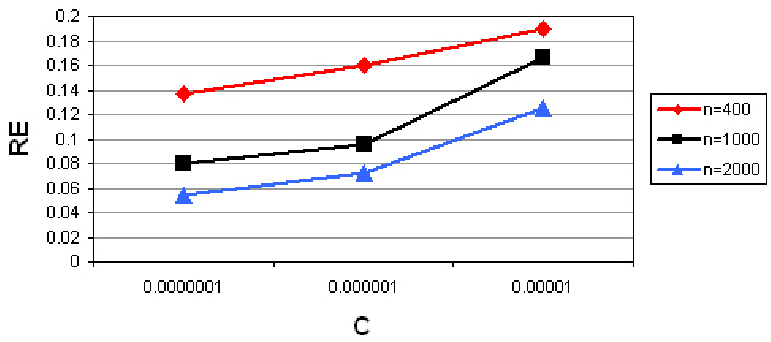 Figure 2: The trade-off between bias correction ( value) and Accuracy (Relative Error).
Accuracy Metrics
Even with small sample sizes, the Spearman’s Footrule Distance (a measure of how much the ranking order shifted) dropped sharply, and Precision at K remained high. This proves that we don't need exact counts to get the ranking order right—approximations are "good enough" for social search.
Critical Insight & Conclusion
The true value of this paper lies in its movement away from "exactness." In social systems, the difference between an item having 500 friend-clicks vs. 510 friend-clicks is negligible for ranking; what matters is whether it has significantly more than the next item. By leveraging this, SampleDyn turns a traversal problem into a localized sampling problem that scales with the desired confidence, not the total number of users.
Future Outlook: As social networks move toward decentralized protocols (like ActivityPub or Bluesky), these sampling-based methods will become even more critical, as they allow individual clients to "probe" the network they can see without requiring a centralized index.