
Chance-Choice: Balancing the Selfish "Crowd" with the Power of Limited Choice
Many Is Better Than All: Efficient Selfish Load Balancing in Mobile Crowdsourcing Systems
This paper introduces "Chance-Choice," a lightweight, distributed load balancing scheme for selfish mobile crowdsourcing networks based on the "d-choice" (Ball and Bin theory) and Proportional Allocation schemes. It aims to achieve Nash Equilibrium in task distribution among selfish users while operating within the constraints of opportunistic and intermittent mobile connectivity.
TL;DR
In mobile crowdsourcing, users are inherently selfish, seeking to minimize their own task load. Modern systems struggle to balance this load without massive communication overhead. Chance-Choice is a new distributed algorithm that uses the "Ball and Bin" d-choice theory to achieve optimal load balancing (Nash Equilibrium) with constant O(1) communication overhead, reducing the load gap by up to 80% compared to traditional proportional methods.
Background: The Selfishness of the Crowd
Mobile crowdsourcing (e.g., sensing or distributed computing) relies on moving users to share the workload. However, most users are "selfish agents"—they won't accept tasks if it makes their own situation worse. Achieving a Nash Equilibrium—where no user can improve their state by moving a task—is the gold standard for stability.
The challenge? Mobile connections are opportunistic (WiFi/Bluetooth). You might only be near a neighbor for a few seconds. If an algorithm requires you to poll every single neighbor (O(n) complexity) before moving a task, the connection might drop before the "best" choice is made.
The Motivation: Why Global Knowledge is Overrated
Existing SOTA methods like Max-weight Best Response are mathematically perfect but practically heavy. They demand information from everyone. On the other hand, Proportional Allocation is lightweight but blindly moves tasks, leading to "load sloshing" and slow convergence.
The authors realized that in the classic "Ball and Bin" problem, you don't need to look at every bin to find a good one. Looking at just two random bins (d=2) and picking the emptiest leads to an exponential improvement in load distribution. Chance-Choice applies this physical intuition to mobile networks.
Methodology: The "Chance-Choice" Mechanism
The algorithm operates during short "contact windows." Instead of trying to find the absolute least-loaded user in the network, it follows a simple yet rigorous process:
- Encounter: Detect neighbors within a short probing interval.
- D-Choice Selection: Randomly pick neighbors (where ).
- Local Comparison: Identify the least loaded among those candidates.
- Proportional Migration: Move the task only if the destination's load allows for a balanced state, preventing unnecessary oscillations.
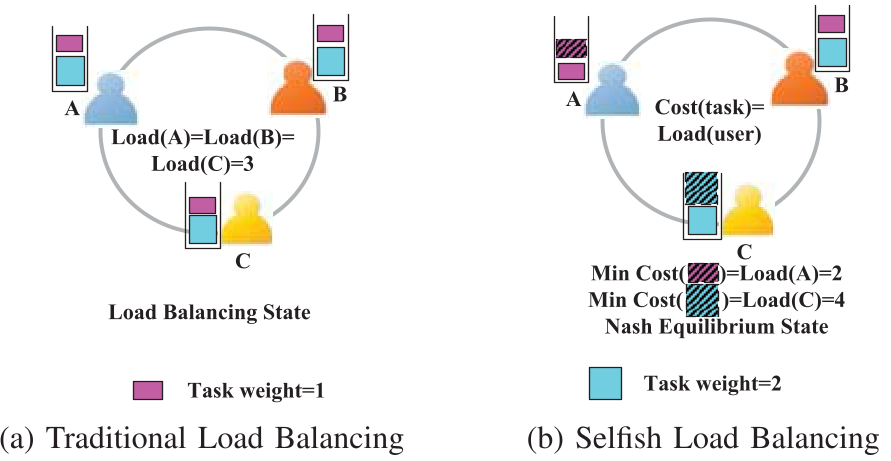
By restricting the search to neighbors, the communication complexity drops to O(1). This makes the system extremely resilient to the "intermittent connectivity" of the real world.
Performance: Fast, Stable, and Lean
The authors validated the algorithm using the MobiClique dataset (76 real users).
1. The Load Gap
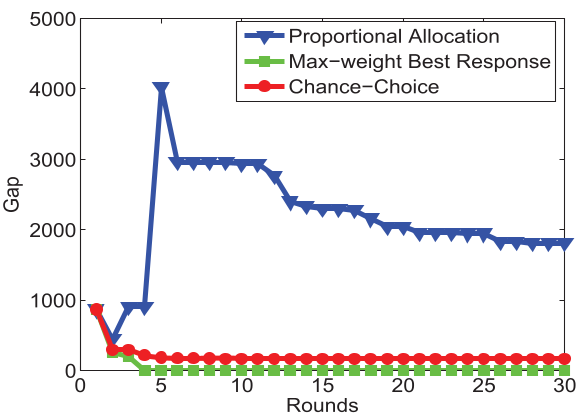
The "Gap" (difference between the most and least loaded user) is the ultimate metric of fairness. In scenarios with short probing intervals (5s to 200s), Chance-Choice consistently outperformed Proportional Allocation, maintaining a narrow gap similar to the heavy Max-weight method but at a fraction of the cost.
2. Convergence Speed
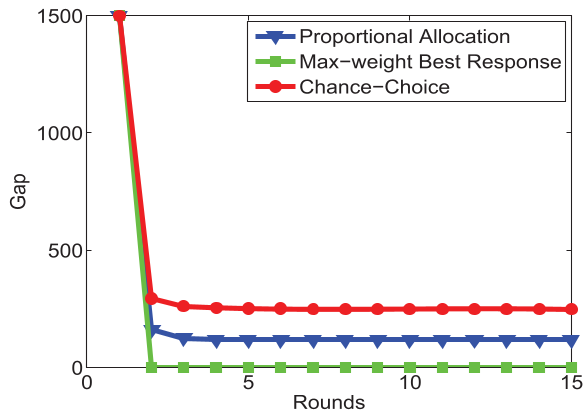
In dynamic networks, speed is life. Chance-Choice reaches a stable Nash Equilibrium much faster than its predecessors. While Proportional Allocation fluctuates wildly as it tries to find a balance, Chance-Choice’s selective logic allows it to "settle" the network quickly.
Critical Insight: The Logic of "Good Enough"
The true brilliance of this work lies in its embrace of incomplete information. In academic theory, we often chase the "Global Optimum." In mobile systems, the global optimum is a ghost—by the time you calculate it, the topology has changed.
By proving that information is "good enough" to reach a stable selfish equilibrium, this paper provides a blueprint for future decentralized protocols in IoT and Edge Computing, where bandwidth and battery are more precious than perfect mathematical symmetry.
Limitations
While the algorithm is robust, its advantage narrows as probing intervals grow very large (allowing users to see everyone). It is a specialized tool for high-mobility, low-bandwidth environments rather than static data centers.
Conclusion
"Many is better than all." By checking a few random neighbors instead of the whole crowd, Chance-Choice proves that distributed systems can be both selfishly stable and computationally efficient.