
Beyond Simple Meetups: A k-Core Approach to Social Event Invitation Engineering
An Efficient Social Event Invitation Framework Based on Historical Data of Smart Devices
The paper introduces a Smart Social Event Invitation Framework designed to recommend event participants based on historical data from smart devices. It utilizes Greedy Searching and k-core graph theory algorithms to maximize participant satisfaction by ensuring attendees are paired with existing friends while prioritizing less active members.
Executive Summary
TL;DR: This paper tackles the "social friction" in group activities—the awkwardness of attending events alone or with incompatible partners. By analyzing historical smart device data (GPS, activity logs), the authors present a framework that uses graph theory (specifically k-core algorithms) to ensure every invitee is surrounded by a minimum number of friends, boosting overall satisfaction and system-wide connectivity.
Context: This work moves beyond simple event recommendation (filtering by interest) into Social Optimization, treating an invitation list not as a set of individuals, but as a cohesive subgraph.
The "Alone in a Crowd" Problem: Why Group Events Fail
Most current platforms act as simple bulletin boards. This leads to two major failure modes:
- Heterogeneity Friction: In activities like hiking or cycling, mismatched physical abilities lead to frustration for both fast and slow participants.
- The Social Cold-Start: Users are less likely to join an event if they don't know anyone else going, leading to high "flake" rates.
The authors argue that a successful invitation must consider availability, ability, and social adjacency simultaneously.
Methodology: Engineering Social Cohesion
The framework operates by first extracting "Activity Profiles" from smart devices to determine routine free time and skill levels. Then, it constructs a friendship graph .
The core innovation lies in the k-core Algorithm. Unlike a greedy search that simply looks for friends of the organizer, the k-core approach seeks a subgraph where every node is connected to at least others.
 Figure: The k-core selecting result ensures higher global connectivity compared to local greedy searches.
Key Algorithmic Insight
- Greedy Algorithm: Starts with the organizer and expands. It’s fast but tends to trap users in small, stagnant cliques.
- k-core Algorithm: Iteratively prunes nodes with fewer than neighbors until a stable core is found. This "global" view allows the system to bridge different social clusters, effectively "inviting" cliques rather than just individuals.
Experimental Performance
The researchers simulated 3,000 members over thousands of events. The results were categorized by "Event Difficulty Levels" to test how the algorithms performed as the pool of qualified candidates shrank.
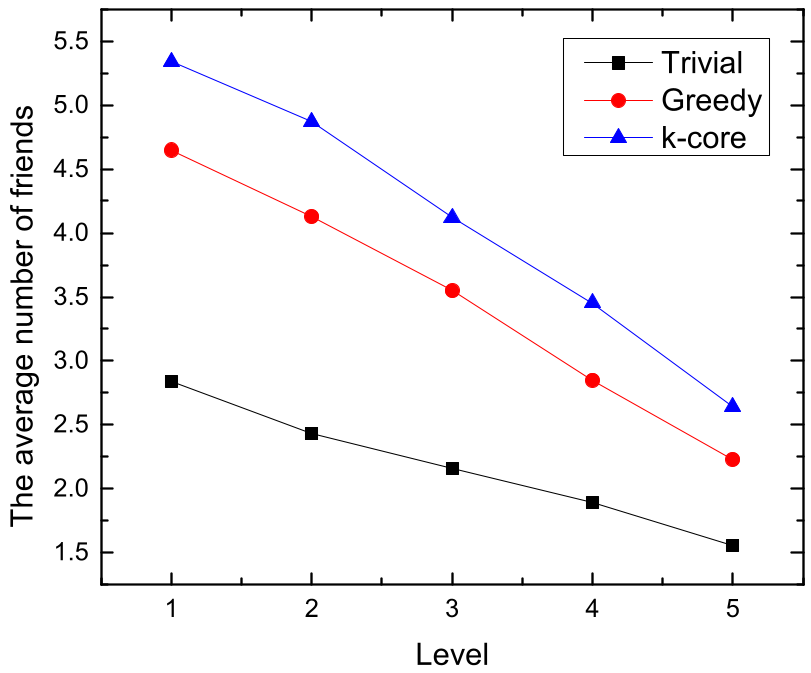
Crucial Findings:
- Minimum Friend Guarantee: The k-core algorithm significantly raised the "floor" for social comfort, ensuring even the most isolated invitee had a support network.
- Connectivity Evolution: As more events occurred, the k-core approach actually improved the density of the entire community graph more effectively than other methods.
- Dynamic Motivation: Implementing a "Your friend just joined!" notification boosted response rates by over 8%, proving that social proof is a powerful lever in event management.
Critical Insight & Future Outlook
This paper provides a robust blueprint for Inclusion-Aware Social Systems. By specifically prioritizing "less active" members (giving them higher invitation priority if they meet criteria), the framework prevents the "rich-get-richer" phenomenon where only social butterflies get invited to events.
Limitations: While the privacy section mentions data masking, the reliance on deep historical device access remains a high hurdle for user trust. Furthermore, the framework currently doesn't account for "negative edges" (disliked members) in the initial graph construction, only in post-event updates.
Conclusion: As we move toward a more automated "social butler" AI, using graph-theoretic constraints like k-core will be essential to ensure that technology brings us together in meaningful, comfortable, and sustainable ways.