
Efficient Social Network Data Query Processing: Moving Beyond SQL-on-MapReduce
Efficient social network data query processing on MapReduce
The paper introduces two novel MapReduce primitives, multiple-join-with-filter and Select-Join, specifically designed to optimize SPARQL query processing on large-scale RDF social network data. By bypassing the inefficient traditional two-layer SQL-to-MapReduce mapping, the approach significantly reduces job overhead and intermediate data.
TL;DR
Processing massive social network data (represented in RDF/SPARQL) often suffers from the "abstraction tax" of SQL. This paper introduces two MapReduce primitives—multiple-join-with-filter and Select-Join—that bypass traditional SQL-to-MapReduce mapping. By merging stages and optimizing shuffle logic, this methodology achieves up to a 2x speedup on industry-standard benchmarks.
The Problem: The Inefficiency of the "Two-Layer" Mapping
As social graphs scale to billions of triples (e.g., DBpedia, Facebook’s Open Graph), the SPARQL language has become the standard for querying these structures. Current distributed execution engines typically translate SPARQL into SQL join operations, which are then translated into MapReduce jobs.
This two-layer approach has two fatal flaws:
- Job Proliferation: Standard SQL joins are often pairwise or limited in scope, forcing a complex SPARQL query to spawn a long sequence of sequential MapReduce jobs.
- Redundant I/O: The "Selection" stage (extracting relevant triples) is usually treated as an independent job, creating massive intermediate files that satisfy no purpose other than being input for the next stage.
Methodology: Custom Primitives for Graph Data
The authors argue that the flexibility of MapReduce remains underutilized. They propose a paradigm shift from "SQL-centric" to "Primitive-centric" processing.
1. Multiple-Join-with-Filter
In graph data, redundant fields often appear because multiple predicates might exist between the same subject and object (e.g., two people who are both "friends" and "coworkers"). Traditional SQL joins would process these as separate operations. The authors' primitive allows for a secondary filter key during the reduce-side join. It joins on a primary ID while simultaneously pruning the result set based on a secondary shared variable—all within a single shuffle phase.
2. Select-Join & Skip-Write
Instead of running a dedicated MapReduce job just to filter triples (Selection), the Select-Join primitive integrates selection logic into the first Join job.
- Select Group: Handles triple patterns that aren't part of the first join.
- Join Group: Processes the first join immediately.
- Skip Write: Critically, the "Select" results are written directly to the file system from the Map-side, bypassing the Shuffle and Reduce phases entirely for those triples.
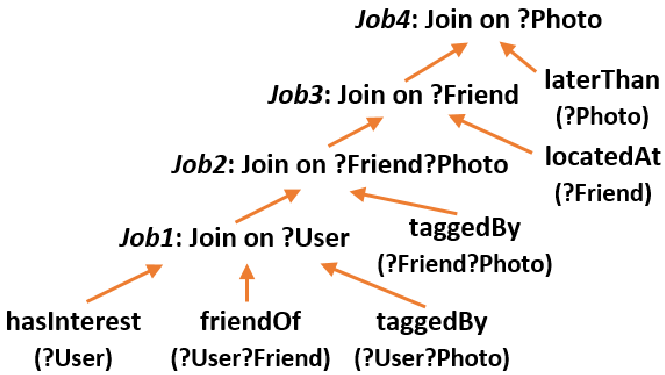 Figure: The traditional "Two-Layer Mapping" requiring 4 separate jobs for a targeted advertisement query.
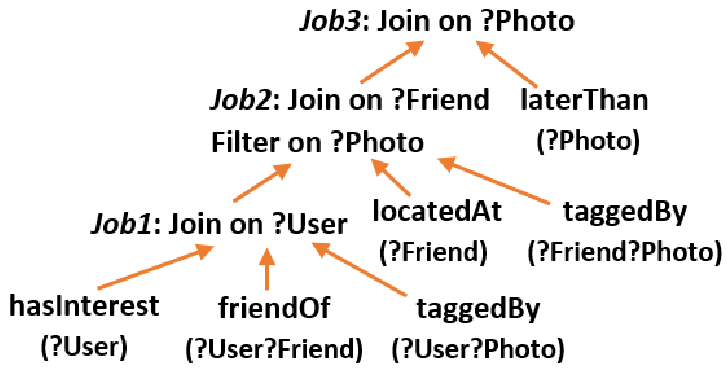 Figure: The optimized workflow using the proposed primitives, reducing the process to 3 jobs.
Experiments & Results
The system was tested using the SNIB (Social Network Intelligence Benchmark) and LUBM (Lehigh University Benchmark) datasets.
Performance Across Graph Patterns
The authors evaluated three fundamental graph motifs:
- Star Pattern: Results showed a massive improvement (up to 2x) by reducing job counts from 2 to 1, effectively eliminating all intermediate data.
- Chain Pattern: Benefited primarily from the "Skip Write" optimization, saving time proportional to the size of the base tables.
- Triangle Pattern: The most complex motif, which utilized both primitives to achieve the highest aggregate performance gains.
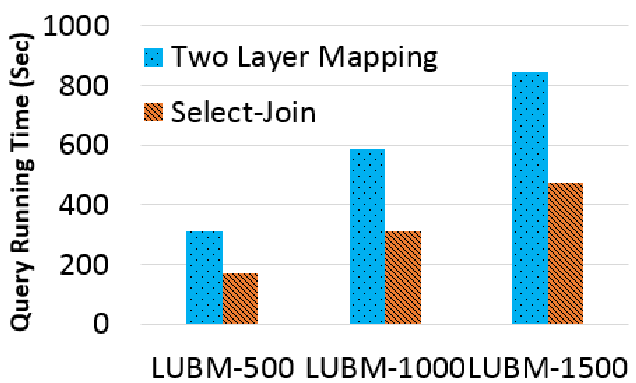 Figure: Performance across SNIB datasets (2000 to 8000 users). The 1-layer mapping consistently outperforms traditional methods.
Critical Analysis & Conclusion
Takeaway
The core contribution of this paper is the realization that SQL abstraction can be a bottleneck in distributed graph processing. By designing MapReduce jobs that align with the structural properties of RDF (triples) rather than the logical properties of SQL (tables), we can achieve significant performance gains.
Limitations & Future Work
While the speedup is impressive, the paper notes that Join Order optimization remains a challenge. The current algorithm uses a frequency-based greedy approach, but an optimal join sequence based on data cardinality could potentially yield even higher efficiencies. Additionally, as the industry moves toward Spark and memory-centric computing, adapting these "filter key" concepts to RDD-based joins would be a logical next step.
Senior Author's Perspective: This work is a classic example of "shaving the layers." In big data, every time you move data between stages, you pay a tax. By merging logic and optimizing the shuffle path, the authors provide a blueprint for high-efficiency graph querying that remains relevant for anyone building custom data pipelines.