
Efficient Trust Propagation: Scaling Trustworthiness Prediction for the Mobile Service Era
Efficiently Predicting Trustworthiness of Mobile Services Based on Trust Propagation in Social Networks
This paper proposes an efficient trust propagation method for predicting the trustworthiness of mobile services in large-scale social networks. By integrating a landmark-based preprocessing mechanism, the method achieves sublinear time complexity (O(K)) for online trust queries while maintaining high prediction accuracy across multiple propagation strategies (MAAP, MASP, MMAAP, MMASP).
TL;DR
Predicting if a mobile service is "trustworthy" usually requires navigating complex social referral chains. This paper introduces a landmark-base preprocessing framework that shifts the heavy lifting of trust computation from online queries to offline preparation. By strategically selecting "hub" nodes as benchmarks, the authors reduced computation time by over 99% while maintaining nearly perfect alignment with gold-standard trust rankings.
Contextual Positioning
In the landscape of service discovery, we've moved from Global Reputation (one score fits all) to Local Trust (subjective, personalized scores). While local trust is more accurate, its computational cost in millions-node networks is an "efficiency wall." This work acts as a bridge, bringing the speed of global systems to the nuanced world of personalized trust.
The Scalability Bottleneck: Why "Shortest Paths" Aren't Enough
Previous trust propagation methods like TidalTrust or MAAP rely on finding optimal paths across a graph. In a network with participants, this often scales at or worse. For a real-time mobile app selection, waiting seconds for a trust score is unacceptable. Furthermore, these methods often ignore the Scale-Free nature of social networks—where a few "hub" users hold the majority of referral power.
Methodology: The Landmark Strategy
The core insight is simple yet powerful: Hub nodes (Landmarks) act as the "navigational beacons" of trust.
1. Preprocessing Phase (Offline)
- Selection: The system identifies the top nodes with the highest input degrees.
- Computation: It pre-calculates the trust values from these landmarks to every other node in the network and vice versa.
- Storage: These results are stored in a specialized data structure .
2. Prediction Phase (Online)
When a user wants to know the trust of service :
- Nearby Check: If the distance is less than threshold , it performs a local search.
- Distant Aggregation: If the distance is large, it fetches the pre-computed trust from and for all landmarks , and aggregates them.
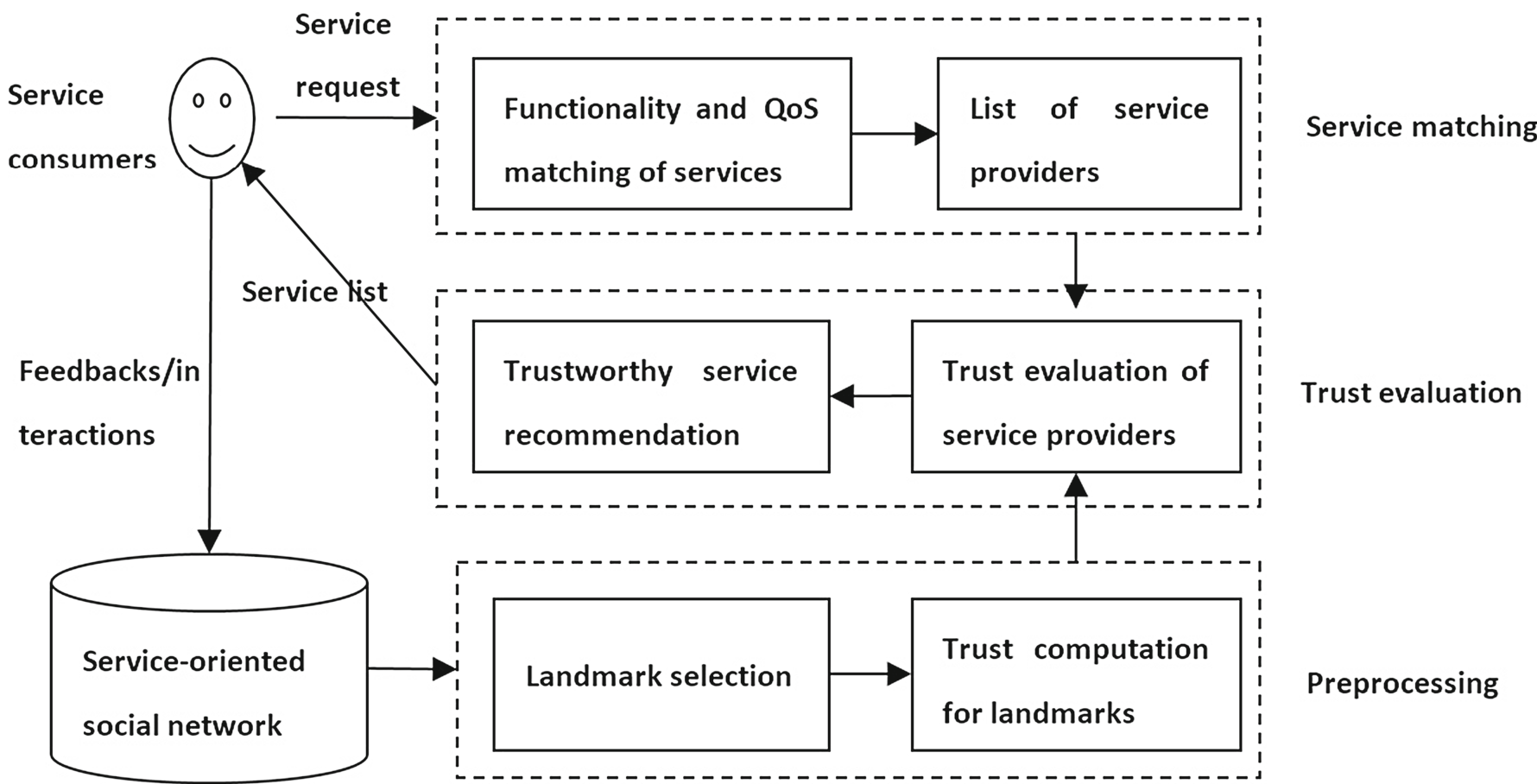 Figure 1: The proposed trust-based framework for mobile service selection, highlighting the Preprocessing and Trust Evaluation blocks.
Mathematical Intuition
The paper supports multiple strategies, but the Multiplication Aggregation (MAAP) is the most intuitive. It treats trust as a probability that "decays" along a path: The landmark approach approximates the global optimal path by looking at "two-hop" jumps through the most reputable nodes in the network.
Experimental Performance
Using a Facebook-like dataset of ~2,000 nodes, the authors compared their "Adapted" versions against "Classic" implementations.
Speedup
The efficiency gains are massive. For 1,000 pairs, the time dropped from 124.57 seconds to just 0.29 seconds—a speedup suitable for real-time mobile environments.
 Table 1: Time performance across different strategies. Remarkable gains are seen even as K (number of landmarks) increases.
Accuracy Maintenance
One might fear that using landmarks loses the "fine-grained" detail of a full graph search. However, the Discounted Cumulative Gain (DCG) analysis proved that the ranking of services remained consistent. For most users, knowing that Service A is "more trusted" than Service B is more important than the exact third decimal of the trust score.
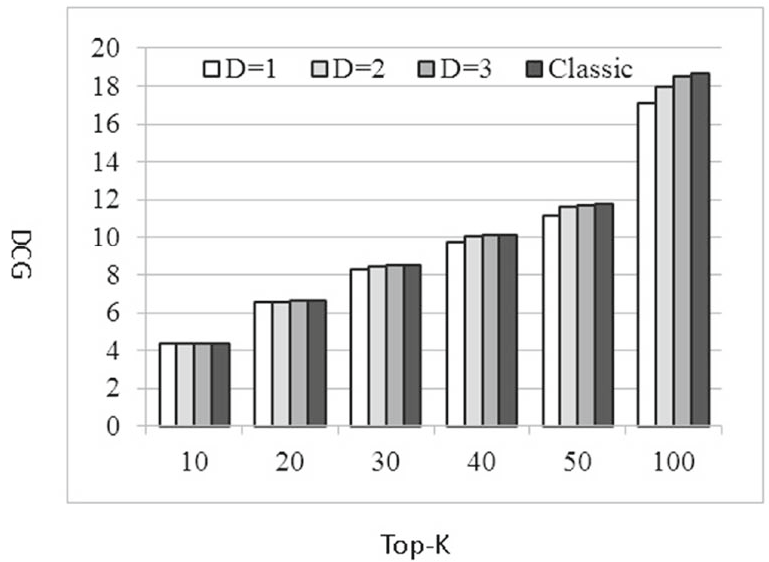 Figure 2: DCG values showing that the ranking quality of the landmark method closely tracks the expensive classic methods.
Critical Insight: The Trade-off
The parameter (number of landmarks) and (distance threshold) are the "tuning knobs."
- Increase : Accuracy goes up, but storage and preprocessing time increase.
- Increase : Accuracy reaches the "Theoretical Max," but online latency starts to creep back up. The paper provides a template for finding the "Sweet Spot" in this 3D space of Time vs. Accuracy vs. Cost.
Conclusion
This research demonstrates that we don't need to choose between subjective trust and high performance. By exploiting the inherent inequality of social network structures (hubs vs. spokes), we can provide real-time, personalized trustworthiness assessments for millions of mobile services. The "Landmark" philosophy is a blueprint for any graph-based recommendation engine facing a scalability crisis.