
Egocentric Centrality: Measuring Influence Without the Full Picture
Egocentric and sociocentric measures of network centrality
This paper introduces and validates egocentric versions of Freeman’s classic network centrality measures, focusing on "Egocentric Betweenness." By analyzing seventeen diverse social networks, the author demonstrates that betweenness calculated from a node’s immediate locality (first-order zone) serves as a robust proxy for "Sociocentric Betweenness" calculated from the complete network.
TL;DR
In the world of Social Network Analysis (SNA), "Betweenness" is the gold standard for identifying brokers and power players. But there’s a catch: you usually need the entire network map to calculate it. Peter V. Marsden’s seminal work proves that we can accurately estimate a person's global brokerage power by looking only at their immediate "neighborhood." Across 17 different networks, the correlation between this local snapshot and the global reality was found to be over 90%.
The "Complete Data" Trap
Most network theories, such as Freeman’s Centrality, assume a Sociocentric view. This means you have a perfect matrix of who knows whom for every single person in a group. In the real world—think of a large city or a massive corporation—getting this data is an ethnographic nightmare.
Researchers often settle for Egocentric data: you ask "Ego" who they know, and whether those people ("Alters") know each other. Historically, critics argued that this "ego-net" approach misses the "betweenness" that comes from long-distance connections (paths of length 3, 4, or more). Marsden’s goal was to find out: How much does this local focus actually hurt our findings?
Methodology: The Math of Local Brokerage
Marsden focuses on three types of centrality:
- Degree: Identical in both designs (it's just a count of direct ties).
- Closeness: Functionally useless in egocentric data because from Ego’s perspective, everyone they know is exactly "1 unit" away.
- Betweenness: The real meat of the paper.
The Egocentric Betweenness measure is calculated by looking at pairs of your friends who don't know each other. If Friend A and Friend B are strangers, you are the bridge. The formula counts these gaps but subtracts cases where other mutual friends could also serve as bridges, effectively measuring your "Brokerage" potential.
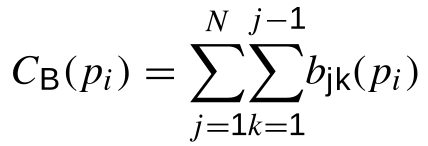 Freeman’s original Sociocentric Betweenness (above) versus the Egocentric approximation.
Why It Works: Hubs vs. Bridges
One might expect that by ignoring long paths, we would lose the "big picture." However, Marsden discovered a "part-whole" correlation. If you are a bridge between two people who are otherwise disconnected in your immediate circle, you are statistically very likely to be a bridge for longer paths that pass through that same sector of the network.
The Exception: The "Hub" vs. "Bridge" Distinction
The correspondence isn't perfect. Marsden identifies two types of central nodes:
- Hubs: Connected to many leaf-nodes (peripheral people).
- Bridges: Connected to a few highly central people.
Bridges (like "Koenig" in the Altneustadt data) often have higher global betweenness than their local data suggests, because they connect major clusters. Conversely, Hubs (like "Berghaus") might look powerful locally but are actually redundant in the larger scheme.
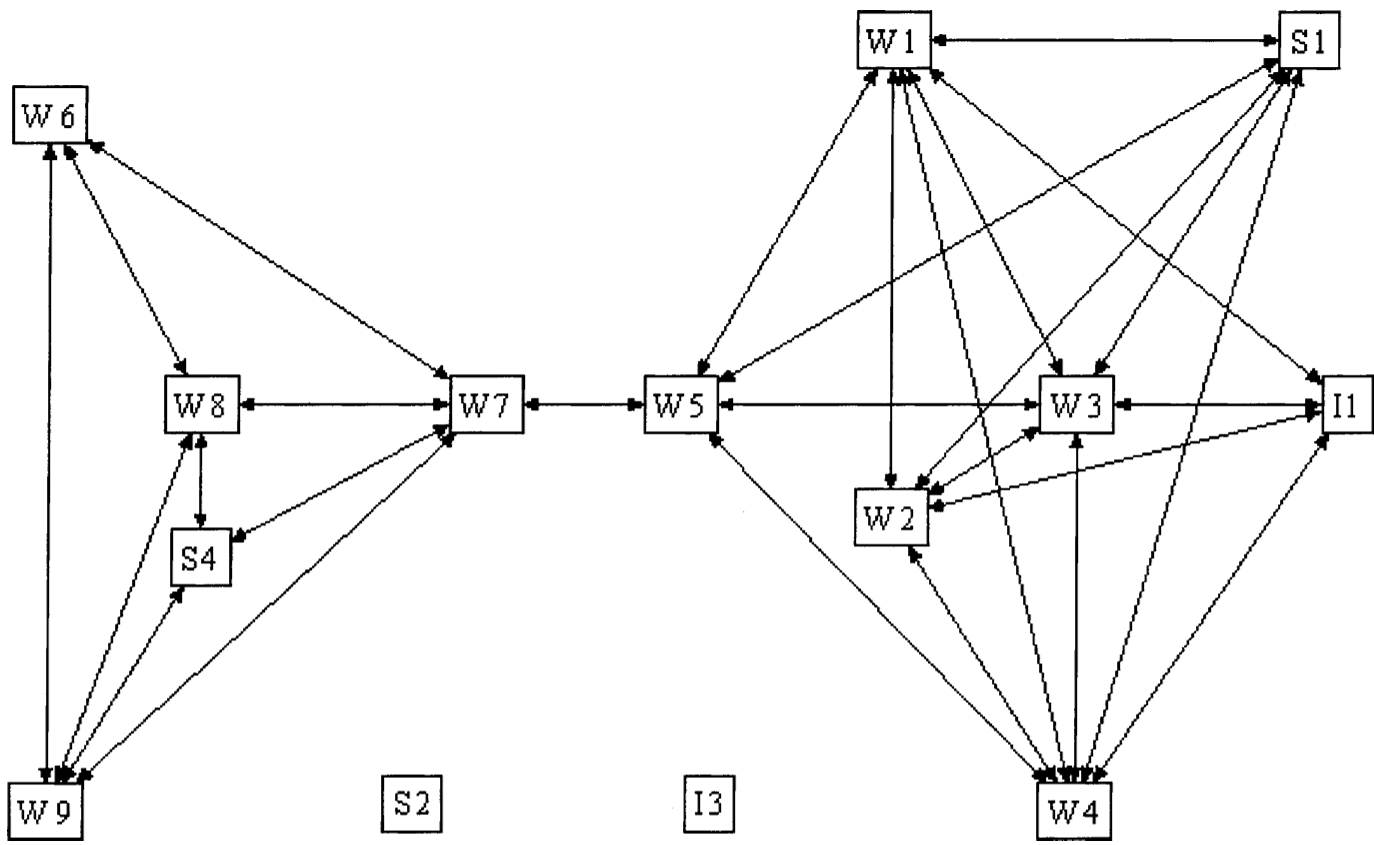 In the classic Bank Wiring Room games network, the egocentric ranks (Nodes W5 and W7) matched the sociocentric ranks perfectly.
Experimental Results
Marsden tested this across 17 networks, including:
- Physician advice networks (Medical Innovation study).
- Corporate managers (Krackhardt's studies).
- Lawyer co-worker relationships.
| Network | Nodes | Correlation (Ego vs. Socio) |
|---|---|---|
| Bank Wiring Room | 14 | 0.993 |
| Law Firm Advice | 71 | 0.982 |
| University Dorm | 217 | 0.973 |
The result is clear: Network size does not diminish the accuracy of the egocentric proxy. Even in the largest network (217 nodes), the correlation remained nearly perfect.
Critical Analysis & Takeaways
The brilliance of this paper is its practical optimism. It tells researchers: "Stop worrying about the missing global data; your local surveys are actually giving you the right answer."
Key Takeaways:
- Scale Invariance: Egocentric measures hold up even as networks grow.
- Substitution: If you can't map the whole world, map the neighbor's neighborhoods. The relative ranking of "important" people will likely stay the same.
- Limitations: The study assumes "Ego" reports their friends' connections accurately. In reality, people often "fill in the blanks" or forget ties, which can bias the results.
For future AI and Social Graph designers, Marsden’s work justifies using "sub-graph" sampling to identify influencers in massive social networks (like X/Twitter or LinkedIn) without needing to process the trillion-edge global graph in its entirety.