
Beyond Unanimity: Modeling Near Consensus in Complex Social Networks via Eigen Theory
Study of near consensus complex social networks using eigen theory
This paper introduces the concept of "Near Consensus" in complex social networks, moving beyond the restrictive "Exact Consensus" model. Using Eigen Theory, the authors characterize the relationship between nodes' decision certitudes, the influence weight matrix, and initial state conditions to achieve practical consensus.
TL;DR
In real-world social networks, achieving 100% agreement (Exact Consensus) is almost impossible. This paper pivots the mathematical focus toward Near Consensus, where a majority of nodes reach a decision threshold. By leveraging Eigen Theory, the authors provide a rigorous framework to predict steady-state opinions based on the initial influence of "hubs" in scale-free networks.
Background: The "Exact Consensus" Trap
Traditional models of complex social networks often rely on the Exact Consensus property. This states that as time approaches infinity (), every single node must converge to a bit-perfect decision certitude of 1 (vote "for") or -1 (vote "against").
From a graph theory perspective, this is a heavy constraint. It requires the network to possess a spanning tree, effectively forcing a rigid hierarchy. However, real human societies are messy. We have "Near Consensus" where most people agree, while some outliers remain.
The Core Insight: Near Consensus Definition
The authors propose a more flexible metric. A network achieves Near Consensus () if:
- At least nodes (a majority) reach a decision certitude .
- The threshold represents the margin of "uncertainty" allowed.
Methodology: Eigen Theory to the Rescue
To understand how opinions evolve, we look at the influence weight matrix . The state of the network at time is .
1. The Power of Eigenvalue 1
The researchers prove that for decisions to converge (rather than oscillate or vanish), the matrix must have at least one eigenvalue equal to 1, with all others having a modulus less than 1. The steady-state vector is not random; it is a linear combination of the eigenvectors associated with .
2. Decomposing Scale-Free Networks
Scale-free networks are dominated by "hubs" (nodes with high connectivity). Calculating the eigenvectors for a network with millions of nodes is computationally expensive. The authors introduce a block-matrix decomposition:
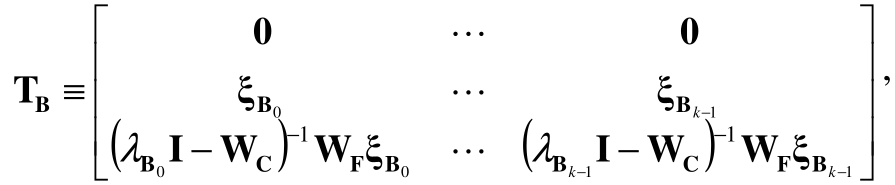
By partitioning the matrix into hubs (), their direct followers (), and the rest of the network (), they show that the global consensus can be determined by analyzing much smaller sub-matrices.
Experimental Proof: Hubs Rule the Consensus
The paper validates this through numerical simulations. While the "exact consensus" (where every node is identical) is clearly violated in Figure 1, the Near Consensus is preserved.
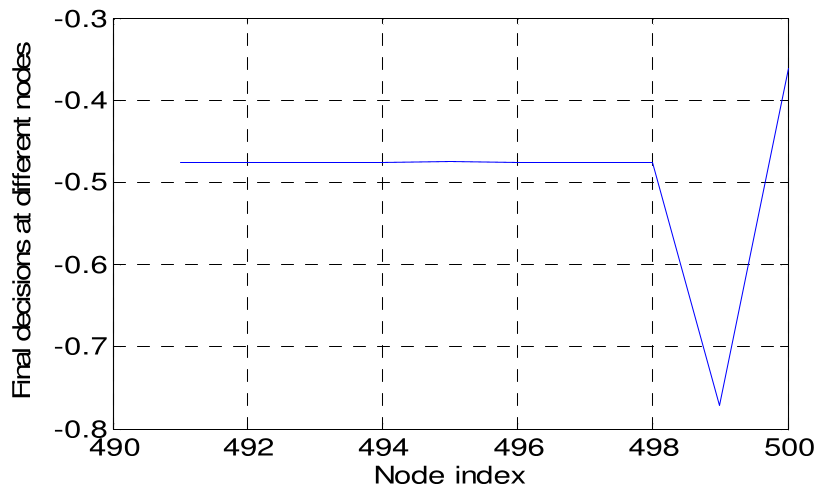 Fig 1: Steady-state values of the decision certitudes. Notice that while nodes vary, they cluster around the values dictated by the network hubs.
Critical Insight & Future Outlook
This work provides a bridge between Lattice Theory and Practical Sociology.
Key Takeaways:
- Initial Conditions Matter: Theorem 1 defines exactly which initial "vibes" (certitudes) will lead to a successful consensus. If the starting values don't fall within a specific linear variety , the network will fail to agree.
- The Hub Strategy: To change a network's opinion, one only needs to influence the hubs ( nodes). Because of the eigen-structure, the followers ( nodes) will naturally gravitate towards the hubs' certitude.
Limitations: The model currently assumes a static weight matrix. In real life, influence weights change based on trust and time (Dynamics). Future research should apply these eigen-properties to Switching Networks where connections appear and disappear.
Author Credits: This analysis is based on the research by Bingo Wing-Kuen Ling, Paul Stewart, Kok-Lay Teo, and Chi K. Tse.