
Gender Prediction via Expiratory Flow-Volume Curves: Respiration as a Biometric Signature
Ekspirasyon Aklm-Vollim Egrisine Dayall
This study proposes using the Expiratory Flow-Volume Curve (EFVC) from pulmonary function tests as a novel biometric marker for gender prediction. Using a dataset of 14,517 individuals, the researchers achieved a state-of-the-art accuracy of 99.43% using Support Vector Machines (SVM) and Gaussian Mixture Models (GMM).
TL;DR
Can the way you breathe reveal your gender? This research demonstrates that the Expiratory Flow-Volume Curve (EFVC)—a standard output of pulmonary function tests—contains highly distinct physiological signatures. By applying machine learning techniques like Support Vector Machines (SVM) and Gaussian Mixture Models (GMM) to a massive dataset of over 14,000 subjects, the authors achieved an astonishing 99.43% accuracy in gender prediction.
Exploring the "Newborn Biometrics"
Traditional biometrics like fingerprints and facial recognition are ubiquitous but not infallible. Researchers are now looking inward at "Newborn Biometrics"—signals derived from internal physiological processes such as heart sounds, brain waves (EEG), and, in this case, respiratory mechanics.
The core insight of this paper is that respiratory characteristics are not just medical indicators but unique identifiers. Because male and female lung anatomy (volume, airway diameter, and muscular strength) differs significantly, the resulting flow-volume loops during a forced exhale are fundamentally distinct.
Methodology: From Breath to Data
The workflow follows a standard but rigorous three-stage biometric pipeline:
- Feature Extraction: The researchers focused on "Forced Vital Capacity" (FVC) measurements. Key features include:
- PEF (Peak Expiratory Flow): The maximum speed of expiration.
- FEV1: Forced expiratory volume in the first second.
- FEF 25-75: Mid-expiratory flow rates.
- Classification Models:
- GMM: Models the distribution of gender classes through weighted Gaussian clusters.
- SVM: Searches for the optimal hyperplane that maximizes the margin between "Male" and "Female" vectors in a high-dimensional kernel space.
- Cross-Validation: A 10-fold cross-validation approach ensured that the model's performance was consistent across the entire dataset.
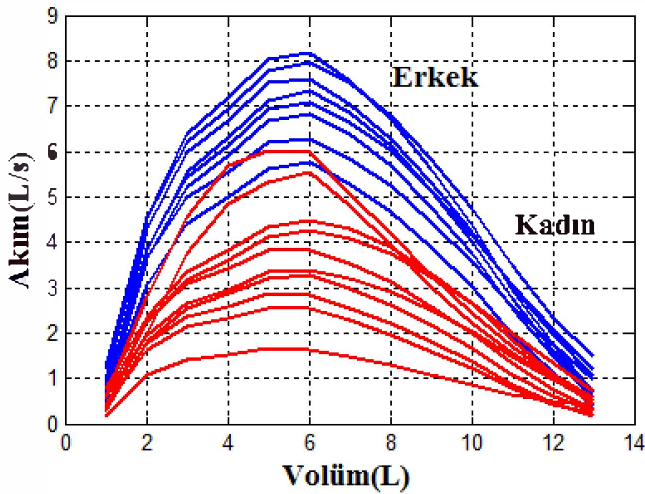 Figure 1: Visual representation of flow-velocity differences between males (typically higher peaks) and females.
Experimental Battle: GMM vs. SVM
The study compared three different feature sets, ranging from 4 basic metrics to 13 comprehensive parameters.
- Feature Set-3 (13 features) provided the highest information density.
- SVM proved superior to GMM in almost every scenario, likely due to its ability to handle high-dimensional feature spaces more effectively through non-linear kernels.
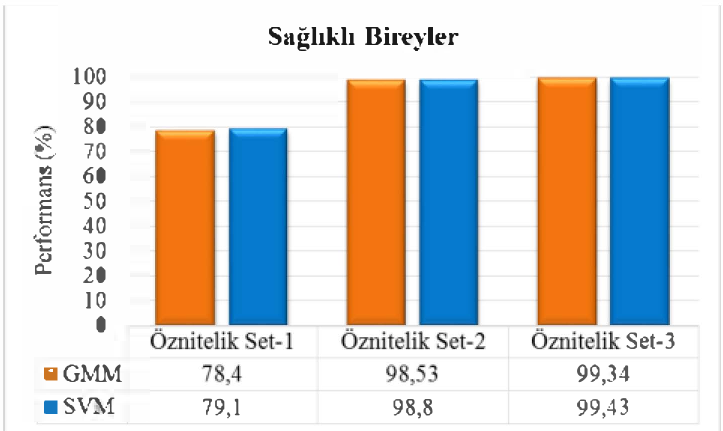 Figure 2: Accuracy results show SVM hitting the 99.43% mark when utilizing the full feature set on healthy individuals.
Critical Insight & Conclusion
While the results are impressive, the study opens a broader conversation:
- Robustness: The accuracy is highest in healthy individuals. Performance might fluctuate in clinical settings where respiratory diseases (like Asthma or COPD) alter the curve's morphology.
- The Future of Biometrics: This work proves that EFVC is more than a medical tool; it's a demographic classifier. The authors plan to extend this to individual identification, potentially allowing "breathing into a device" to serve as a secure, secondary authentication factor.
Takeaway: The integration of medical diagnostics and machine learning continues to blur the lines between healthcare and security, turning our basic biological functions into digital keys.