
Elderly Healthcare Info Mining: Bridging Memory Computing and Clinical Prediction
The design and implementation of the elderly healthcare information mining platform
This paper presents a memory-computing-based data mining platform specifically designed for elderly healthcare, utilizing a hierarchical cloud architecture (System, Control, and Service layers). It features a parallelized decision tree algorithm optimized for heart disease prediction and large-scale, heterogeneous health data.
TL;DR
With the global aging population, the "data explosion" in healthcare requires more than just storage; it requires high-speed analysis. This paper introduces a dedicated healthcare mining platform that leverages memory computing and parallelized decision trees to predict heart disease efficiently. By abstracting complex distributed computing into a user-friendly web interface, the system achieves significant speedups and high accuracy on large-scale datasets.
Problem & Motivation: Beyond Passive Storage
Traditional Healthcare Information Systems (HIS) are essentially digital filing cabinets. While they store massive amounts of data, they lack the "brain" to process it. The authors identify three major bottlenecks:
- Heterogeneity: Modern health data comes from clinics, wearables, and lifestyle logs, making it difficult to unify.
- Scalability: Standard algorithms fail when datasets grow to millions of records.
- Usability: Most mining platforms are built for data scientists, not doctors or caregivers who need actionable insights.
The research intuition here is that by moving the calculation from disk-based paradigms (like standard MapReduce) to memory-based parallel frameworks, we can achieve the near-real-time performance required for clinical decision support.
Methodology: The "Healthcare Cloud" Architecture
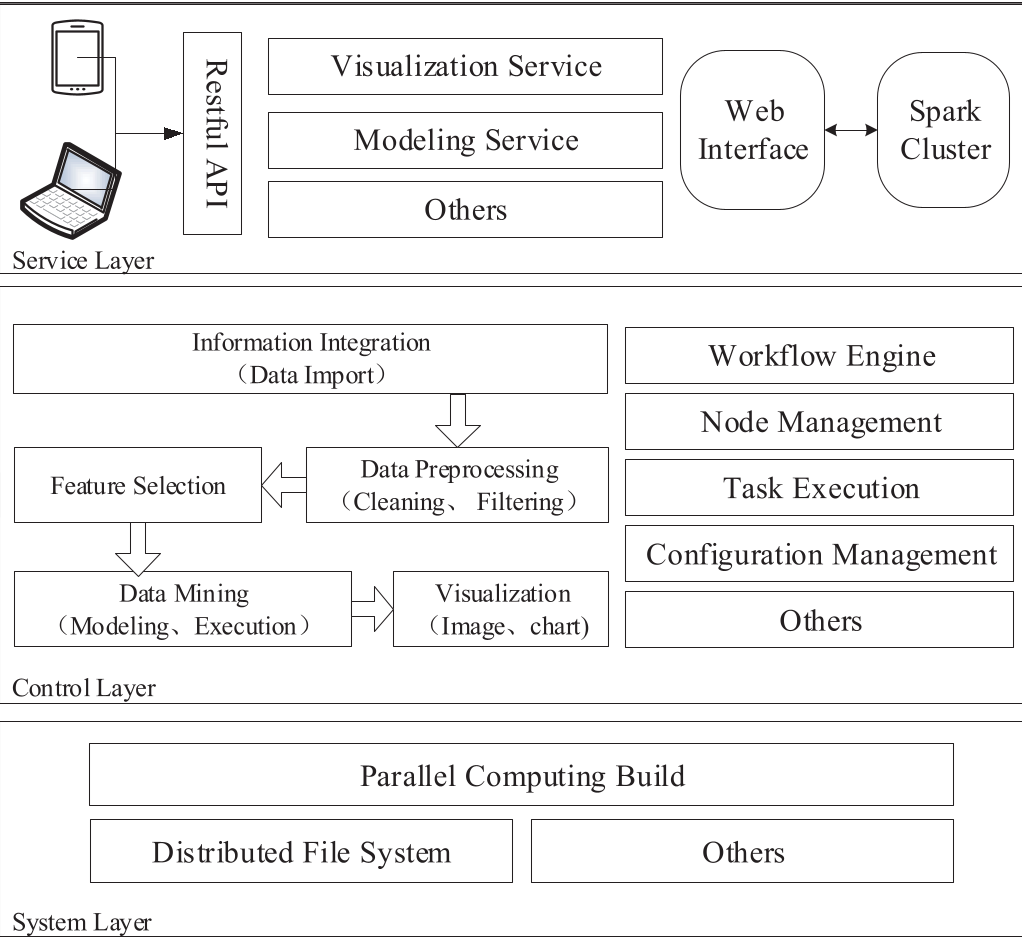
The platform is structured into three distinct layers to decouple physical resources from user operations:
1. The System Layer (Memory Computing)
Unlike traditional Hadoop-based systems that write intermediate data to disks, this layer stores iterative data in memory. This provides a massive performance boost for machine learning algorithms which are inherently iterative.
2. The Control Layer (Workflow Management)
Each mining task is treated as a module within a Directed Acyclic Graph (DAG). This includes:
- Data Integration & Cleaning: Legalizing messy sensor data.
- Feature Selection: Using expert knowledge to pick the right indicators (age, cholesterol, etc.).
- Parallel Decision Model: This is the "secret sauce." The algorithm calculates split points (Bins) in parallel across nodes to minimize communication overhead.
3. Service Layer (User Interface)
By providing a RESTful API and a web-based "Zeppelin"-inspired interface, medical staff can trigger complex mining tasks as a "black box" without writing a single line of distributed code.
Experiments: Performance under Pressure
The researchers tested the system using the UCI heart disease dataset, expanded with Gaussian noise to simulate big data environments.
- Node Efficiency: The study found that while increasing nodes reduces execution time, there is a "sweet spot" (around 4 nodes in their setup). Beyond this, communication overhead between nodes begins to counteract the parallel gains.
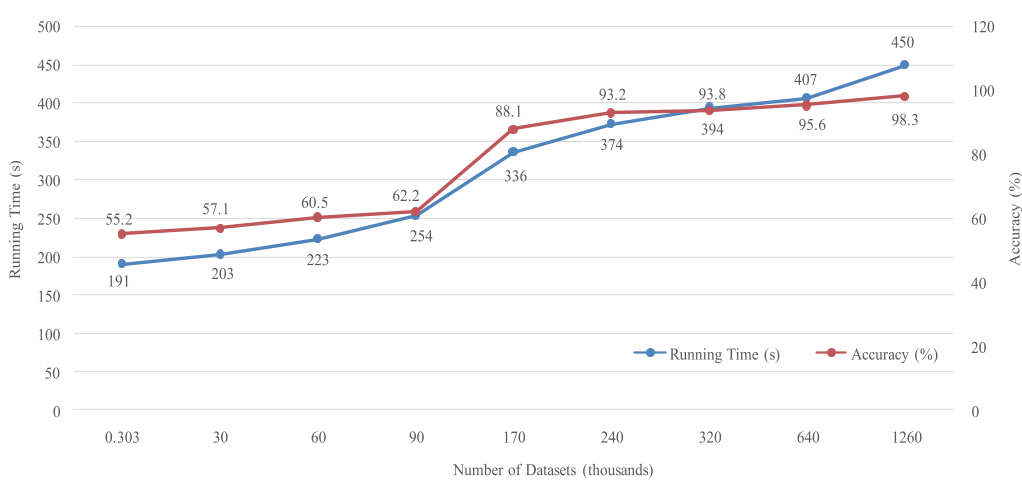
- Scalability: As the data size grows, the platform follows an "S-shaped" growth curve. This stability indicates it is well-suited for regional or national-level health data processing.
Critical Analysis & Conclusion
Takeaway
The integration of memory computing (likely Spark-based, though "Zeppelin" is explicitly mentioned for the workflow) is a massive leap forward for medical informatics. It allows for breadth-first tree construction, which is significantly more efficient for distributed memory than depth-first approaches.
Limitations
- Parameter Tuning: The current model requires manual configuration of pruning parameters (). Future work should focus on automated "AutoML" to dynamically adjust these.
- Data Diversity: While heart disease is a critical use case, the platform's ability to handle unstructured data (like doctor's notes or medical imaging) via Deep Learning remains a future frontier.
Future Outlook
This work sets a precedent for "Inference-as-a-Service" in the elderly care sector. As wearable technology matures, platforms like this will be the backbone of preventative medicine, moving us from treating diseases to predicting and preventing them.