
EEG-Based Emotion Assessment: Bridging Semantic Ontologies and Data Mining
Electroencephalogram-based emotion assessment system using ontology and data mining techniques
This paper presents an enhanced EEG-based emotion assessment system that integrates ontological modeling with data mining techniques. By utilizing the DEAP dataset and C4.5 decision tree classification, the framework achieves SOTA-level accuracy in mapping neural signals to the Arousal-Valence emotional space.
TL;DR
This research introduces a sophisticated framework for human-machine interaction that decodes emotions from brainwaves. By combining Ontological Modeling (for structured data management) and C4.5 Decision Trees, the system achieves a significant performance boost on the public DEAP dataset, reaching nearly 70% accuracy in predicting emotional arousal.
The Problem: Data Chaos in Affective Computing
The primary challenge in Affective Computing (AC) is not just "reading" the brain, but managing the sheer complexity of the data.
- Unstructured Data: EEG signals are typically stored in proprietary, unstructured formats that machines cannot "understand" semantically.
- Feature Overload: Modern signal processing (FFT, Wavelets) generates thousands of features (Entropy, Complexity, Power Ratios), most of which are noise.
- Gender Variance: Men and women exhibit distinct neurophysiological responses to emotional stimuli—a factor often ignored in "one-size-fits-all" models.
Methodology: The Semantic-Statistical Bridge
The authors' "Secret Sauce" lies in the EEG-Emotion Ontology and a rigorous feature selection pipeline.
1. Ontological Architecture
Instead of treating EEG as raw numbers, the system maps data to a four-layer ontology (Domain, Category, Class, Instance). This allows the system to "know" that a specific data point is a "Kurtosis feature" calculated from "Electrode AF3" during a "High Arousal state."
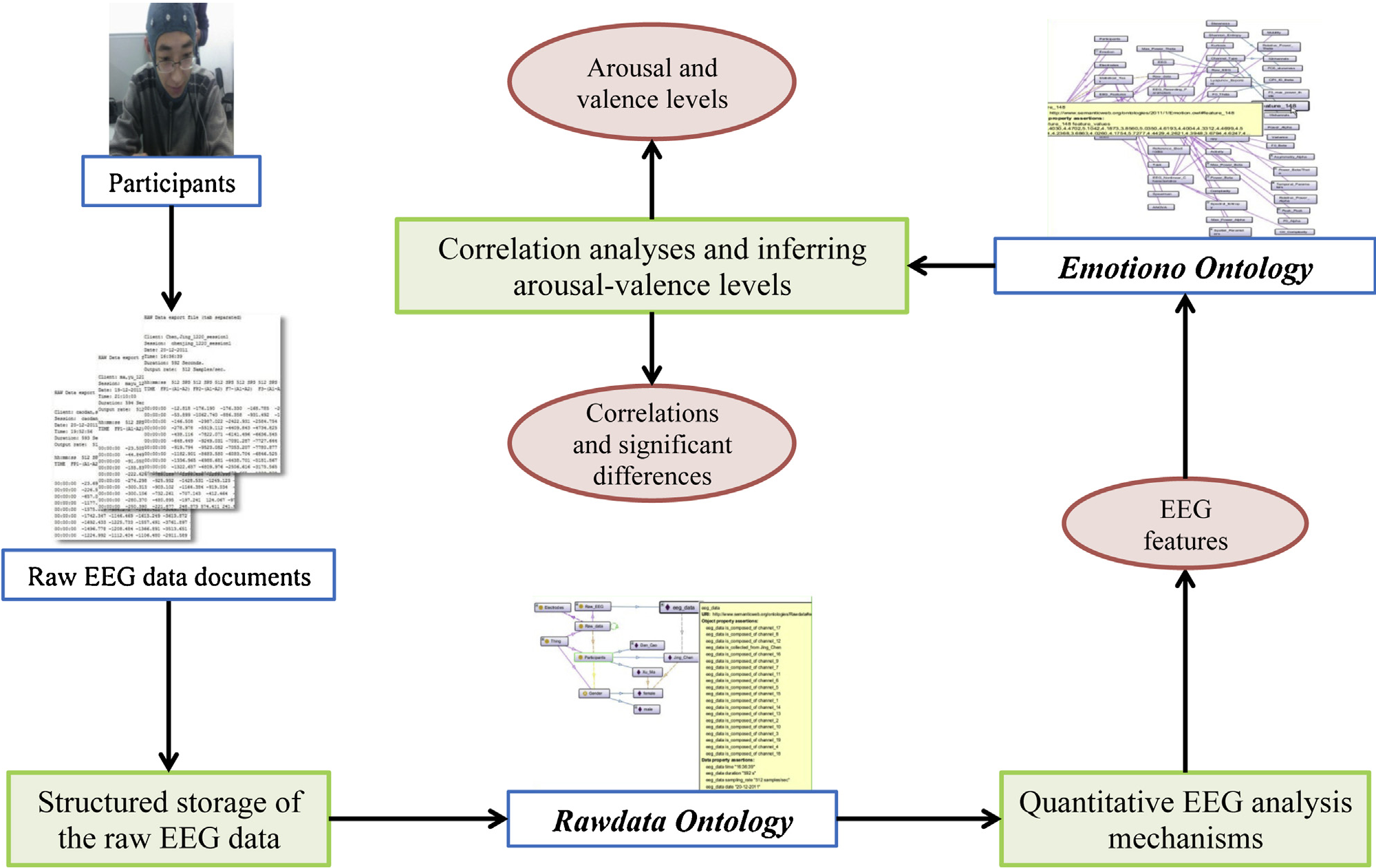 Figure: The multi-stage structure of the EEG-based emotion assessment system.
2. Feature Extraction & Selection
The core utilizes a mix of:
- Linear Features: Power in Theta, Alpha, and Beta bands.
- Non-linear Features: Shannon Entropy, Kolmogorov Complexity, and Hjorth parameters.
- Gender-Specific Filtering: Spearman correlation coefficients revealed that females often show negative correlations between EEG features and valence, while males trend positive.
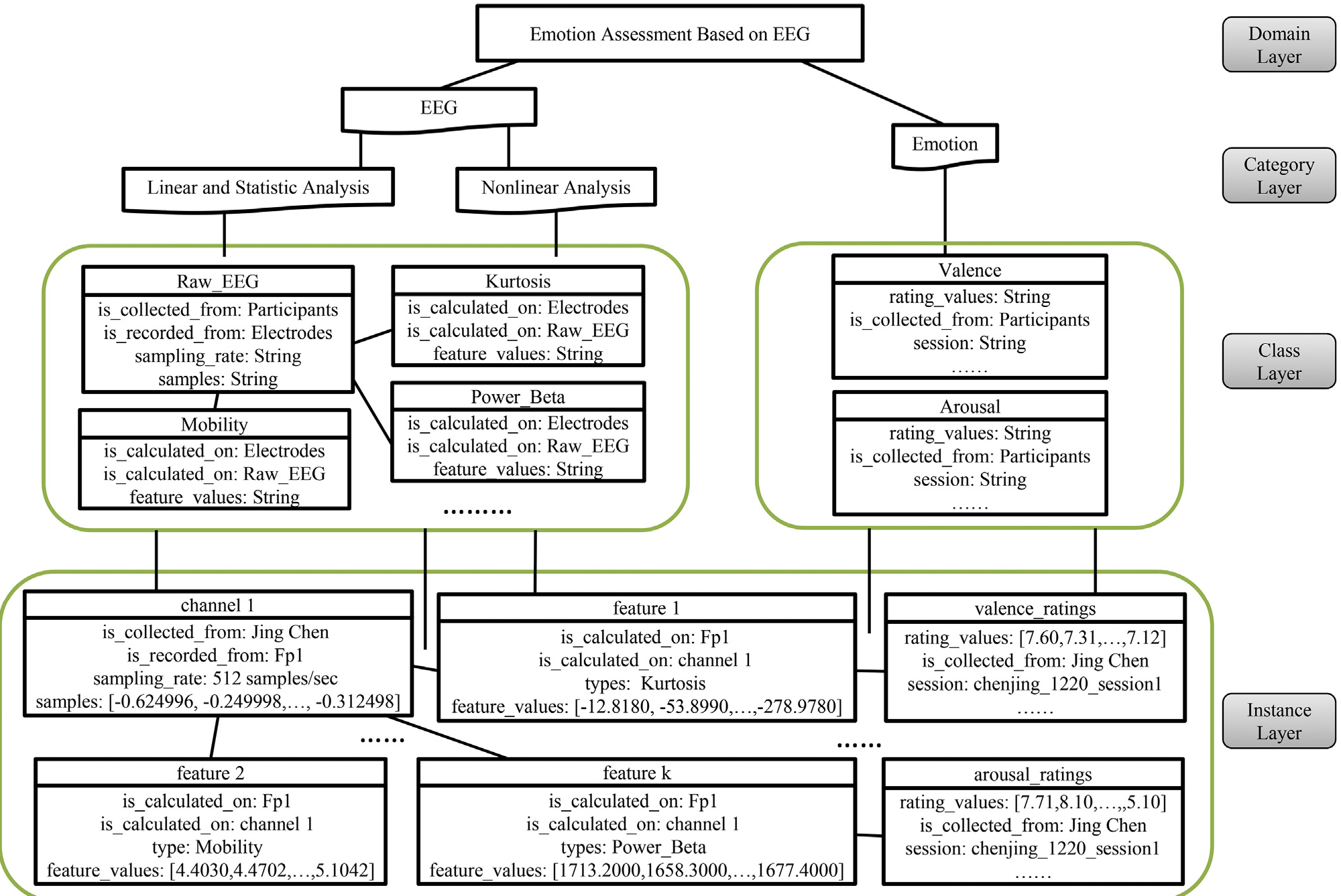 Figure: The semantic representation of EEG features and human emotional states.
Experimental Results: SOTA Performance
The system was validated against the DEAP dataset (32 subjects). The results were compared across four classifiers: C4.5, SVM, Multilayer Perceptron (MLP), and k-Nearest Neighbor (k-NN).
| Dimension | C4.5 Accuracy | Baseline (DEAP Paper) |
|---|---|---|
| Arousal | 69.09% | 62.00% |
| Valence | 67.89% | 57.60% |
The C4.5 Decision Tree emerged as the winner. Why? Unlike black-box models like SVM, C4.5 excels at handling the noisy, hierarchical nature of physiological features by maximizing information gain through recursive partitioning.
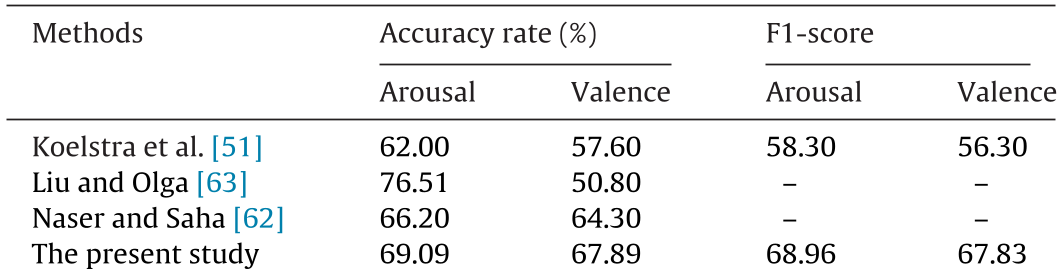 Figure: Quantitative comparison showing the present study outperforming previous SOTA methods.
Critical Analysis & Takeaways
This paper proves that Information Representation is just as important as the Classification Algorithm. By structuring EEG data via ontologies, the authors made it possible to conduct more granular, gender-aware statistical tests.
Limitations:
- The system still relies on pre-selected features (manual engineering).
- Real-time deployment remains a challenge due to the computational overhead of non-linear complexity calculations.
Future Outlook: The next frontier is Multimodal Fusion. Combining these structured EEG ontologies with facial expression recognition or heart rate variability (HRV) could push accuracy past the 80% threshold, enabling truly "empathetic" AI in sectors like autonomous driving and automated tutoring.
Conclusion: This work is a landmark in making Affective Computing hardware-independent and semantically rich, moving us closer to a future where machines don't just process our commands, but understand our feelings.