
Mining the Enterprise Brain: Recovering Social Networks from Email Archives via Spreading Activation
Use of E-mail Social Networks for Enterprise Benefit
The paper presents a framework for extracting hidden social networks from enterprise email archives using Information Extraction (IE) and a Spreading Activation algorithm. The core system, built on the Ontea platform, successfully maps relationships between primary entities (people) and attributes (phone numbers) across multilingual datasets.
Executive Summary
TL;DR: This paper explores the transition of email from a mere communication tool to a structured "Enterprise Social Network." By combining pattern-based Information Extraction (IE) with a Spreading Activation algorithm, the researchers demonstrate how to automatically link people to their contact details, products, and roles. While achieving 60% precision on challenging Spanish datasets, the work highlights that the structural context of an email is as valuable as the text itself.
Background: Positioned between classical Information Extraction and Graph Theory, this work is a bridge toward "Self-Organizing Enterprise Systems." It follows the lineage of IBM Galaxy, aiming to provide "Xobni-like" functionality (automatic contact profiling) within a corporate firewall.
The Problem: The Hidden Web of Emails
Traditional search tools treat emails as flat documents. However, an email archive is actually a high-dimensional graph where people, topics, and metadata are deeply intertwined. Existing tools fail to identify:
- Multi-aliasing: One person using multiple email addresses.
- Attribute Ownership: Which phone number in a long email chain belongs to which specific person?
- Cross-Message Context: Drawing connections between a person mentioned in Message A and a product ID mentioned in Message B.
Methodology: Spreading Activation in Multipartite Graphs
The authors' core innovation is the Cumulative Edge Scorer with Attenuation. Instead of simple keyword matching, they treat the email archive as a hierarchical tree.
1. Information Extraction (IE)
Using the Ontea tool, the system extracts key-value pairs (e.g., Person: Juan Perez, Phone: +34 91...). It doesn't just extract the text; it records the "physical proximity"—where the info sits in the sentence, paragraph, or block.
2. The Algorithm: Cumulative Edge Scorer
The algorithm mimics the way human memory works (Spreading Activation). It starts at a specific node (e.g., a phone number) and "pumps" activation energy through the graph.
- Attenuation: As energy travels further from the source, it weakens.
- Node Degree: If a node is connected to many things (like a generic company name), the energy it passes on is diluted.
- Convergence: The "Primary Entity" (Person) that accumulates the highest energy is deemed the owner of the attribute.
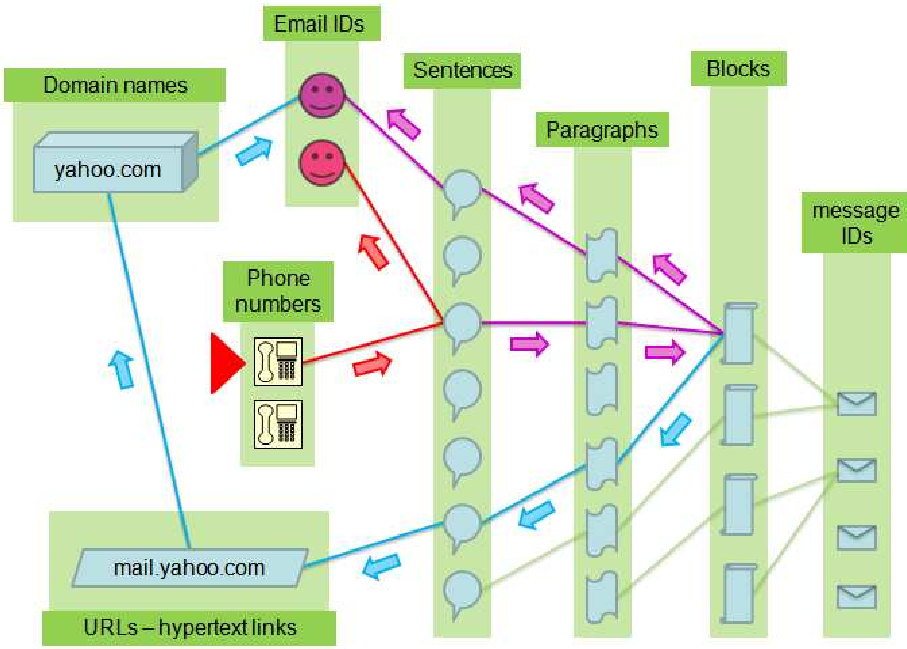 Figure 1: Activation begins at the phone number (red arrow) and flows toward email IDs. Shorter, more direct paths carry more weight.
Experiments and Results
The researchers tested the system on 50 Spanish emails—a difficult set due to accented characters and different cultural formatting compared to previous English tests.
Performance Benchmarks
The system showed a clear disparity between Information Extraction (finding the items) and Social Network Extraction (linking them).
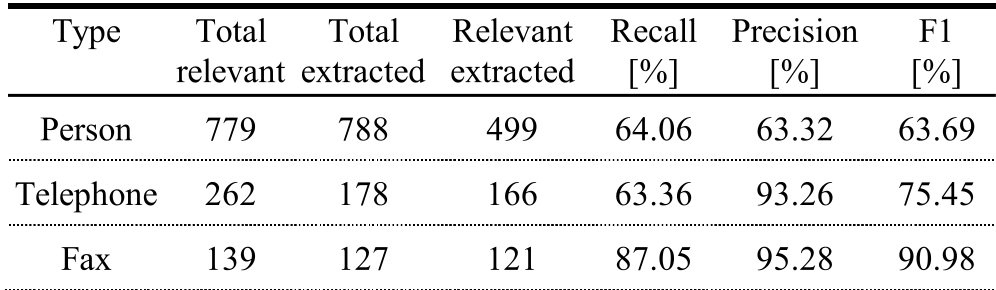
| Task | Recall | Precision | F1-Score |
|---|---|---|---|
| Name Extraction (Strict) | 64.06% | 63.32% | 63.69% |
| Phone Extraction (Strict) | 63.36% | 93.26% | 75.45% |
| Phone-to-Person Pairing | 45% | 60% | N/A |
Critical Analysis: The Recall Bottleneck
Interestingly, when the "Social Network Extractor" was fed correctly extracted names, its internal pairing precision was 85.7%. The drop to 60% in the final results was almost entirely due to the IE layer failing to catch names or numbers in the first place. This proves that Spreading Activation is highly resilient to noise, but sensitive to missing data.
Critical Insight & Conclusion
While this prototype used regex-based IE (modern systems would use Transformers/LLMs), the logic of Spreading Activation remains highly relevant. It provides a mathematically sound way to handle "weak links" in enterprise data.
The Takeaway: To build a "Corporate Brain," we must focus on high-recall extraction. Even partial or "fuzzy" matches are useful because the graph logic of Spreading Activation can filter out localized errors, but it cannot infer entities that were never extracted to begin with.
Future Outlook: The authors envision using this to auto-populate CRM databases from scratch, creating a system that "knows" its customers and suppliers from the moment it is installed by simply reading the historical email archive.