
EmbraceNet: Building Robust "Immunity" for Multimodal Deep Learning Models
EmbraceNet: A robust deep learning architecture for multimodal classification
This paper introduces EmbraceNet, a novel deep learning architecture for multimodal classification designed to handle cross-modal correlations and data loss. It utilizes docking layers for modality alignment and a probabilistic embracement layer for fusion, achieving superior robustness in scenarios with missing sensors compared to traditional early, late, and intermediate fusion methods.
TL;DR
In the real world, sensors fail. EmbraceNet is an elegant architectural solution for multimodal classification that doesn't just "tolerate" missing data—it treats it as a first-class citizen. By using a probabilistic selection mechanism (multinomial sampling) during fusion, it forces the model to learn cross-modal correlations, ensuring that if one sensor goes dark, the others can seamlessly fill the gap.
Background: The Fragility of Modern Fusion
Most multimodal deep learning relies on concatenation (Early/Intermediate Integration). While powerful, these methods have a "glass jaw": they assume all inputs are present. If a camera turns off or a wearable sensor disconnects, the input distribution shifts so violently that model performance often "plummets" to near-random levels.
The authors of EmbraceNet identify that current workarounds—like filling missing values with zeros or averages—are mere "band-aids" that don't address the fundamental need for a unified, robust latent space.
Methodology: Docking and Embracing
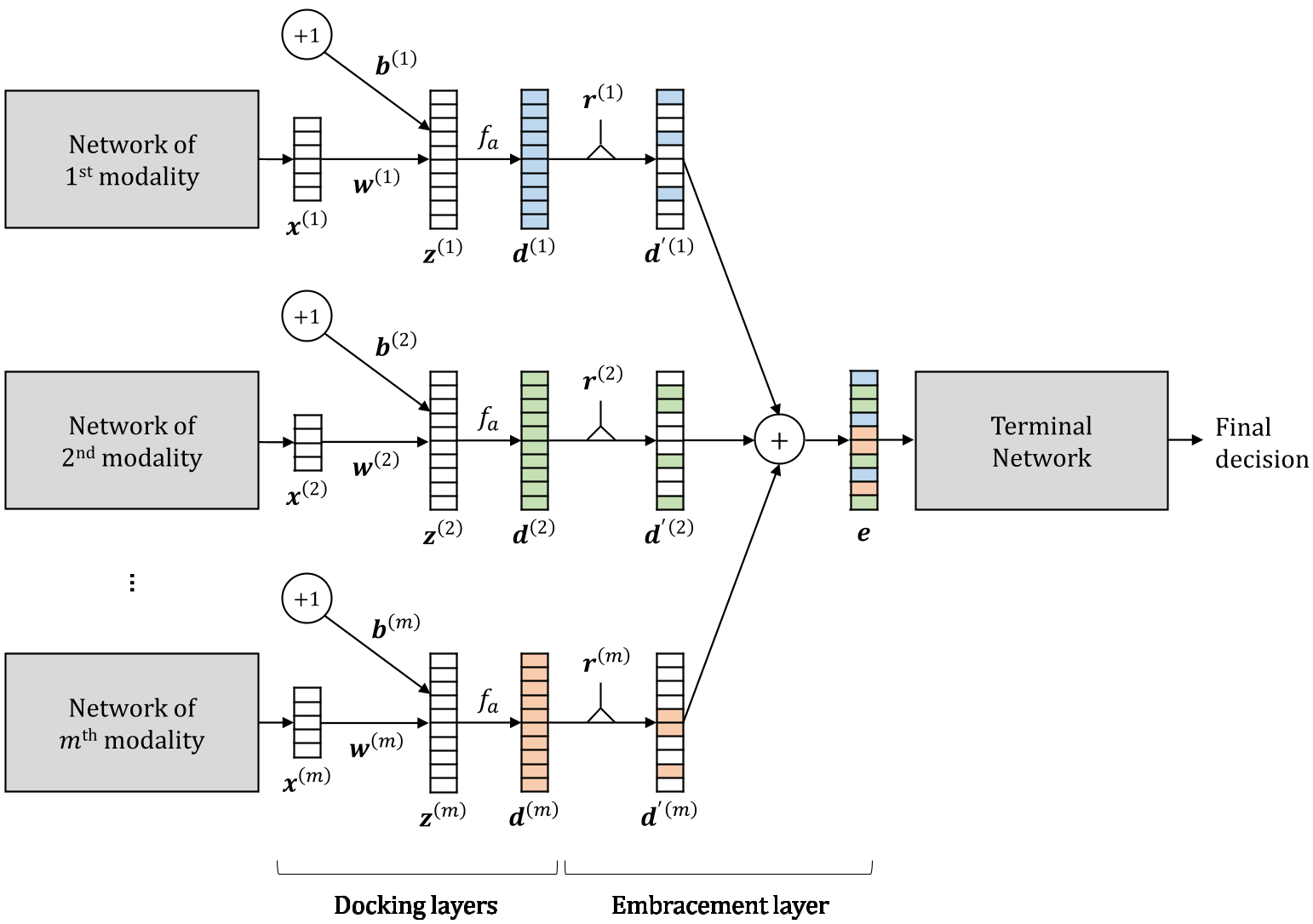
EmbraceNet comprises two main stages that can be wrapped around almost any existing neural network (CNNs, LSTMs, etc.).
1. Docking Layers (Normalization)
Since different modalities (audio, video, sensors) have different feature dimensions, the Docking Layers act as adapters. They map varying input vectors into a shared -dimensional space.
2. The Embracement Layer (The "Magic" Sauce)
Unlike concatenation or summation, the embracement layer performs a multinomial sampling for each element of the output vector: Where is a one-hot vector sampled from a multinomial distribution.
Calculated Randomness: For every single neuron in the fused representation, the model randomly picks information from only one modality. This forces every modality to learn how to represent the target class in a way that is compatible with all other modalities.
Why It Works: The Regularization Insight
The paper draws a fascinating parallel to the theory of sexual reproduction. Just as genes must learn to cooperate with a random set of other genes to survive, EmbraceNet's modalities are forced to cooperate.
This creates an "Internal Dropout" effect:
- Training: The model can't rely on a single dominant modality because that modality might be "sampled out" for specific features.
- Inference: If a modality is missing, the weights of the multinomial distribution are adjusted to zero for the missing source, and the probabilities are redistributed. Because the model was trained to produce consistent outputs from partial samplings, the missing data barely impacts the final decision.
Experimental Showdown
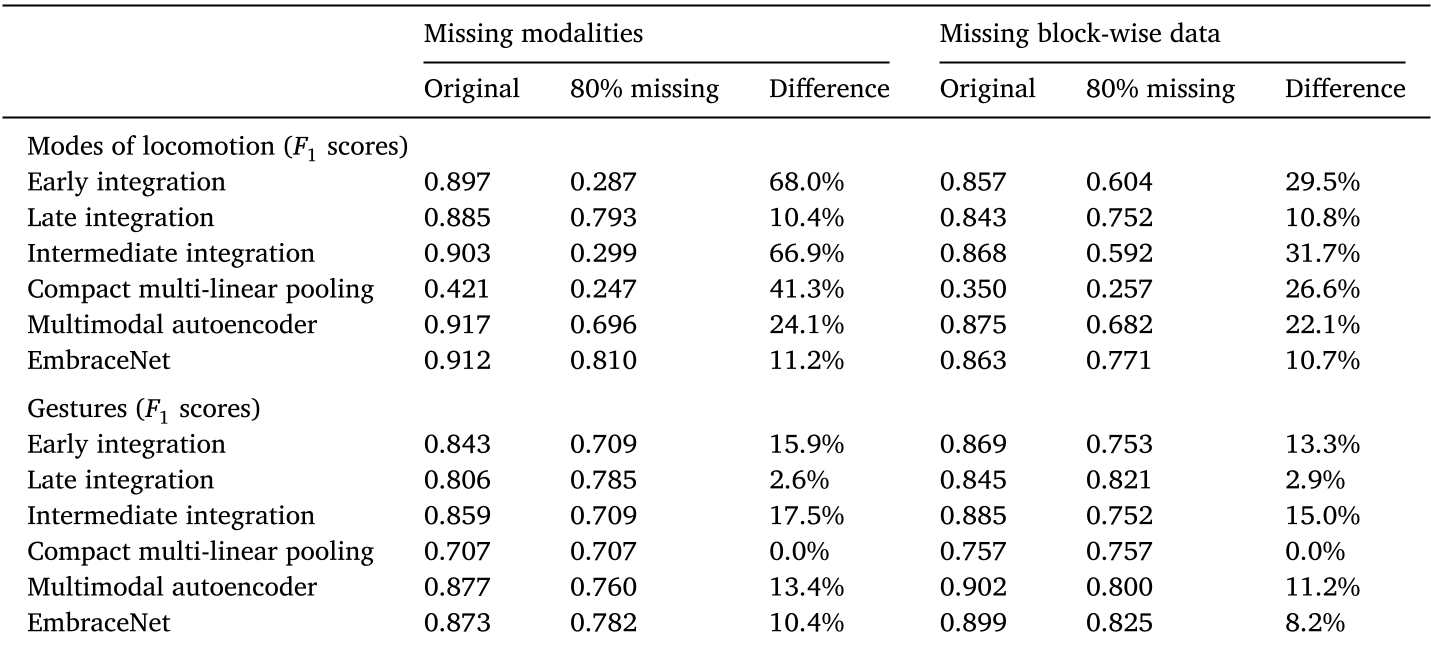
The authors tested EmbraceNet against heavyweights like Compact Multi-linear Pooling and Multimodal Autoencoders on specialized datasets (Gas Sensors and the OPPORTUNITY activity dataset).
Key Results:
- Resilience to Data Loss: In the OPPORTUNITY dataset, when 80% of modalities were removed, EmbraceNet's F1 score only dropped by 10-11%, whereas Early Integration saw a massive 68% crash.
- Consistency: Visualizing the activations (Figure 7) reveals that EmbraceNet generates nearly identical "activation maps" for a class, regardless of whether it's seeing all sensors or just a few.
Critical Perspective: Is It a Universal Fix?
While EmbraceNet is a breakthrough for robustness, it has its limits:
- Loss of High-Order Interaction: By sampling individual modalities for each output neuron, it might lose some extremely complex, fine-grained multiplicative interactions that Bi-linear pooling captures.
- Classification Focus: The paper focuses on classification. Its application in generative tasks (like Multimodal LLMs) remains an open area for exploration.
Conclusion: A New Standard for IoT and Wearables
EmbraceNet is a vital contribution for anyone deploying AI "in the wild." In environments where hardware is unreliable, the ability to maintain 90% accuracy with 50% data loss isn't just a feature—it's a requirement. It proves that probabilistic fusion is the key to moving beyond "lab-only" multimodal models.