
The Architecture of Interaction: How Knowledge Spillovers Sculpt Social Networks
The Emergence of Social Networks from Interactive Learning
The paper introduces an Agent-Based Model (ABM) to simulate the emergence of social networks through interactive learning and knowledge spillovers. By modeling agents with multi-dimensional knowledge vectors and using reinforcement learning for partner selection, it demonstrates how cognitive proximity drives knowledge diffusion while social proximity shapes the resulting weighted network topology.
TL;DR
This research investigates the co-evolution of knowledge and social structure using an Agent-Based Model (ABM). It reveals a striking dichotomy: the cognitive distance between individuals determines how much they learn, but the reinforcement of successful interactions is what actually builds the social map. While the model successfully generates "Small World" characteristics, it suggests that simple reciprocity is not enough to explain the complex, "rich-get-richer" (scale-free) nature of human innovation networks.
Problem & Motivation: The Geography of Innovation
Why do tech firms cluster in Silicon Valley? Classical economics points to "Knowledge Spillovers"—the idea that being close to others facilitates accidental learning. However, modern research suggests that physical distance is only one piece of the puzzle.
The authors argue that two other dimensions are critical:
- Cognitive Proximity: You need to know enough to understand your peer, but be different enough to have something new to learn.
- Social Proximity: The history of successful trust and interaction that makes you choose one partner over another.
The core challenge addressed here is: How does the act of learning actually create the network we inhabit?
Methodology: The Dual Dynamics of Learning
The paper proposes a model where 100 agents interact over 600 time steps. Each agent possesses a "knowledge vector" across multiple categories.
1. The Knowledge Mechanic (Cognitive Distance)
The ability to learn is modeled through an Absorptive Capacity (AC) function. If the "distance" in knowledge between two agents is too small, there is nothing to learn; if it's too large, they cannot understand each other.

Figure 1: The exponential function defines the 'sweet spot' for learning. The parameter dictates the breadth of an agent's understanding.
2. The Network Mechanic (Reinforcement Learning)
The social network is not static. It is a weighted network where the weight of a link increases every time an interaction is "fruitful." The authors use a reinforcement rule where agents update their preferences () for future partners based on past success ().
Experiments & Results: A Paradox of Influence
The researchers conducted sensitivity analyses on (cognitive openness) and (social reinforcement).
Impact on Knowledge
As expected, higher values lead to a rapid increase in the community's average knowledge. Experts thrive when they are intellectually accessible to others; otherwise, they remain "isolated islands" of high knowledge that the community cannot absorb.
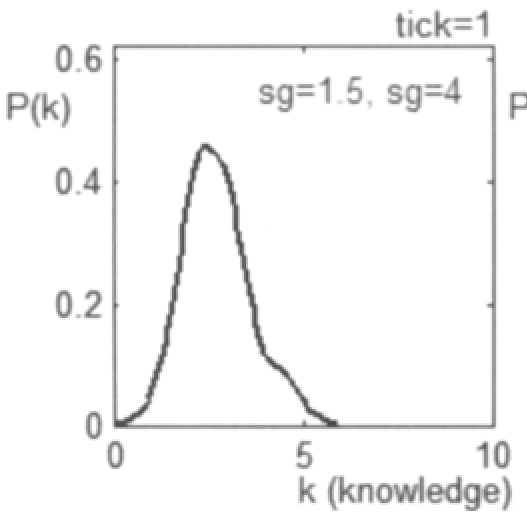 Figure 2: Knowledge distribution over time. Note how a high (right) allows specialized knowledge to diffuse, lifting the entire population.
Impact on Network Topology
Surprisingly, the factors that make knowledge diffusion efficient have almost no effect on the network's structural properties (clustering, degree distribution). Instead, the topology is almost entirely a function of the reinforcement parameter .
| Parameter | Clustering () | Path Length () |
|---|---|---|
| (Random) | 0.51 | 1.78 |
| (High Reinforcement) | 0.06 | 4.36 |
Experimental Note: High reinforcement actually decreases clustering because agents become "locked" into specific successful pairs rather than exploring local triangles.
The Missing Piece: The Scale-Free Mystery
In real-world networks (like the internet or scientific citations), we see a Power Law distribution (a few hubs with many connections). This ABM, however, produced a Poisson distribution, typical of random graphs.
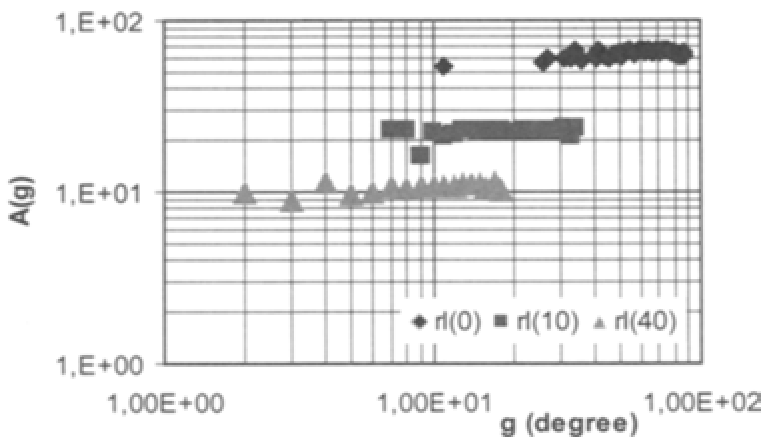 Figure 3: The weighted degree distribution follows a bell-curve shape, failing to capture the "Scale-Free" behavior seen in actual social organisms.
Critical Analysis & Conclusion
This work provides a rigorous framework for viewing social networks as a "record of past successes." It proves that cognitive fit drives the content of a network, while frequency of success drives the shape.
Limitations:
- Lack of Transitivity: The model lacks a mechanism for "friend-of-a-friend" introductions, which is why it fails to achieve high clustering or scale-free status.
- Uniformity: The assumption of a uniform starting knowledge might oversimplify the initial conditions of industrial districts.
Future Outlook: To simulate more realistic innovation ecosystems, future models should integrate social triadic closure (transitivity) with this reinforcement learning approach. This would better reflect how professional circles expand not just through direct success, but through social reputation and referrals.