
Beyond Topology: Emergent Communities in Socio-Cognitive Networks
Emergent Communities in Socio-cognitive Networks
This paper introduces a socio-cognitive network model that identifies communities based on the interplay between internal cognitive consistency and external social conformity. By simulating belief propagation through a Metropolis-Hastings algorithm, the authors demonstrate that community structures emerge naturally as a function of "trust" (belief similarity), achieving state-of-the-art-like results on the classic Zachary Karate Club benchmark.
TL;DR
Why do communities form? Historically, we answered this by looking at "who talks to whom." This paper argues we should look at "who thinks like whom." By modelling each node in a social network as a possessor of an internal cognitive network, the authors show that communities emerge naturally from the tension between logical consistency and social peer pressure.
The Missing Dimension: Cognitive Dissonance
Prior work in community detection—like the famous Girvan-Newman algorithm—relies heavily on Betweenness Centrality or structural modularity. However, social structures are not just lines on a map; they are driven by the psychological need to avoid Cognitive Dissonance.
The authors suggest that trust is endogenous: we trust those who share our worldview. If my friend believes "A is good" and "B is bad," but I believe they are both good, our social link is under strain. The model quantifies this using Balance Theory, where "triangles" of beliefs must be logically consistent (e.g., a friend of my enemy is my enemy).
Methodology: The Two-Layered Energy Model
The authors define a socio-cognitive system where the state is governed by a global energy function:
- Cognitive Energy (): Based on Heider’s Balance Theory. It minimizes contradictions within an individual's own mind.
- Social Energy (): Based on similarity. It minimizes the distance between the belief matrices of connected friends.
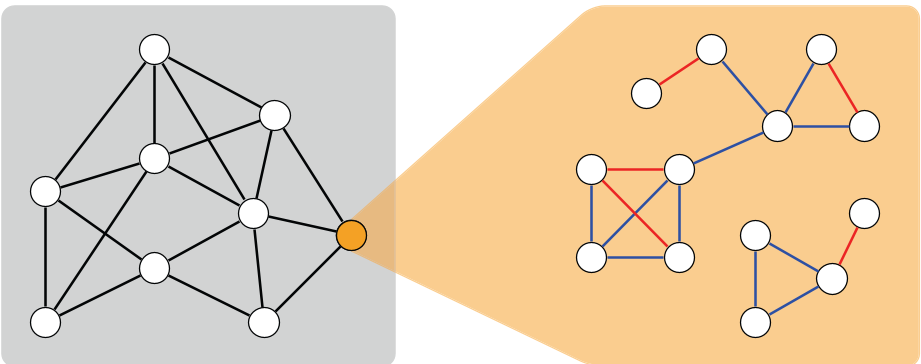 Figure 1: The dual-layer model. Social nodes (left) contain internal belief networks (right) where blue lines are positive associations and red are negative.
Through a Metropolis-Hastings simulation, nodes flip their beliefs to reach a lower energy state. A "Community" is defined not by a hard boundary, but by the statistical probability of two nodes reaching the same belief equilibrium over thousands of runs.
Experimental Results: The Karate Club Test
The model was tested on the Zachary Karate Club, a gold-standard benchmark representing a real-life split in a social group.
- Accuracy: The model accurately mapped the split, but more interestingly, it produced a Dendrogram (a tree of clusters) that shows how communities merge and split at different probability thresholds.
- Bias Correction: Unlike the Girvan-Newman method, this socio-cognitive approach doesn't penalize small peripheral groups (like the {5, 6, 7, 11, 17} cluster) just because they have few external connections.
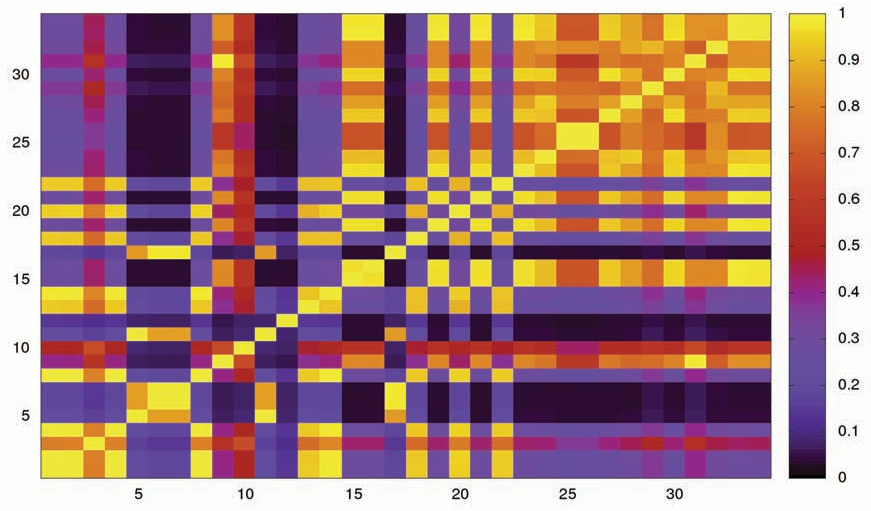 Figure 2: Heatmap showing the probability of shared membership. Darker areas indicate solid, high-trust communities.
The "Soc-Cog" Ratio: A Phase Transition
The most striking discovery is the role of the I/J ratio (Social strength vs. Cognitive strength):
- High Cognitive Force (Small I/J): Everyone is a "free thinker." The system collapses into maximal diversity (communities of size 1).
- High Social Force (Large I/J): Conformity wins. The entire network adopts a single "hive-mind" cognitive map.
- The Transition Zone: This is where real-world complexity lives. Multiple community sizes coexist, suggesting that our social "factions" are a direct result of being in a specific thermodynamic equilibrium between logic and loyalty.
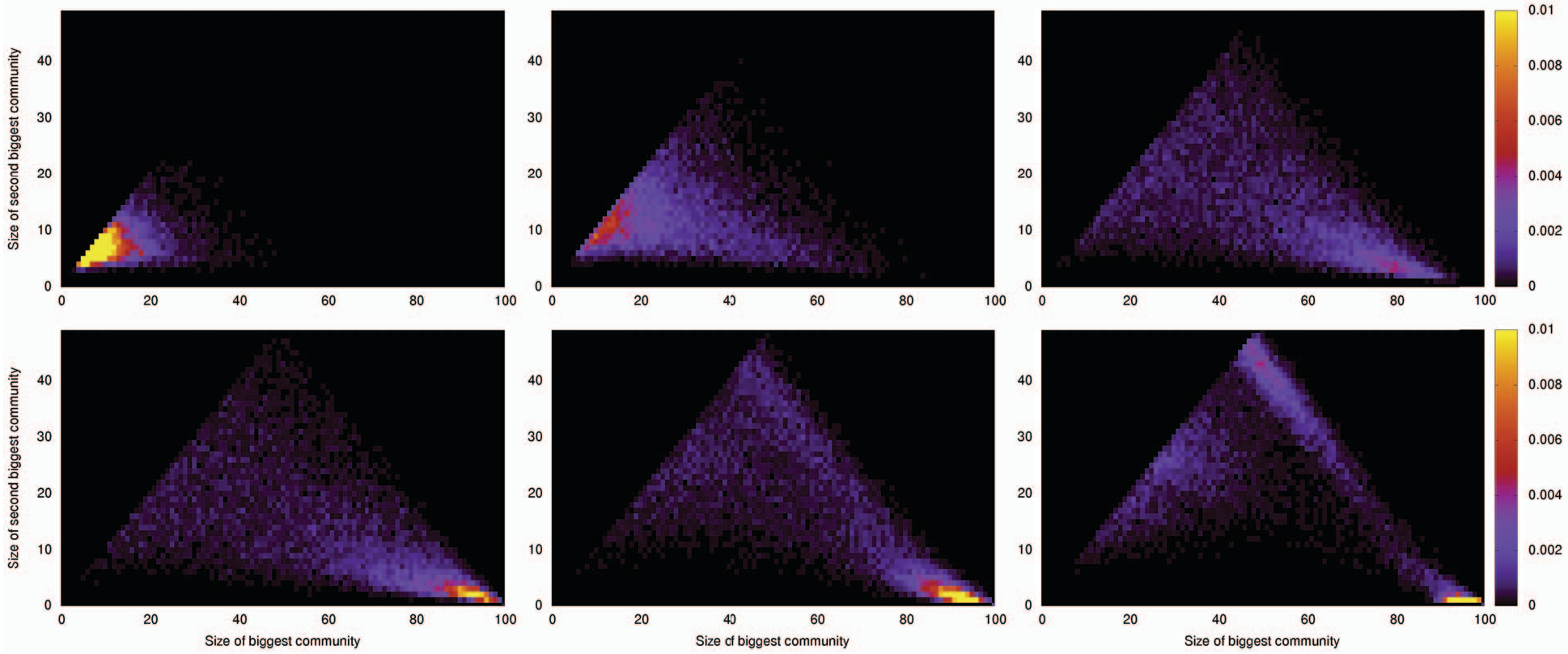 Figure 3: Evolution of the two biggest communities. As we move from top-left to bottom-right, the network shifts from fragmented factions to a dominant majority.
Critical Insight & Conclusion
This work represents a shift from Descriptive community detection (what does the graph look like?) to Generative community detection (what forces created this graph?).
Limitations: The model assumes a fixed set of concepts, whereas in real social networks, new concepts emerge constantly. Furthermore, inferring the exact parameters from real-world data remains an "inverse problem" that is notoriously difficult to solve.
Takeaway: Future social algorithms (including AI-driven content moderation or recommendation systems) should account for the Cognitive Consonance of their users. By understanding the "internal energy" of a group's beliefs, we can better predict group fission and social polarization.