
Hierarchical Matching: A New Paradigm for Socially-Aware D2D Caching
SPECIAL SECTION ON EMERGING TECHNOLOGIES FOR DEVICE TO DEVICE COMMUNICATIONS
This paper proposes a SDN-enabled socially-aware D2D caching framework that integrates bandwidth slicing and content sharing. It leverages a hierarchical matching game (HSM) and Non-Orthogonal Multiple Access (NOMA) to maximize spectrum efficiency and satisfy diverse QoS requirements in 5G networks.
TL;DR
The explosion of mobile data necessitates moving content from the core to the edge. This paper introduces an SDN-enabled socially-aware D2D caching scheme that uses a Hierarchical Matching Game. By splitting bandwidth into dynamic slices and utilizing NOMA, it achieves a 44.7% gain in spectrum efficiency over random allocation while maintaining low computational overhead.
The Core Challenge: Sociality meets Physical Constraints
Distributed caching allows smart devices to serve as Content Providers (CPs). However, two major hurdles persist:
- Selfishness: Users are reluctant to share resources without social incentives (trust, similarity).
- Externalities: In D2D links, one user's connection affects others through co-channel interference, creating a "dynamic preference" problem that traditional stable matching cannot solve.
Methodology: The Two-Stage Hierarchical Game
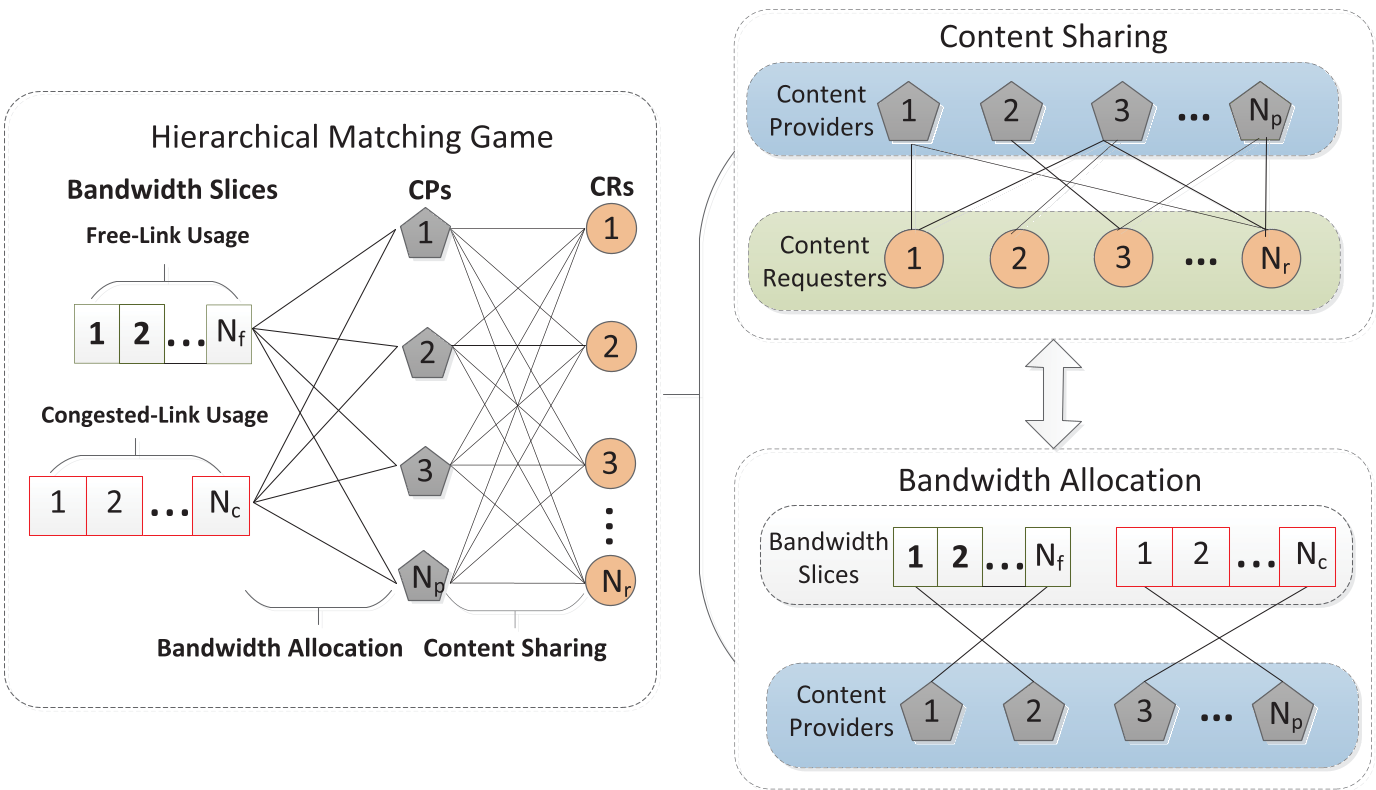
The authors model the network as a hierarchical bipartite graph, solving the resource allocation in two distinct layers:
Stage 1: SDN-Controlled Bandwidth Slicing
The SDN controller acts as the "brain," logically partitioning bandwidth into slices for "free" and "congested" links. It uses a Dynamic Bandwidth Allocation (DBA) algorithm—a many-to-one matching without externalities—to assign these slices based on the CP's social importance and real-time demand.
Stage 2: Social-Aware Content Sharing with NOMA
This is where the "Socially-Aware" aspect shines. CRs (Content Requesters) choose CPs based on Interest Similarity and Social Trust.
- NOMA Integration: To boost capacity, CPs share multiple contents on the same slice using Non-Orthogonal Multiple Access.
- Handling Externalities: Since NOMA introduces interference, CR preferences change constantly. The paper uses a Many-to-Many matching with externalities, solved via a distributed algorithm where users "falsify" preferences to reach a stable exchange state.
Mathematical Intuition: Power Allocation via GP
The power allocation problem is non-convex due to NOMA's Successive Interference Cancellation (SIC). The authors cleverly transform this into Geometric Programming (GP): By converting the constraints into a convex form, they utilize interior-point methods to find the global optimum for power distribution among NOMA users.
Experimental Validation
The results confirm that the Hierarchical Stable Matching (HSM) algorithm converges rapidly.
- Efficiency: It reaches a near-optimal solution compared to the computationally prohibitive Exhaustive Search.
- User Satisfaction: The probability of satisfying QoS requirements increases significantly when bandwidth slicing is enabled, compared to rigid, equal allocation.
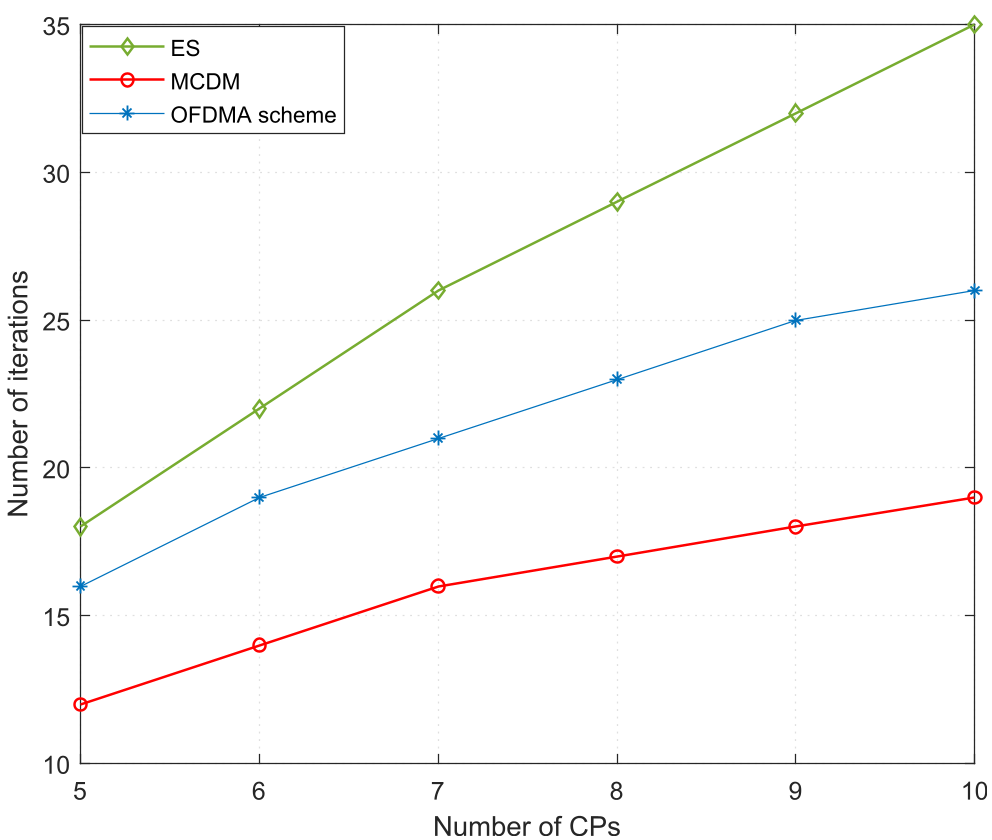 The figure above illustrates that the proposed HSM (NOMA + Slicing) consistently outperforms OFDMA and non-slicing benchmarks.
Critical Insight & Conclusion
The brilliance of this work lies in how it bridges the gap between Social Science (trust/interests) and Hard Engineering (NOMA/SDN). By treating the network not just as a collection of nodes, but as a social community with physical constraints, it provides a scalable way to handle the 5G data deluge.
Future Outlook: The next step would be incorporating Energy Harvesting or Mobility Prediction into the matching game to ensure the D2D links remain stable as users move through urban environments.