
Machine Psychometrics: The Digital Mirror of Personality in Social Networks
10345_Emerging Trends in Personality Identification Using Online Social Networks - A Literature Survey.
Summary
Problem
Method
Results
Takeaways
This paper presents a comprehensive literature survey on personality identification through Online Social Networks (OSNs), focusing on methods that utilize the Big Five personality model. It categorizes the transition from traditional questionnaire-based assessments to automated data mining techniques using textual, structural, and behavioral features extracted from platforms like Facebook and Twitter.
## Executive Summary
**TL;DR**: This foundational survey explores the evolution of personality identification from manual psychological testing to automated "digital footprint" analysis. By mining the rich data of Online Social Networks (OSNs), researchers can now predict Big Five personality traits—Openness, Conscientiousness, Extraversion, Agreeableness, and Neuroticism—with accuracy levels that occasionally surpass human observers.
**Background**: Positioned as a definitive literature survey (ACM 2018), this work maps the academic landscape of personality computing. It serves as both a taxonomy of features and a performance benchmark for the first decade of social media mining.
## The Core Paradox: True Self vs. Idealized Self
A central tension in this research is the **Idealized Virtual-Identity Hypothesis**: Do we use Facebook to show who we *want* to be, or who we *actually* are? This paper highlights critical evidence supporting the **Extended Real-Life Hypothesis**, which posits that social networks are a genuine extension of our physical environment. Behavioral residue (like our network density) and identity claims (like our status updates) provide authentic cues that are difficult to fake over time.
## Methodology: The Anatomy of a Digital Personality
The transition from *What* people say to *How* they say it forms the core methodology of automated identification.
### 1. Linguistic Fingerprinting
Researchers leverage several sophisticated toolsets to parse text:
* **LIWC (Linguistic Inquiry and Word Count)**: Measures psychological dimensions through word categories (e.g., use of first-person pronouns vs. social words).
* **MRC Psycholinguistic Database**: Analyzes words based on "concreteness," "familiarity," and "meaningfulness."
* **Speech Acts**: Focuses on the *intent*—is the user asserting, questioning, or commanding?
### 2. Structural and Behavioral Features
Beyond words, the "Digital Residue" provides high-signal data:
* **Network Topology**: Extraversion is uniquely mirrored in "Betweenness Centrality" and friend counts.
* **Temporal Patterns**: The frequency of updates and the "latency" of responses to friends.

*Note: The paper categorizes features into linguistic (textual) and non-linguistic (structural/behavioral) dimensions.*
## Key Insights: Trait-by-Trait Analysis
The survey provides a granular look at how specific traits manifest online:
* **Extraversion**: The "easiest" to detect. Positively correlated with friend counts, photo uploads, and the use of positive emotion words.
* **Neuroticism**: Linked to higher frequencies of first-person singular pronouns ("I", "Me") and words expressing anxiety or negative appraisal.
* **Conscientiousness**: Characterized by words related to work, achievement, and fewer swear words. Interestingly, high conscientiousness often correlates with a *lower* frequency of overall social media use.
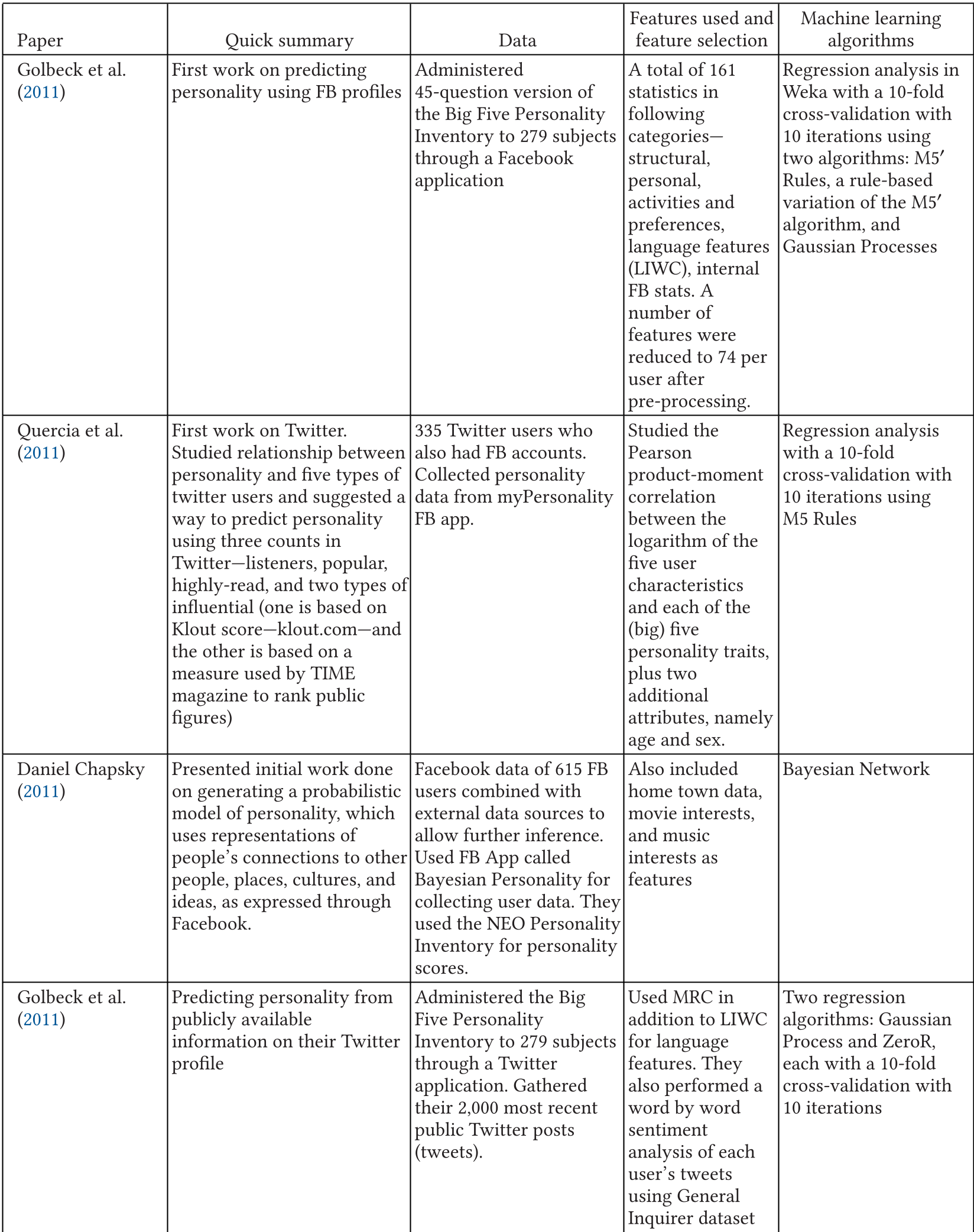
*Table: A comparison of benchmarking studies (Golbeck, Quercia, etc.) showing the shift from simple regression to complex ensemble learning.*
## Critical Analysis & Future Horizons
While the results are promising, the authors identify several "bottlenecks":
1. **Platform Specificity**: Behavior on LinkedIn (professional) differs drastically from Twitter (adversarial), requiring cross-domain normalization.
2. **Privacy and Ethics**: As personality prediction becomes "stealthy" (requiring no active participation from the user), the ethical implications for targeted advertising and hiring become profound.
3. **The "Noise" in Internet Slang**: Bottom-up models still struggle with the evolving nature of internet shorthand and emojis compared to top-down dictionary methods.
## Conclusion
The study of personality via social networks is moving from "can we do it?" to "how can we use it responsibly?" This survey underscores that our digital shadows are not just random data—they are a high-fidelity psychological profile that remains etched in the architecture of the web.