
Beyond Polarity: Mapping the Five Dimensions of Human Emotion in the Twittersphere
Emotion analysis of Twitter using opinion mining
This paper introduces a specialized framework for fine-grained emotion analysis on Twitter, moving beyond traditional positive/negative sentiment classification. It categorizes tweets into five core psychological emotions—Happiness, Anger, Fear, Sadness, and Disgust—using a hybrid linguistic approach that combines corpus-based adjective scoring with dictionary-based verb and adverb weighting.
TL;DR
Standard sentiment analysis often answers the what (is it positive or negative?) but ignores the how (is the user angry, sad, or disgusted?). This paper presents a specialized framework to extract five specific emotional dimensions—Happiness, Anger, Fear, Sadness, and Disgust—from Twitter data. By combining a psychologically validated adjective corpus with a custom linguistic algorithm for adverbs and verbs, the authors move beyond simple polarity to provide a multidimensional view of public opinion.
The "Polarity" Problem: Why Positive/Negative isn't Enough
Most existing sentiment analysis tools function as a simple "mood thermometer," measuring whether a text is warm (positive) or cold (negative). However, human psychology is far more complex. A "negative" tweet could be fueled by fear, which suggests uncertainty, or by anger, which suggests a call to action.
The authors argue that for Business Intelligence and Policy Making, knowing the specific flavor of the sentiment is more valuable than the sentiment itself. They identify two major hurdles:
- Linguistic Noise: Tweets are cluttered with URLs, hashtags, and emoticons that traditional NLP parsers often struggle to interpret correctly.
- Contextual Modifiers: Words like "not," "very," or "hardly" can completely flip or intensify an emotion, requiring a sophisticated scoring logic rather than simple word counting.
Methodology: The Architecture of Emotion
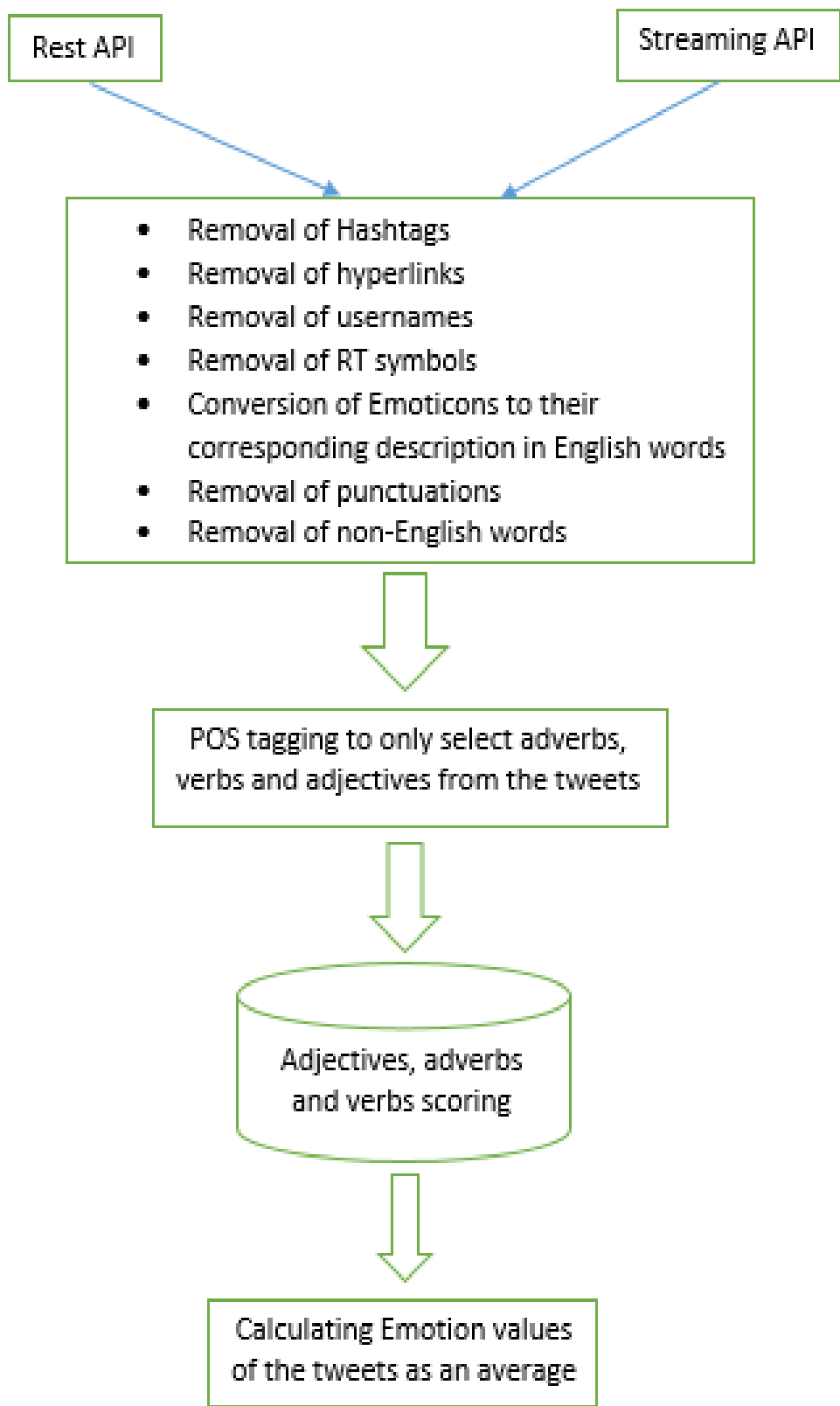
The proposed framework is divided into a Pre-processing Module and a Scoring Module.
1. Pre-processing & Feature Extraction
The system doesn't just strip away Twitter "noise." Instead, it intelligently processes emoticons by translating them into English descriptions (e.g., ☺ becomes "Smiling face") before they are removed by punctuation filters. Then, a Part-of-Speech (POS) tagger isolates three key opinion carriers: Adjectives, Verbs, and Adverbs.
2. The Adjective Corpus & Vector Scoring
The core innovation lies in the 5-tuple vector. Unlike traditional dictionaries that give a word a single score, this paper uses a corpus of 1,000 adjectives where each word has a strength score for all five emotions. For example, the word "beautiful" carries high scores for Happiness and low scores for Anger or Disgust.
3. The Modifier Algorithm (The Physics of Sentiment)
To handle the complexity of adverbs (intensifiers/negators), the authors developed a specific logic:
- Summing Modifiers: If multiple adverbs/verbs precede an adjective (e.g., "not very..."), their strengths are summed.
- Inversion Logic: If the modifier sum is negative (e.g., "not"), the resulting emotion is calculated by subtracting the adjective's value from the maximum scale (inverting the emotion).
- Intensification: If positive, it acts as a multiplier.
Experimental Results: Visualizing Public Mood
The framework was tested on high-volume hashtags like #AAPHelpLine. By aggregating thousands of tweets, the authors were able to generate Spider Charts and Bar Graphs that provide a "biometric" signature of a specific topic.
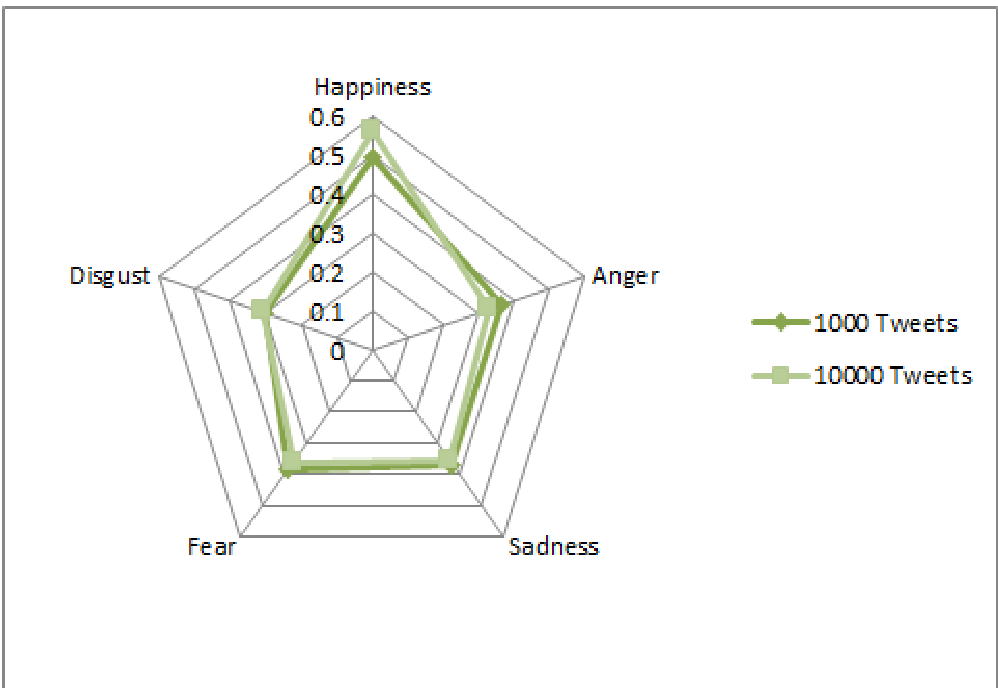
The study revealed that as the sample size increased (from 1,000 to 10,000 tweets), the emotion distribution stabilized, providing a reliable "Emotional Profile" of the public discourse. In the case of political hashtags, this allowed researchers to see whether the public was primarily "angry" at a policy or "fearful" of its consequences.
Critical Insight & Future Outlook
While this paper provides a robust linguistic foundation, it relies heavily on a static adjective corpus. The researchers acknowledge that the next frontier is Cyber-language Slang. As language evolves on platforms like Twitter (using "lit," "sus," or "mid"), the corpus must become dynamic.
The transition from "Big Data" to "Big Emotion" is a significant shift. This work proves that with the right linguistic heuristics, we can transform the chaotic noise of Twitter into a structured, multidimensional map of the human experience. As these models move toward real-time application, we can expect them to become vital instruments for brand management and governmental social listening.