
Efficiency in Affective Computing: Achieving 91% Emotion Recognition with Single-Channel EEG
Emotion Assessment Based on EEG Brain Signals
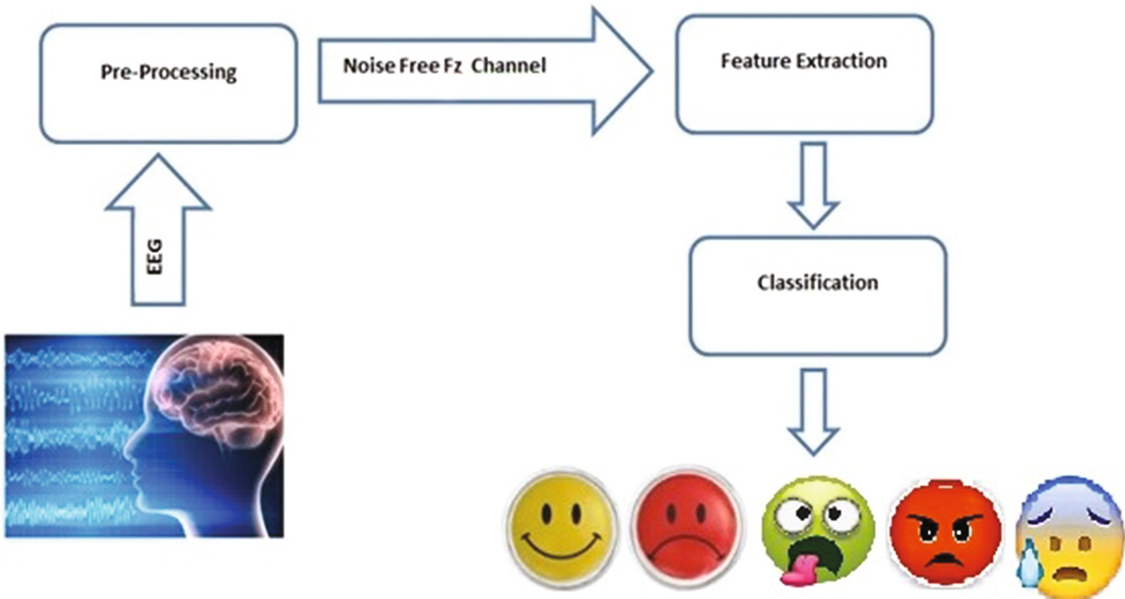
This paper introduces an emotion assessment method that classifies five distinct emotional states (happy, sad, angry, fear, and disgust) using single-channel EEG brain signals. By leveraging a Continuous Wavelet Transform (CWT) and a novel Standard Deviation Vector (SDV) feature, the proposed system achieves a SOTA accuracy of 91% using an SVM classifier on the public DEAP dataset.
TL;DR
Researchers from Huazhong University of Science and Technology have developed a streamlined emotion assessment framework. By focusing on the Fz electrode and employing a specialized Standard Deviation Vector (SDV) extracted via Continuous Wavelet Transform (CWT), they successfully classified five emotions with 91% accuracy. This outperforms multi-channel systems while significantly reducing computational complexity.
Background & Motivation: Moving Beyond "Fakeable" Expressions
A longstanding challenge in Human-Computer Interaction (HCI) is the objective assessment of human emotion. While facial recognition and voice analysis are common, they are subjective and can be easily manipulated by the subject. Brain signals (EEG), however, represent the "inner truth" of cognition.
The primary bottleneck in current EEG-based research is the trade-off between accuracy and hardware complexity. Most SOTA results require bulky 32 or 64-channel caps and complex feature selection algorithms that make real-time, wearable BCI (Brain-Computer Interface) application nearly impossible. This paper asks: Can we achieve high accuracy with just one sensor?
Methodology: The Power of Frequency-Time Insight
The authors' core insight is two-fold:
- Spatial Localization: Based on physiological studies, the frontal area of the brain—specifically the Fz electrode—is the most active during emotional processing.
- Feature Compression: Instead of raw time-domain signals, they use Continuous Wavelet Transform (CWT) to handle the non-stationary nature of brain waves.
The SDV Feature Extraction Pipeline
The process transforms 1D raw signals into a condensed 1D feature vector through a 2D intermediate stage:
- CWT with Bump Wavelet: The raw Fz signal is transformed using the Bump mother wavelet, which is optimized for the oscillatory nature of EEG.
- Maximum Magnitude Resizing: The resulting CWT matrix is resized into a 45x45 matrix by dividing the time domain into blocks and extracting the maximum voltage.
- Standard Deviation Vector (SDV): By calculating the standard deviation across time for each frequency row, they produce a 45x1 vector that encapsulates how brain voltage varies across 1Hz to 45Hz.
Experiments and Benchmarking
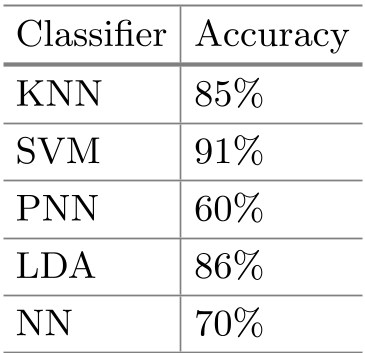
Using the DEAP public database, the researchers compared five machine learning classifiers. The Support Vector Machine (SVM) with a polynomial kernel emerged as the clear winner.
Performance vs. The Field
The most striking aspect of this research is the comparison with multi-channel systems:
| Research | No. Channels | Emotion Classes | Accuracy |
|---|---|---|---|
| Wang et al. | 32 + Peripheral | 4 | 71.32% |
| Mehmood et al. | All EEG Channels | 4 | 76.60% |
| Proposed Work | 1 (Fz) | 5 | 91.00% |
Critical Analysis: Why Does It Work?
The success of this method likely stems from the SDV feature's ability to act as a noise filter. By taking the standard deviation across frequency rows, the model captures the variance in specific oscillatory bands (like Alpha or Beta) associated with emotional shifts, while disregarding transient artifacts that often plague single-channel recordings.
Limitations & Future Work
- Participant Dependency: Emotions are highly subjective; the training set still relies on self-reported labels which can introduce noise.
- Deep Learning Potential: While the author used traditional ML, the 2D CWT matrix produced in step 2 of the methodology is a prime candidate for Convolutional Neural Networks (CNNs), which might further improve robustness.
Conclusion
By proving that a single EEG channel is sufficient for high-fidelity emotion classification, this work paves the way for the next generation of "Smart Headbands" and non-intrusive BCI therapy tools. It shifts the focus from "more data" to "smarter features."