
Decoding Drama: Emotion-Based Character Clustering in Cinemetric Analysis
Emotion-based character clustering for managing story-based contents: a cinemetric analysis
This paper introduces an emotion-based character clustering method to manage story-based content by analyzing Character-nets extracted from movie scripts. By calculating emotional similarity through WordNet-based emotion vectors, the system classifies characters into Protagonists, Tritagonists, and Antagonists, achieving a 60% accuracy across ten tested films.
TL;DR
Researchers have developed a novel framework that transforms movie scripts into "Character-nets"—social networks built on dialog. By extracting emotional signatures from these dialogs using WordNet, the system can automatically group characters into Protaganists, Tritagonists (allies), and Antagonists with roughly 60% accuracy, moving cinemetrics from simple shot-counting to deep narrative understanding.
The Shift from Vision to Story
For decades, Cinemetrics—the quantitative study of film—has been obsessed with what we see and hear: the average shot length, the color palette, or the intensity of motion. While these metrics are useful, they ignore the soul of the medium: the Story.
The authors argue that the heart of any story lies in character relationships. However, a major challenge in automated story analysis is distinguishing between different types of "minor" characters. Why is one character a loyal friend while another is a deadly rival? The answer, according to this study, lies in their Emotional Vector.
Methodology: From Dialog to Sentiment Space
1. Constructing the Character-net
The foundation of this approach is the Character-net, a directed graph where:
- Nodes represent characters.
- Edges represent dialog exchanges.
- Weight is determined by the volume of dialog.
By applying Degree Centrality (DC), the system identifies the "Important" characters who occupy the center of the narrative web.
2. The WordNet-based Emotion Model
To go beyond simple keyword matching, the authors use WordNet to find "Potential Emotional Words." If a word like "nightmare" isn't a direct emotion, the system traces its hypernyms and synonyms (e.g., nightmare -> fear) to assign it an emotional value. This results in a 30-dimensional emotion vector for every line of dialog.
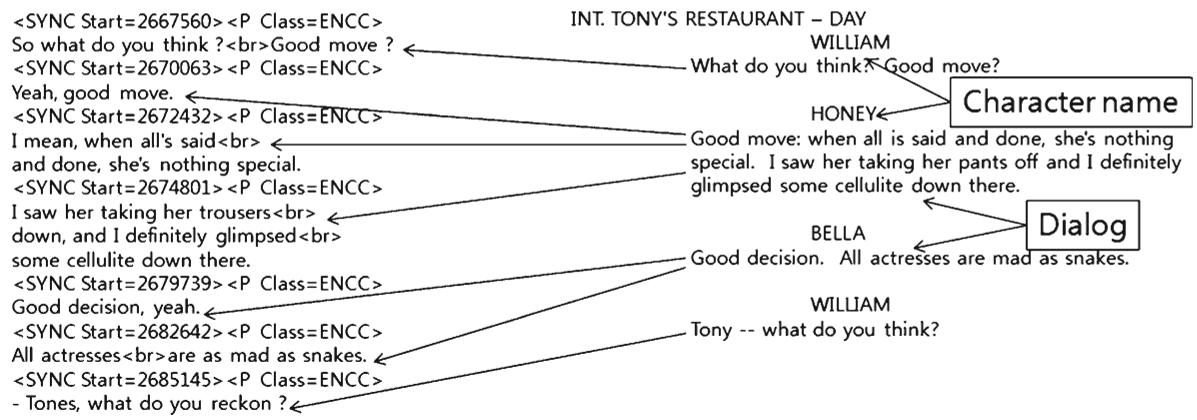 Figure 1: The alignment between scripts and subtitles is used to identify speakers, listeners, and timeframes.
3. Clustering the Identities
Once emotion vectors are aggregated for each character, the EM (Expectation-Maximization) Algorithm is used to group them. The character with the highest centrality is the Protagonist. Characters grouped with the protagonist are labeled Tritagonists, while those in the opposing cluster are labeled Antagonists.
Experimental Insights: Highs and Lows
The team tested the system on ten iconic films, including Avatar, Die Hard, and Se7en.
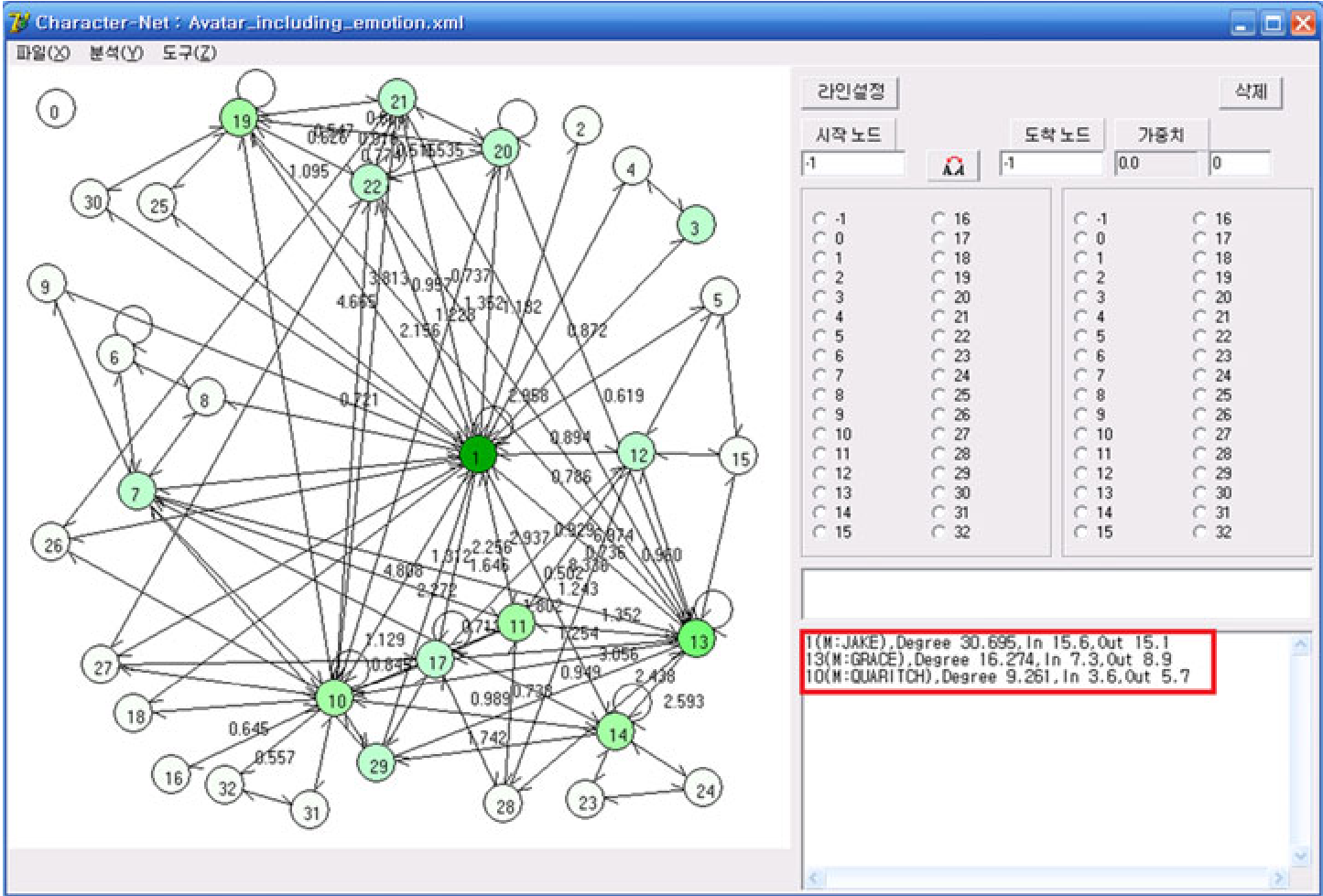 Figure 2: The CBA (Character-nets Builder and Analyzer) visualizing the social network of the movie "AVATAR".
Where it Succeeded:
In Avatar and A Few Good Men, the system achieved 100% role identification. These films feature distinct emotional boundaries between heroes and villains and provide both with significant "screen time" in the form of dialog.
Where it Failed:
The system struggled with movies like Star Wars: Episode II and Se7en. The reason? Dialog Scarcity. In Se7en, the antagonist (John Doe) has very few lines despite his massive narrative impact. Without a sufficient "lexical trail," the statistical clustering fails to differentiate them from secondary characters.
Critical Analysis & Takeaways
The paper proves that emotion is a viable feature for structural story analysis. However, its reliance on Lexical Affinity (WordNet) is a double-edged sword:
- Pros: It is computationally efficient and doesn't require massive training datasets.
- Cons: It struggles with subtext, irony, and "silent" antagonists.
The Future of Narrative AI: This work lays the groundwork for smarter content management systems. Imagine a Netflix-style recommendation engine that doesn't just suggest "Action movies," but specifically "Movies where the protagonist and antagonist share a high emotional similarity"—a hallmark of complex psychological thrillers.
To improve accuracy, future iterations should likely integrate Scene Analysis (physical proximity) and Contextual Embeddings (like BERT) to capture emotions that aren't explicitly stated in the lexicon.