
Color as Social Glue: Can a Diary Empathize with You?
Effects of Emotion-Based Color Feedback on User’ Perceptions in Diary Context
This study investigates the impact of emotion-based color feedback on users' psychological perceptions in digital diaries. By comparing emotion-matched, random, and no-color feedback interfaces, the researchers aim to enhance social presence and user enjoyment in private digital channels.
Executive Summary
In the age of social media, the private diary is often seen as a lonely relic. This paper, presented by researchers from Sungkyunkwan University, explores whether we can inject a sense of "social communication" into private channels using color feedback. By highlighting emotional words with specific hues, the authors attempted to mimic human empathy. The core finding? Feedback matters more than accuracy. While users felt more "connected" and "excited" when the diary changed colors, they didn't significantly distinguish between emotionally intelligent colors and random ones.
The Problem: The Loneliness of the Private Channel
While Social Network Services (SNS) allow us to broadcast emotions to the world, they often compromise privacy. Conversely, traditional private diaries offer a safe space for honesty but lack the "opponent" necessary for social interaction. This creates a psychological void. The researchers identified a critical gap: How can a static interface satisfy the human need for empathy without involving another person?
Methodology: Mimicking the Chameleon
The study is rooted in the chameleon effect—the natural human tendency to mimic the nonverbal behaviors of interaction partners to build rapport.
Experimental Design
The authors developed a digital diary that detects emotional keywords and provides immediate visual feedback. They tested three conditions:
- Emotion-based: Colors matched the sentiment (e.g., Red/Violet for joy/love).
- Random: Fixed achromatic (gray) highlights regardless of sentiment.
- Control: No visual feedback at all.
 Figure 1: The conceptual framework where color serves as the bridge between user emotion and system response.
The Scenario
To trigger high "valence" and "arousal" (intense positive emotions), participants wrote about their "first love."
Experiments & Results: Is Emotion-Matching Necessary?
The researchers measured four key metrics: Social Presence, Attachment, Enjoyment, and Satisfaction.
The "Feedback" Advantage
The data revealed a clear "Threshold Effect." Once color feedback was introduced—even if it was just gray highlights—scores for Social Presence and Enjoyment spiked.
- Social Presence: Jumped from 4.31 (Control) to ~7.0 (Feedback groups).
- Enjoyment: Rose from 3.40 (Control) to ~5.9 (Feedback groups).
The Surprise: Random vs. Emotional
Surprisingly, the "Emotion-based" group did not significantly outperform the "Random" group. Users felt just as "together" with a diary that highlighted words in gray as they did with one that used vibrant, emotionally-coded colors.
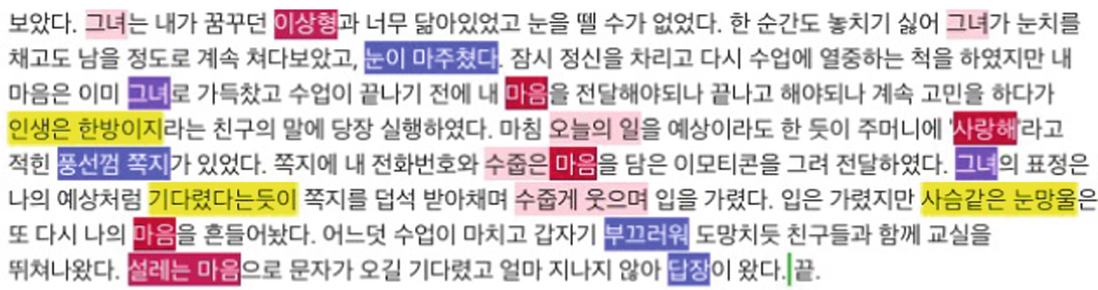 Figure 2: Comparison between Emotion-based (Color) and Random (Achromatic) feedback.
| Measured Variable | Emotion-based (Mean) | Random (Mean) | No Feedback (Mean) |
|---|---|---|---|
| Social Presence | 6.97 | 7.40 | 4.31 |
| Enjoyment | 5.70 | 6.10 | 3.40 |
Critical Analysis: Why Didn't Emotion Work Better?
The authors suggest a few "hard truths" for HCI designers:
- The Novelty of Response: In a private context, the mere existence of a response is so satisfying that the nuance of that response becomes secondary.
- Sample Limitations: With only 15 participants, the study might lack the statistical power to distinguish subtle emotional differences.
- Individual Color Association: Not everyone associates "Red" with "Joy." Personal color preferences might have muddied the "Emotion-based" data.
Conclusion & Future Outlook
This paper proves that interactivity is the antidote to isolation in software design. For developers of AI diaries or mental health apps, the takeaway is simple: Don't just store data; react to it. Even simple visual cues can transform a soul-searching monologue into a perceived dialogue.
Future research should look at "negative valence" scenarios (sadness/anger) to see if users become more sensitive to color accuracy when they are in a low emotional state.