
Beyond Panic: How Physical Exhaustion Drives Crowd Dynamics in Emergencies
Emotion-Based Crowd Simulation Model Based on Physical Strength Consumption for Emergency Scenarios
This paper introduces an emotion-based crowd simulation model for emergency scenarios that uniquely integrates physical strength consumption with panic dynamics. By combining a physics-based energy expenditure calculation with an enhanced emotional contagion model inspired by the James-Lange theory, the framework achieves SOTA realism in predicting pedestrian movement and stress distribution.
TL;DR
Simulating a panicked crowd is more than just coding "flee" behaviors. This paper introduces the first model that couples Physical Strength Consumption (PSC) with Emotional Contagion. By modeling how exhaustion fuels panic and how panic forces strenuous movement, the researchers have created a simulation that mirrors real-world evacuation patterns with unprecedented accuracy.
The Missing Link: Why Emotion is Not Enough
Most existing crowd models focus on the "Psychological"—how fear spreads like a virus. But they forget the "Physiological." In a real disaster, people aren't just scared; they are tired. Your heart is racing, your muscles are burning, and your ability to keep running decays over time.
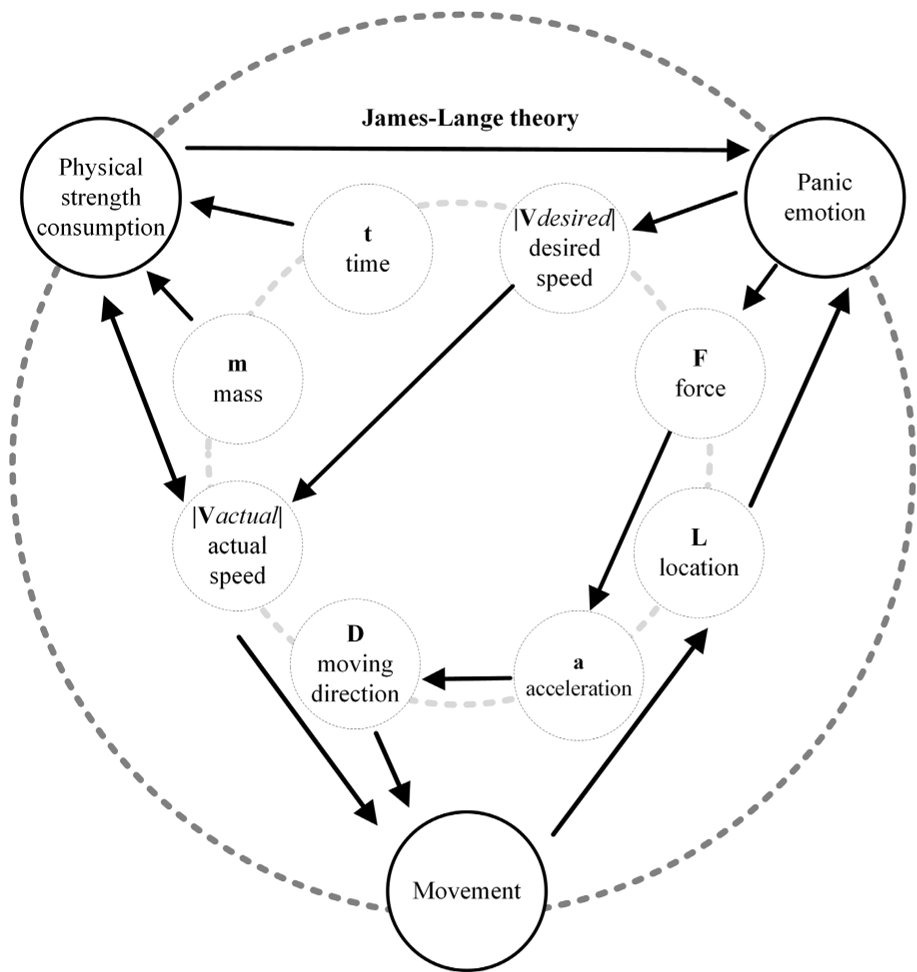
The authors argue that ignoring this leads to "unrealistic" simulations where agents run at top speed indefinitely. This paper bridges the gap using the James-Lange theory, which suggests that our physiological responses (shaking, rapid heart rate) aren't just results of fear—they are inputs that make us feel even more panicked.
Methodology: The "Devoted Actor" Framework
The core of this work lies in its tripartite architecture:
1. Physics-Based Strength Calculation
Instead of arbitrary decay, the model calculates the work () an individual performs by considering horizontal driving forces (overcoming friction) and vertical pulling forces (gravity). This ensures that agents moving through complex terrains (like subway stairs) exhaust themselves faster than those on flat ground.
2. The James-Lange Panic Model
The panic level () is a weighted sum of:
- Emotional Cognitive (): Fear from the hazard and contagion from neighbors (OCEAN personality-based).
- Emotional Experience (): A value derived directly from the agent's current heart rate, which is in turn calculated from their physical energy expenditure.
3. Integrated Movement Dynamics
The final movement is a "tug-of-war" between the desired speed (pushed by panic) and the actual speed (limited by the remaining physical strength).
Experiments: Validating against Chaos
The researchers didn't just test in a vacuum; they benchmarked against the UMN Dataset and real-world disaster footage (Kenya shopping mall, British Parliament shooting).
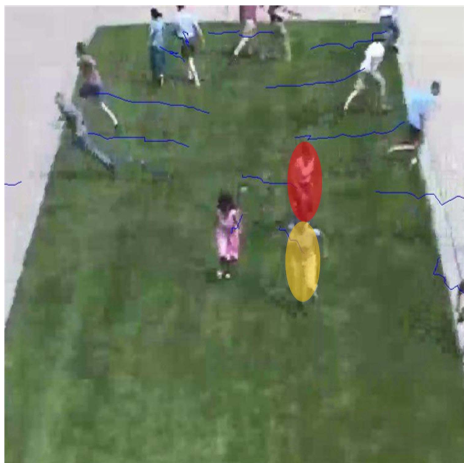
Key Comparison: Grass Scenario
In the "Grass" scenario, traditional models (Durupinar/Neto) showed agents moving with uniform robotic speed. In the new model, Individual No. 1 moves closer to Individual No. 2 because Individual No. 2 starts to fatigue, creating the "clumping" and "trailing" effects seen in real human crowds.
Quantitative Edge
Using Entropy Metrics (measuring the similarity to real trajectories), the proposed model consistently scored lower than its predecessors across all emergency scenarios, indicating a tighter fit to ground-truth data.
| Scenario | Our Model (Entropy) | Durupinar (Entropy) |
|---|---|---|
| Nairobi Square | 1.27 | 3.29 |
| Phone Explosion | 1.56 | 4.82 |
Deep Insight & Future Outlook
The brilliance of this work is the realization that physiology is a feedback loop. By linking metabolic expenditure to the OCEAN personality profile (e.g., how "Neuroticism" influences decay rates), the model generates a truly heterogeneous crowd where some individuals "freeze" early due to exhaustion-induced panic, while others sustain "fight or flight" longer.
Limitations: Currently, initial states (how much energy does a crowd have at the start of a clip?) must be estimated manually. The next frontier involves using wearable Bio-Tech to feed real physiological telemetry (heart rate, max) into the simulator to create "Digital Twins" of real-world urban hubs for emergency planning.
Summary
This paper shifts the paradigm of crowd simulation from purely behavioral to a bio-psycho-social approach. It proves that to understand how a crowd moves, you must first understand how a crowd burns energy.