
ISA-ICI: Solving Information Deficiency in Emotion Cause Extraction via Sentiment Knowledge and Structural Consistency
Emotion Cause Extraction by Combining Intra-clause Sentiment-enhanced Attention and Inter-clause Consistency Interaction
This paper introduces ISA-ICI (Intra-clause Sentiment-enhanced Attention and Inter-clause Consistency Interaction), a hierarchical neural network for Emotion Cause Extraction (ECE). By fusing external sentiment lexicons, syntactic dependency trees, and clause-side consistency priors, it achieves a new SOTA F1-score of 0.7797 on the benchmark ECE dataset.
TL;DR
Emotion Cause Extraction (ECE) is a critical sub-task of sentiment analysis that seeks to answer why a certain emotion was expressed. This paper presents ISA-ICI, a model that tackles the "information deficiency" of existing methods. By integrating external sentiment lexicons, syntactic dependency parsing, and an inter-clause consistency mechanism, the authors achieved a new state-of-the-art F1-score of 0.7797.
Problem & Motivation: Beyond the Textual Surface
In ECE, a document is usually split into multiple clauses. Given an "emotion clause" (e.g., "he was frustrated"), the task is to identify which other clauses contain the cause (e.g., "because his debt was heavy").
The authors identify a major flaw in prior deep learning models: they are "information-blind." They treat text as a generic sequence, ignoring three vital cues:
- Sentiment Keywords: Words like "debt" or "hard" are semantic anchors for causes.
- Syntactic Logic: The relationship between a verb and its object often points directly to a cause.
- Positional Habit: In natural writing, causes for a specific emotion tend to reside on the same side (either mostly before or mostly after) of the emotion clause.
Methodology: The Hierarchical Approach
The ISA-ICI framework is divided into two main stages: word-level encoding and clause-level interaction.
1. Sentiment-Enhanced Word Encoding
To ensure the model doesn't miss "hidden" emotional cues, the authors use a Graph Convolutional Network (GCN) over the syntactic dependency tree of each clause. Crucially, they introduce a Sentiment-Enhanced Attention mechanism. Instead of letting the model learn attention weights from scratch, they guide it using a sentiment lexicon. They calculate a "sentiment score" for words and use Cross-Entropy loss () to minimize the difference between the model's attention weights and the lexicon-based weights. This forces the model to "look" at the most meaningful words.
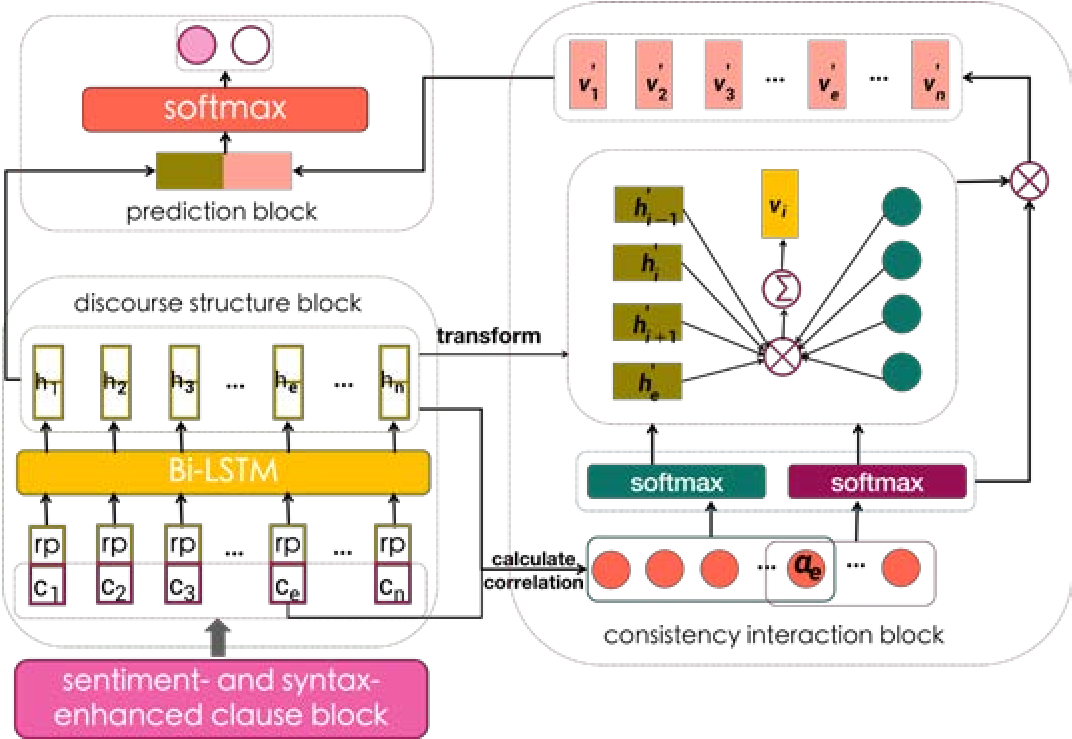 Fig 1: The ISA-ICI Framework showing the flow from Word-level GCN to Clause-level Consistency Interaction.
2. Inter-Clause Consistency Interaction (ICI)
At the clause level, after processing the sequence through a Bi-LSTM, the model applies a Consistency Interaction Block. Based on the observation that causes cluster, the model calculates the correlation between the emotion clause and candidate clauses on the left and right sides separately. This creates a side-specific "contextual summary" that helps the model decide if a clause is a cause based on the behavior of its neighbors on the same side.
Experiments & Results
The model was tested against 10 competitive baselines, including rule-based methods (RB), SVM-based methods (Multi-Kernel), and advanced neural networks like RTHN (RNN-Transformer).
Performance Comparison
ISA-ICI outperformed the existing SOTA across all metrics:
- F1-Score: 0.7797 (vs. RTHN's 0.7677)
- Precision: 0.7905 (Highest among all compared deep learning methods)
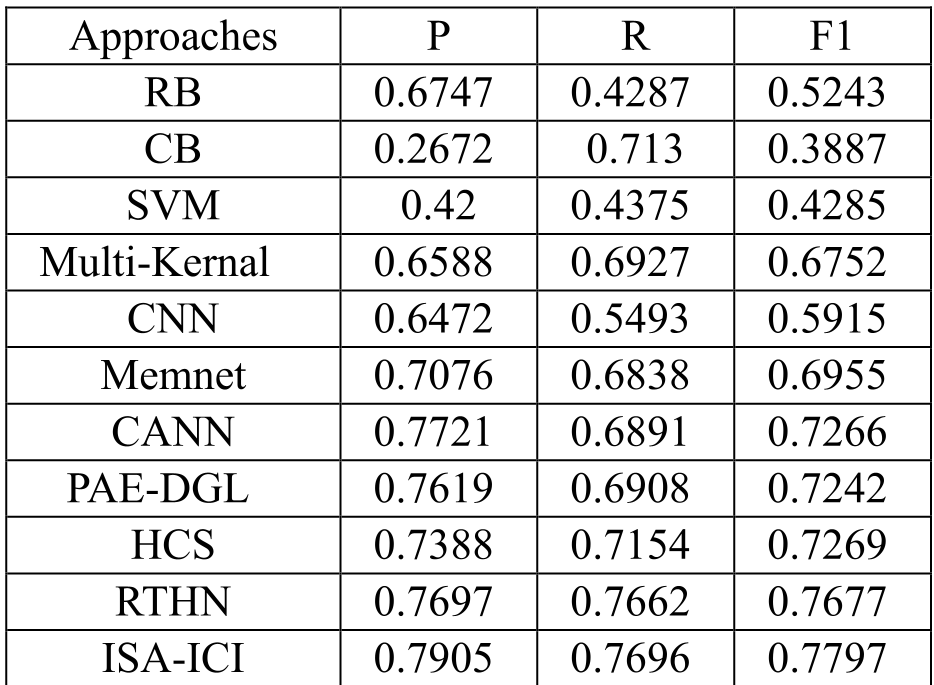 Table 1: Comparison of Precision (P), Recall (R), and F1-score.
Ablation Study: What Matters Most?
To see which component was the "heavy lifter," the authors performed an ablation study:
- Removing Sentiment Knowledge (No-Sentiment): F1 dropped to 0.7715.
- Removing Consistency Interaction (No-Consistency): F1 dropped to 0.7702.
This suggests that while all components help, the Inter-clause Consistency provides the strongest inductive bias for the ECE task.
Critical Analysis & Conclusion
Takeaway
The ISA-ICI model proves that "raw" deep learning isn't always enough for nuanced NLP tasks like ECE. By re-introducing Linguistic Rules (syntactic trees) and Expert Knowledge (sentiment lexicons) into a modern Neural Network architecture, we can overcome the data scarcity and information deficiency inherent in specialized datasets.
Limitations & Future Work
The model relies on a Chinese sentiment lexicon and the pyltp toolkit for parsing; its performance in other languages would depend on the quality of those external tools. Furthermore, while the model assumes consistency on "one side" of the emotion, complex narratives might have causes scattered across the document. Future iterations could explore State Space Models (SSM) or Long-range Transformers to better capture these scattered dependencies.
Author's Note: This research represents a significant shift back toward "Informed Machine Learning," where domain-specific priors are used to prune the hypothesis space of deep neural networks.