
Deciphering the Digital Mood: Sequence Modeling and Heuristics in Blog Emotion Classification
Emotion Classification Using Web Blog Corpora
This paper explores emotion classification in web blogs using SVM and CRF models, leveraging user-provided emoticons as silver-standard labels. It demonstrates that modeling sentence-level transitions via Conditional Random Fields (CRF) significantly improves classification accuracy over traditional Support Vector Machines (SVM).
TL;DR
This research tackles the challenge of identifying emotions in web blog corpora by shifting from isolated sentence analysis to context-aware sequence modeling. By using Conditional Random Fields (CRF) and leveraging self-labeled emoticons from over 5 million blog posts, the authors prove that the "rhythm" of emotions matters—and that a blogger's final sentence is surprisingly the best mirror of their overall mood.
Background: The Social Web as a Living Lab
Before the era of LLMs, the primary bottleneck in affective computing was high-quality annotated data. This paper identifies a brilliant "natural" dataset: web blogs where users manually tag their "mood" or insert emoticons. This collaborative annotation provides a continuous, expanding corpus for training supervised models without the cost of professional annotators.
Problem: The Limits of Isolation
Most early sentiment classifiers utilized Support Vector Machines (SVM) or Bayesian approaches that treated every sentence as an independent unit. However, human emotion in writing is rarely erratic; it flows from one state to another. Prior works failed to capture this "emotional transition," leading to inconsistencies when aggregating sentence-level predictions into a single document-level emotion score.
Methodology: Why Sequence Matters
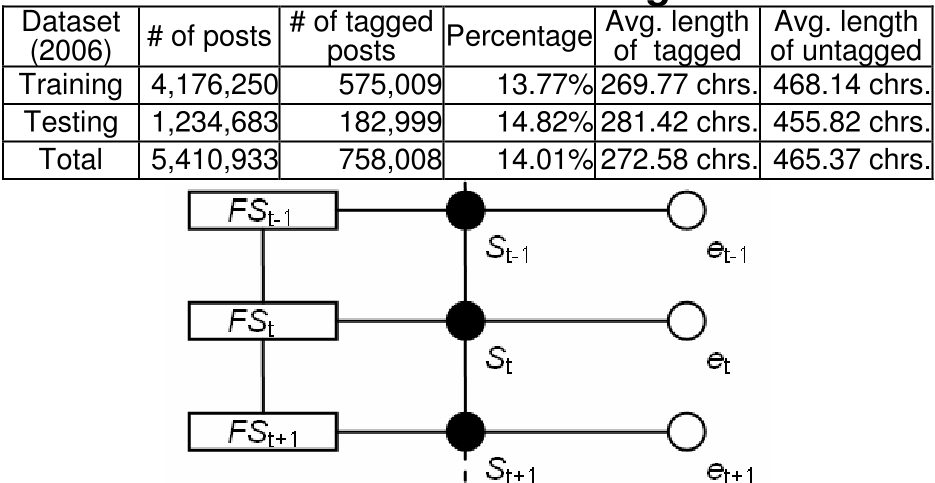
The core innovation lies in the adoption of CRF (Conditional Random Fields). Unlike SVMs, which decide the emotion of Sentence B regardless of Sentence A, CRF computes the probability of an emotion sequence.
Conceptual Framework
The system extracts features based on a pre-defined emotion lexicon. While the SVM acts as a point-wise classifier, the CRF integrates the "Context," effectively learning the transition probabilities between states (e.g., how likely is a 'Happy' sentence to follow a 'Happy' sentence?).
From Sentences to Documents
To bridge the gap between a single sentence and a full blog post, the authors tested three heuristics:
- Majority Vote: The most frequent emotion.
- Longest Streak: The emotion with the longest consecutive run.
- The Last Word: The emotion of the final sentence.
Experimental Results: The CRF Edge
The experiments were divided into coarse-grained (Positive/Negative) and fine-grained (Happy, Joy, Sad, Angry) tasks.
Key Findings:
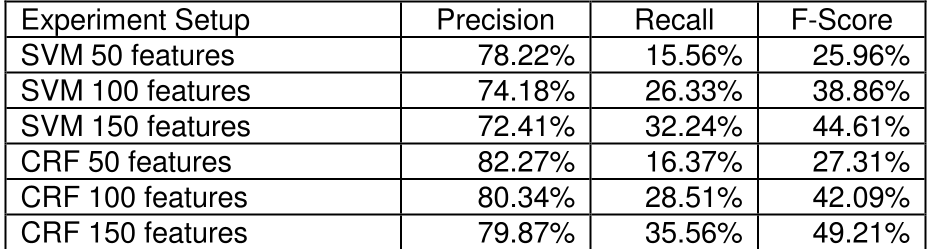
- CRF Superiority: In binary classification with 150 features, CRF achieved an F-Score of 49.21%, significantly higher than SVM's 44.61%.
- Overfitting in SVM: Interestingly, as the feature set grew to 500 keywords, SVM's precision dropped, while CRF remained more robust due to its structural constraints.
The "Concluding Emotion" Phenomenon
Perhaps the most insightful result came from document-level testing. The Last Sentence Heuristic (c3) outperformed both majority voting and longest-series tracking. This suggests a stylistic norm in blogging: authors tend to summarize their feelings or provide a final "emotional punch" with an emoticon at the very end of their post.
Deep Insight: Consistency and Transition
The study reveals that bloggers are remarkably consistent. In the dataset, Positive → Positive transitions accounted for over 55% of all instances. CRF thrived here because it could model this "stickiness" of emotion, whereas SVM tended to over-predict the majority class (Positive), failing to capture the nuances of negative emotional transitions.
Conclusion and Future Outlook
This paper provides a foundational insight for modern sentiment analysis: position and context are as important as vocabulary. While we now use Transformers to capture these dependencies, the discovery that the "final sentence" holds disproportionate weight in human emotional expression remains a valuable heuristic for UI/UX design and social media monitoring today.
Limitations: The model relies heavily on feature coverage (keywords). If a sentence contains no emotional keywords from the lexicon, the system struggles—a problem largely solved by modern word embeddings but a significant hurdle in the era of early statistical NLP.