
Beyond the Smile: Why Affordable EEG Outperforms Facial Recognition in Emotion Detection
Emotions detection using facial expressions recognition and EEG
The paper investigates multi-modal emotion detection by comparing Facial Expression Recognition (FER) and Electroencephalography (EEG). It proposes a machine learning pipeline using the affordable Emotiv Epoc EEG headset and SVM classification, outperforming commercial FER tools in detecting seven distinct emotional states.
TL;DR
Researchers from the Slovak University of Technology have demonstrated that "reading the brain" is significantly more effective than "reading the face" for emotional feedback in HCI. Using an affordable Emotiv Epoc headset and a customized SVM-based pipeline, they achieved 58% classification accuracy across seven emotions, nearly tripling the performance of industry-standard facial recognition software (19%).
Background: The Quest for Empathetic Systems
In Human-Computer Interaction (HCI), the "holy grail" is a system that understands how a user feels in real-time. Whether it's a website detecting user frustration or an e-learning platform sensing boredom, accurate emotion detection is key. However, we've long been stuck between two extremes:
- Non-intrusive but low-accuracy logs (mouse/keyboard movement).
- Intrusive, expensive medical equipment (32-channel EEG).
This paper explores the "middle ground"—low-cost EEG sensors versus professional Facial Expression Recognition (FER) software.
The Core Problem: The "Neutral Face" Bias
Most commercial FER tools like Noldus FaceReader rely on visible muscle movements (Action Units). The researchers found a critical flaw: when users are passively watching content (like music videos), they rarely exhibit exaggerated facial expressions. FaceReader tended to classify almost everything as "Neutral," leading to a dismal 19% accuracy. EEG, meanwhile, captures the internal neurophysiological response that the face doesn't show.
Methodology: Mapping Brain Waves to Emotions
The authors' approach bridges the gap between the Dimensional approach (Valence-Arousal) and the Categorical approach (Discrete emotions like Joy, Anger).
1. The Physics of the Brain
The method focuses on Alpha (8-13 Hz) and Beta (13-30 Hz) waves.
- Arousal: Calculated as the Beta/Alpha ratio in the frontal cortex (AF3, AF4, F3, F4). High Beta relative to Alpha signals high brain activity/excitement.
- Valence: Calculated by comparing the activity of the left vs. right hemisphere. Hemispheric asymmetry is a well-known biomarker for "approach" (positive) vs. "withdrawal" (negative) behavior.
2. The Machine Learning Pipeline
Instead of feeding raw signals into a model, they used a two-step process:
- Linear Regression: Used to predict what the user would have reported on a self-assessment scale.
- SVM Classifier: A Support Vector Machine with a linear kernel was used to categorize the final emotion. To solve the issue where some emotions (like Joy) had more samples than others (like Anger), they used oversampling to balance the training data.
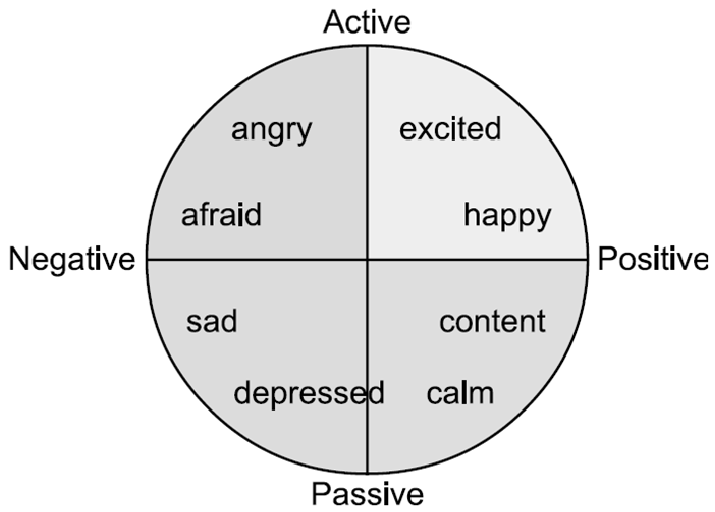 Fig 1: The 2D Valence-Arousal model utilized to map neurological signals to emotional quadrants.
Experiments & Results
The researchers conducted a study where participants watched 20 emotion-evoking music videos while wearing an Emotiv Epoc headset and being filmed.
Performance Highlights:
- EEG Accuracy: 58% (Linear Kernel with oversampling).
- FER Accuracy (FaceReader): 19%.
- Device Comparison: They also tested the Emotiv Insight (5 dry electrodes), which only achieved 30% accuracy, proving that electrode count and placement (Epoc's 14 channels) are vital even in "low-end" gear.
 Table 1: Comparison of different SVM kernels and the impact of oversampling.
The Oversampling Breakthrough
Without oversampling, the model struggled with "rare" emotions like Fear and Anger, often misclassifying them as Disgust or Joy. By balancing the dataset, the accuracy for "Sadness" jumped to an impressive 88%.
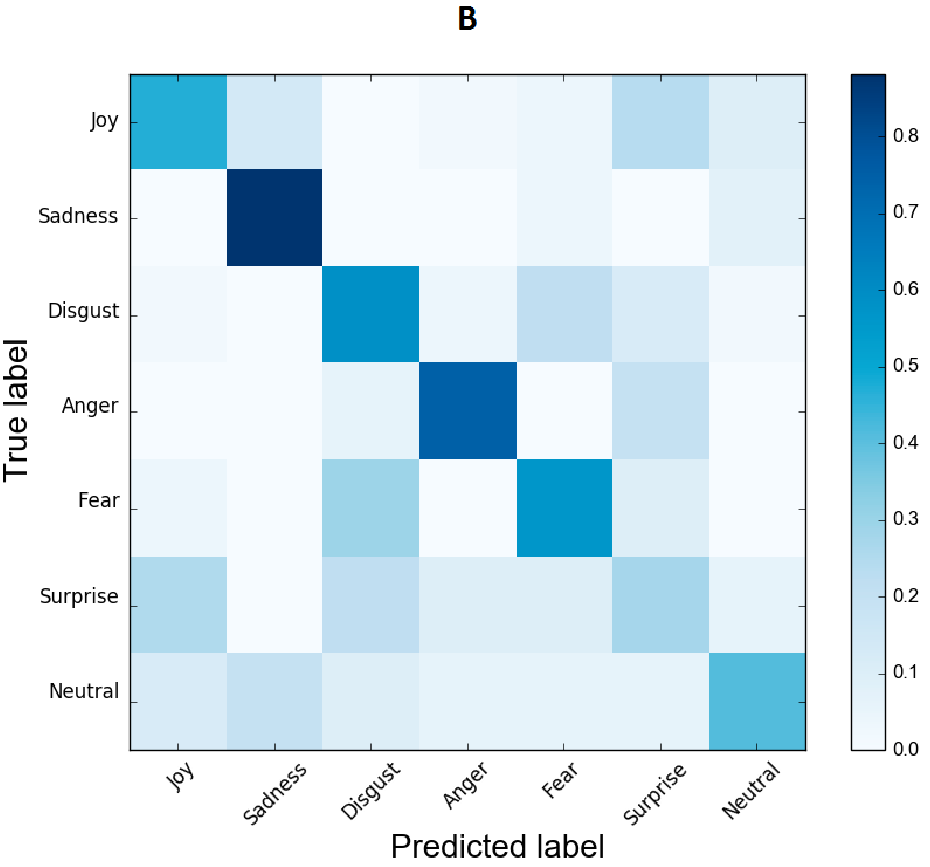 Fig 2: Confusion matrices showing how oversampling (B) significantly reduces misclassification of minority classes compared to (A).
Critical Insight & Future Outlook
The most striking takeaway is the failure of facial recognition in passive environments. If a user isn't actively grimacing, FER software is essentially blind. EEG provides a window into the "silent" emotional processing of the brain.
Limitations: 58% is better than 19%, but still far from the 90% accuracy seen in studies using 32-channel medical EEG. The authors also noted that the physical headset itself might inhibit natural facial expressions, creating a "measurement bias" for the camera-based tools.
The Future: The future of affective computing likely lies in sensor fusion—combining the non-intrusiveness of FER with the "internal truth" of low-cost EEG and Galvanic Skin Response (GSR) to create a robust, multi-modal emotional profile.
Takeaway for Researchers
If your research depends on detecting emotions during passive tasks (reading, watching, browsing), do not rely on facial analysis alone. Even an affordable EEG like the Emotiv Epoc will provide a much more accurate ground truth than the most expensive computer vision software.